


What is the real price of a cheap meal?
Value chains and hidden costs of the food system.
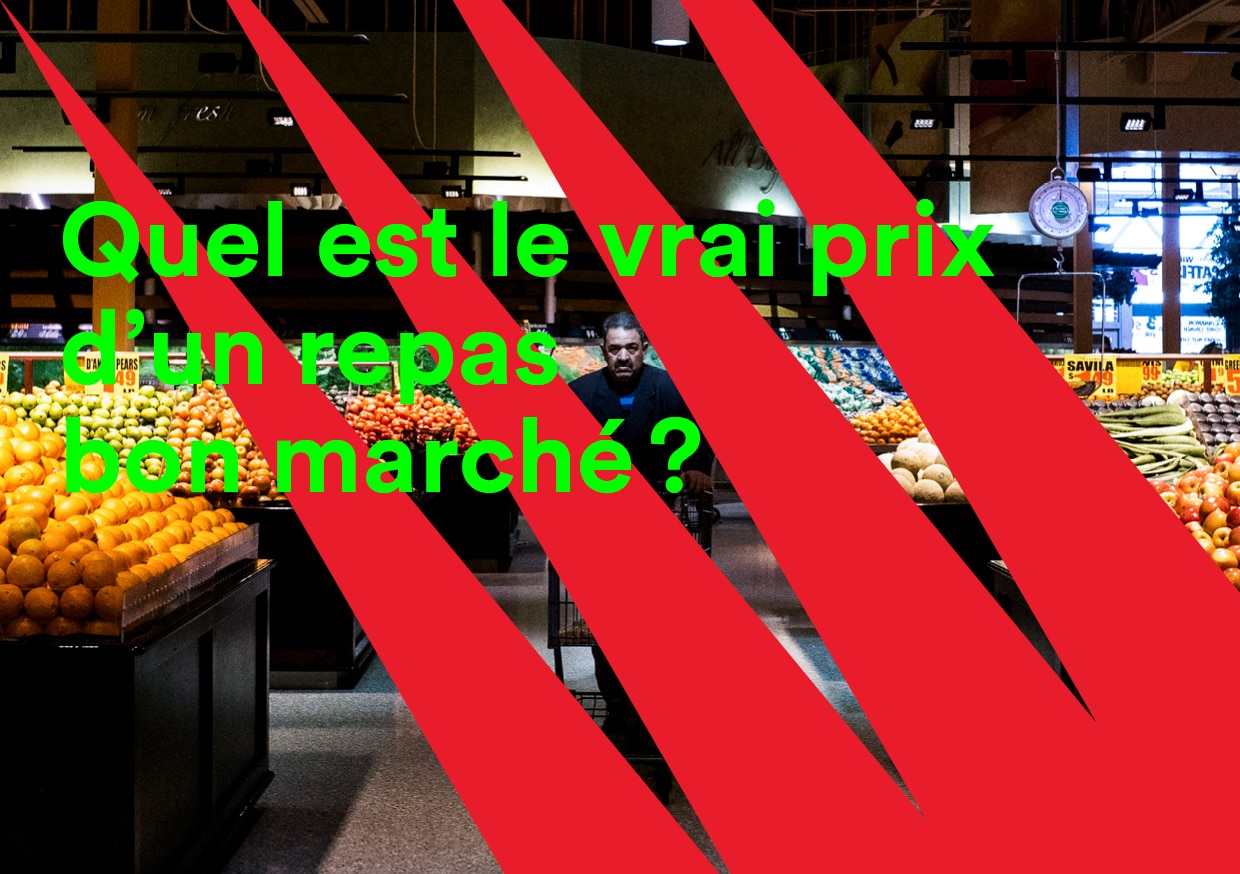
Peter van Agtmael, Mahmoud al-Haj Ali Shops at Cermak in Aurora, Illinois, Aurora (Illinois, USA), 2015 © Peter van Agtmael / Magnum Photos
On Thursday, October 8, the Alimentarium will inaugurate a new section of “SYSTEMA ALIMENTARIUM. Towards a Great Food Revolution?”, dedicated to value chains and the hidden costs of our food system.
The six stages are: inputs, agricultural production, trade, storage and processing, retail, and meal preparation. Throughout the exhibition, one key question recurs: What value is created, who benefits from it, and which costs remain excluded from the price paid at the checkout?
The price is visible. The real cost is much less so.
Every food item has at least two stories. The first is relatively easy to read through its price: raw materials, labor, machinery, energy, processing, transportation, and commerce. The second is less visible. Consequences of water pollution, soil degradation, biodiversity loss, greenhouse gas emissions, health impacts, or the precarious conditions of certain professions may be borne elsewhere, later, by other people, or by ecosystems. These are the hidden costs that the exhibition seeks to make perceptible.
Yet the exhibition does not reduce the food system to its negative impacts. It also highlights its achievements: today it feeds more than eight billion people, provides billions of jobs, and relies on unprecedented scientific knowledge, infrastructure, and logistical capabilities. The challenge lies here: how can we preserve this ability to feed the world while distributing added value more fairly and reducing the costs that markets do not always reflect?
A conveyor chain to make the system visible
At the center of the exhibition stands a vast conveyor chain that evokes production, processing, and the continuous flow of food. It serves as the backbone of the visitor journey. The six stages of the system follow one another without being isolated: decisions about seeds or energy affect production; trading choices shape commodity flows; storage and processing influence product lifespan and value; distribution organizes supply; and cooking completes the economic journey without erasing everything that came before.
Around this industrial structure, scales and eras collide. A seventy-year-old tractor faces a BOTINKIT smart kitchen robot from Shenzhen. Photographs place food flows back into landscapes, workplaces, and human realities. Unexpected objects shift perspectives, such as The Consumer at Rest, a chair by artist Frank Schreiner. The collections demonstrate that food has always been a matter of technology, labor, innovation, and societal choices.
With Icebreaker, Grégoire Vorpe condenses this sense of vertigo into a single image. The artwork consists of 1,600 cardboard fragments sourced from packaging materials. Together, they form a colossal container ship heading toward a tiny iceberg. The very material used to protect and transport goods becomes a means of questioning both the power of global flows and the fragility of natural balances.
Six stages. Thousands of decisions.
The journey begins even before crops are grown or animals are raised. Water, seeds, fertilizers, energy, machinery, and technologies make production possible. Next come fields and farms, followed by traders who buy, sell, finance, and direct raw materials. Storage and processing extend shelf life, ensure safety, divide, cook, ferment, or recombine food products. Retail selects and stages the offer. Finally, in domestic and professional kitchens, food becomes a meal.
Each stage adds something: yield, availability, safety, storage period, convenience, choice, and pleasure. Each stage can also shift costs to the next stage or beyond the economic system altogether. The exhibition focuses precisely on these interdependencies. No link in the chain operates alone; no single actor controls the entire system.
“What your nose cannot smell”
Can we recognize a food without knowing its history? An olfactory installation begins with this contradiction. Visitors smell pairs of familiar foods, such as banana and strawberry, sourdough bread and corn flakes, potatoes and pasta, carrot sticks and barbecue chips, before discovering everything their sense of smell fails to reveal.
The scent of a banana says nothing about the plantations, ripening facilities, ships, or labor that brought it to Switzerland. The toasted aroma of corn flakes does not tell the story of corn cleaning, cooking, flattening, roasting, fortification, or packaging. The nose recognizes the final product; the exhibition reconstructs the chain that produced it. After following that chain, do we still perceive the food in the same way?
When food is lost, resources have already been spent
Food losses begin long before food reaches household bins. According to United Nations agencies, around 13% of global food production is lost between harvest and retail, particularly during transportation, storage, and processing. In 2022, an additional 1.05 billion tonnes were wasted at the retail, food service, and household levels, representing 19% of the amount of food available to consumers.
Discarding food does not erase the resources already used to produce it. Land, water, energy, labor, packaging, and transportation have all been mobilized even if the food ultimately feeds no one. This reality directly connects economic efficiency and hidden costs: producing more is not enough if a significant share of what is produced is lost along the way or wasted after purchase.