<?xml version="1.0"?>
<response><item key="0"><title> Le cerveau </title><field_image></field_image><field_index>CP004-03</field_index><field_card_description>Le cerveau, quartier g&#xE9;n&#xE9;ral du syst&#xE8;me nerveux, est le poste de commandement de notre corps et le si&#xE8;ge de notre pens&#xE9;e.</field_card_description><field_subtitle><![CDATA[<p>Le cerveau permet la perception et l’interprétation du monde extérieur. Son implication dans des processus vitaux tels que le battement du cœur, la respiration et l’alimentation en fait un organe indispensable à la survie.</p>
]]></field_subtitle><field_content><![CDATA[  <div class="paragraph paragraph--type--wysiwyg paragraph--view-mode--detailed-preview">
          
<div class="field-collection"><h4>Anatomie d’un organe cloisonné </h4><p>Le <strong>cerveau</strong>, une masse rose grisâtre et plissée comme une noix, ne laisse rien transparaître de ses remarquables capacités. Le cerveau représente environ 2&nbsp;% du poids corporel et est composé de milliards de cellules nerveuses&nbsp;: les <strong>neurones</strong>. Il représente l’une des parties de <strong>l’encéphale </strong>(avec le diencéphale, le tronc cérébral et le cervelet) et est composé de deux <strong>hémisphères </strong>de tailles environ égales. La surface de ces hémisphères est presque entièrement parcourue de plis appelés gyri et séparés par des rainures superficielles. Le cerveau est principalement constitué d'une matière blanchâtre (substance blanche), alors que sa surface est recouverte d’une fine pellicule de matière grisâtre (cortex cérébral ou substance grise). Cette différence de couleur provient du fait que le <strong>cortex </strong>contient principalement les corps cellulaires des neurones, alors que la <strong>substance blanche</strong> est constituée d'un agglomérat d'axones qui relient les différentes aires corticales les unes aux autres. Au centre du cerveau, quatre ventricules, des grandes cavités en forme de C, communiquent entre elles. À l’intérieur de ces ventricules ainsi qu’autour du cerveau le <strong>liquide cérébro-spinal</strong> (ou céphalo-rachidien) agit comme un coussin et protège le cerveau des traumatismes.</p>
</div><div class="field-collection"><h4>Essentiel à toutes fonctions vitales</h4><p>Le <strong>cortex </strong>ou <strong>écorce cérébrale</strong> représente le sommet de la hiérarchie du <strong>système nerveux</strong>. Il permet aux êtres humains d’avoir conscience d’eux-mêmes et de leurs sensations, de communiquer, mémoriser, bouger et comprendre. C'est donc un organe essentiel qui assure la régulation de toutes les fonctions vitales. Il est divisé en quatre <strong>lobes&nbsp;</strong>: le lobe frontal, le lobe pariétal, le lobe occipital et le lobe temporal. Ces lobes sont ensuite divisés en de nombreuses régions (plus de 50 en tout) appelées aires de Brodmann. Certaines aires ont été associées à des fonctions précises telles que la parole, alors que les fonctions plus complexes telles que la mémoire semblent impliquer plusieurs aires. Le cerveau reçoit des informations provenant de l’ensemble du corps humain via des nerfs (voie sensitive), les intègre et les analyse, puis répond en émettant de nouveaux signaux qui redescendent par les <strong>nerfs </strong>(voie motrice) vers les parties du corps concernées.</p>
</div><div class="field-collection"><h4>Le cerveau, sens et alimentation</h4><p>Le <strong>système digestif</strong> fournit les nutriments nécessaires au fonctionnement des cellules composant le cerveau. Le cerveau peut à son tour agir sur les sensations de faim et de satiété en réponse à des changements de concentration de certains nutriments et hormones dans le sang, tels que le sucre et l’insuline. L’estomac, par exemple, peut également envoyer au cerveau un signal indiquant qu’il se remplit, poussant le cerveau à déclencher la sensation de satiété. Mais alimentation ne rime pas qu’avec faim et satiété, elle est aussi à l’origine des sensations de goûts et de plaisir. Les messages gustatifs provenant de la langue sont transmis au cerveau et analysés dans l’aire gustative du cortex. Le cerveau peut alors reconnaître les différentes saveurs des aliments, car chaque aliment stimule un sous-ensemble de neurones dans cette aire gustative. D’autres événements sont également déclenchés dans le cerveau, comme les réflexes liés à la digestion, à la production de salive ou de sucs gastriques.</p>

<p></p>

<div data-embed-button="paragraph_library_item" data-entity-embed-display="view_mode:paragraphs_library_item.render" data-entity-type="paragraphs_library_item" data-entity-uuid="c602bfbf-5b24-4736-b84a-fdd55f5d5cd9" data-langcode="fr" data-entity-embed-display-settings="[]" class="embedded-entity" xmlns:xlink="http://www.w3.org/1999/xlink">

            <div class="image-gallery-item">
        <a href="/sites/default/files/media/image/2016-04/cerveau_0.png" class="opener lightboxed" data-caption="
&nbsp;">
      <span class="svg-icon">
        <svg>
          <use xlink:href="svg/sprite.min.svg#icon-resize" />
        </svg>
      </span>
          
  <img loading="lazy" src="/sites/default/files/media/image/2016-04/cerveau_0.png" width="488" height="328" alt="cerveau.png" typeof="foaf:Image">


        </a>
      </div>
              <h6 class="gallery-caption">
          
&nbsp;
        </h6>
            </div>


<p></p>
</div>
      </div>
,   <div class="paragraph paragraph--type--wysiwyg paragraph--view-mode--detailed-preview">
          
<p><b>Livre</b></p>&#13;
&#13;
<p>MARIEB, Elaine N., 2005. <i>Anatomie et physiologie humaines. </i>Adaptation de la 6e edition américaine (René Lachaîne). Pearson Education France  </p>&#13;
      </div>
]]></field_content></item><item key="1"><title> Le sacrifice</title><field_image><![CDATA[  <img loading="lazy" src="/sites/default/files/styles/course_tile/public/media/image/2016-05/WEB-Christianisme-----sacrifice_0_0.png?itok=v2Pjusap" width="277" height="277" alt="WEB-Christianisme-----sacrifice.png" typeof="foaf:Image" />


]]></field_image><field_index>ST008-08</field_index><field_card_description>Les anciens sacrifices remplac&#xE9;s par le sacrifice de J&#xE9;sus</field_card_description><field_subtitle><![CDATA[<p>Les sacrifices d’animaux étaient courants dans l’Antiquité et justifiaient la mise à mort de l’animal. Le sacrifice de Jésus va bouleverser cet ordre et se substituer aux anciennes coutumes. Il s’actualise lors de l’eucharistie, mais son interprétation reste complexe. Quelle est l’interprétation du vin et du pain dans le Christianisme ? Catholiques et protestants n’ont pas la même réponse.</p>
]]></field_subtitle><field_content><![CDATA[  <div class="paragraph paragraph--type--wysiwyg paragraph--view-mode--detailed-preview">
          
<div class="field-collection"><!-- scald=48:sdl_editor_representation --><!-- END scald=48 -->
<div data-embed-button="paragraph_library_item" data-entity-embed-display="view_mode:paragraphs_library_item.render" data-entity-type="paragraphs_library_item" data-entity-uuid="34ee5725-5aa3-4c81-ad2c-840a7cc5c7f9" data-langcode="fr" data-entity-embed-display-settings="[]" class="embedded-entity" xmlns:xlink="http://www.w3.org/1999/xlink">

            <div class="image-gallery-item">
        <a href="/sites/default/files/media/image/2016-05/WEB-Christianisme-----sacrifice_0_0.png" class="opener lightboxed" data-caption="
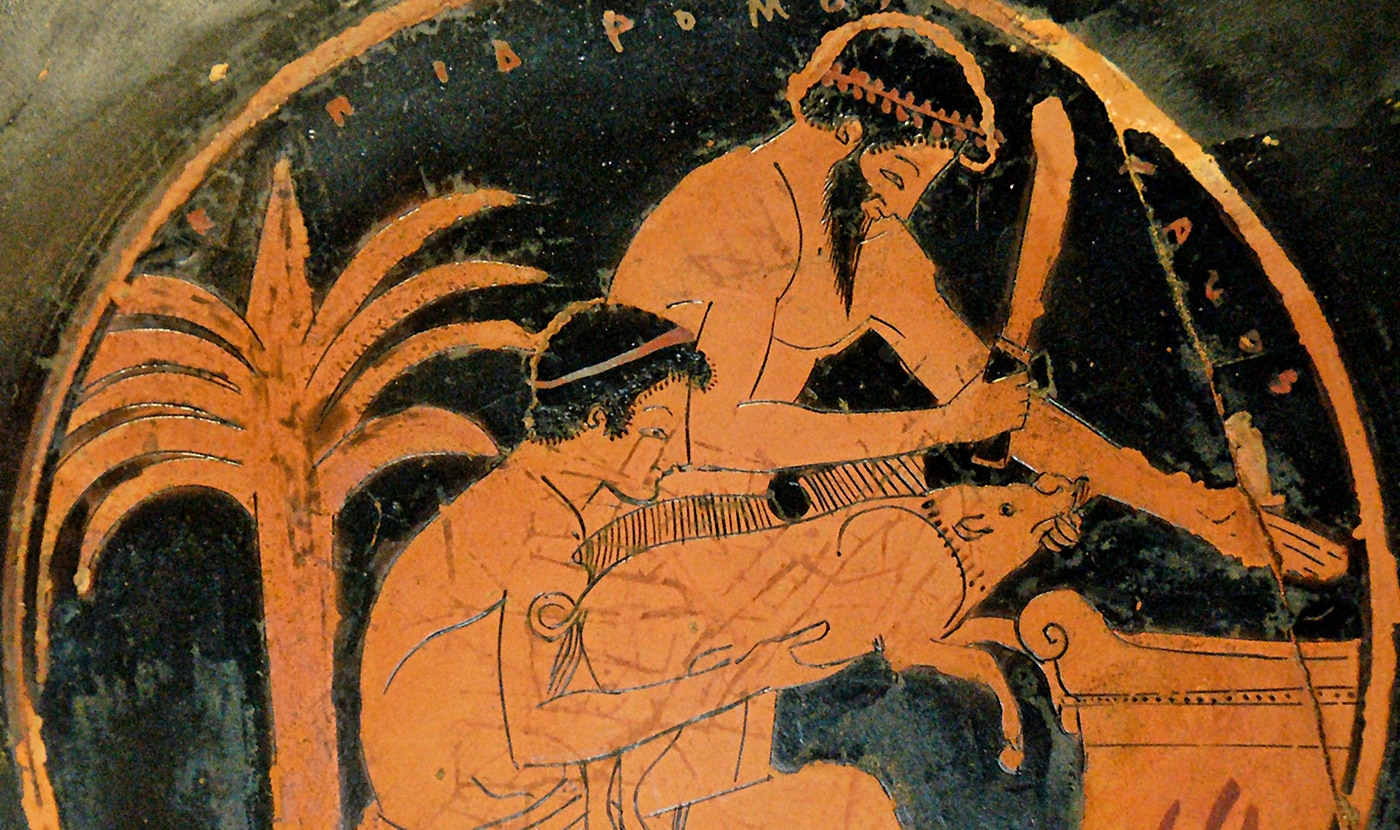
CC/Jastrow - Sacrifice d’un porc en Grèce Antique, Epidromos 5e siècle AEC, Musée du Louvre, Paris">
      <span class="svg-icon">
        <svg>
          <use xlink:href="svg/sprite.min.svg#icon-resize" />
        </svg>
      </span>
          
  <img loading="lazy" src="/sites/default/files/media/image/2016-05/WEB-Christianisme-----sacrifice_0_0.png" width="1400" height="830" alt="WEB-Christianisme-----sacrifice.png" typeof="foaf:Image">


        </a>
      </div>
              <h6 class="gallery-caption">
          
CC/Jastrow - Sacrifice d’un porc en Grèce Antique, Epidromos 5e siècle AEC, Musée du Louvre, Paris
        </h6>
            </div>


</div><div class="field-collection"><h4>Les sacrifices antiques</h4><p>Les sacrifices et les <strong>offrandes aux dieux </strong>se retrouvent dans de nombreuses religions, et concernent principalement les animaux. La consommation de viande a toujours posé une question fondamentale, celle de la <strong>mise à mort</strong>. Il fallait donc sacrifier l’animal pour que l’abattage ne ressemble pas à un acte gratuit et banal.</p>

<p>Chez les <strong>Grecs</strong>, il était impensable de manger de la viande sans avoir auparavant sacrifié l’animal aux dieux. La viande était un mets d’exception&nbsp;; il fallait la partager avec les dieux avant de la<strong> partager</strong> entre les convives lors d’un banquet. Une partie de l’animal, même minime (quelques poils par exemple) était offerte aux dieux. Cette habitude s’est perpétuée dans l’Empire <strong>romain</strong>, même lorsque la consommation de viande avait augmenté dès les premiers siècles de notre ère. L’idée de sacrifice se retrouve également chez les <strong>Hébreux</strong>&nbsp;pour lesquels le sang représente le principe vital et devait être versé sur l’autel en offrande à Dieu. De plus, il leur était, et leur est toujours, interdit de consommer du sang.</p>
</div><div class="field-collection"><h4>Une nouvelle forme de sacrifice </h4><p>Lors du dernier repas, Jésus s’offre en sacrifice.&nbsp;Celui-ci va peu à peu se <strong>substituer </strong>aux sacrifices de l’Antiquité. Les premiers chrétiens dans l’Empire romain<strong> refusent</strong> d’immoler les animaux aux dieux païens et ne consomment pas de viande provenant d’animaux sacrifiés. Ils ne reconnaissent qu’un seul sacrifice, celui du Christ, et témoignent ainsi de leur appartenance à la <strong>nouvelle religion</strong>. Ce comportement est inacceptable pour les autorités impériales&nbsp;: ceux qui refusent de sacrifier aux dieux sont persécutés. Mais le christianisme s’impose progressivement et, au 4<sup>e</sup>&nbsp;siècle, il devient la religion officielle. Les sacrifices d’animaux sont définitivement <strong>abandonnés</strong>, par contre, le sacrifice divin continue à être symbolisé par la fraction du <a href="/fr/node/1067">pain</a>, appelé communion, cène ou eucharistie.</p>
</div><div class="field-collection"><h4>Un sacrifice qui reste mystérieux </h4><p>Lorsque Jésus annonce&nbsp;: «&nbsp;Je suis le pain vivant,… Qui mangera ce pain vivra à jamais.&nbsp;», ses auditeurs sont choqués&nbsp;: «&nbsp;Comment cet homme peut-il nous donner sa chair à manger&nbsp;?&nbsp;» et «&nbsp;Ce langage-là est trop fort&nbsp;! Qui peut l’écouter&nbsp;?&nbsp;» (Jean 6&nbsp;; 51,60). Effectivement, les mots utilisés par Jésus sont troublants&nbsp;: s’agirait-il de cannibalisme ou de théophagie (de <em>theos </em>‘dieu’ et <em>phagein</em> «&nbsp;‘manger’)&nbsp;? La question de la <strong>présence réelle</strong> du Christ dans l’eucharistie a été longuement débattue par les ecclésiastiques. Quelle est la nature du <a href="/fr/node/1056">pain</a> et du <a href="/fr/node/1062">vin</a> partagés par les fidèles lors de la communion&nbsp;? Pour les catholiques, il y a le mystère de la<strong> transsubstantiation&nbsp;</strong>: le pain et le vin changent de substance&nbsp;: ils deviennent réellement le corps et le sang du Christ. Pendant longtemps, il fallait être à jeun pour recevoir l’hostie (du latin <em>hostia </em>‘victime’). Pour les protestants par contre, la présence du Christ dans le pain et le vin n’est pas réelle, elle reste <strong>symbolique.</strong></p>
</div>
      </div>
,   <div class="paragraph paragraph--type--wysiwyg paragraph--view-mode--detailed-preview">
          
<p>Walter, Philippe, 2003. <i>Mythologie chrétienne</i>. Paris : éditions imago</p>&#13;
&#13;
<p>Souan, Olivier, 2015. Commémorer la résurrection du Christ. <i>Le Point Références, Le christianisme : rites et fêtes.</i> Janvier-février 2015. pp. 20-21</p>&#13;
&#13;
<p>Grottanelli, Cristiano, 1996. La viande et ses rites. In Flandrin, Jean-Louis, Montanari, Massimo. <i>Histoire de l’alimentation.</i> Paris : Fayard. pp. 117-132</p>&#13;
&#13;
<p>Fischler, Claude, 2001. <i>L’homnivore</i>. Paris : Odile Jacob</p>&#13;
&#13;
<p>Rousseau, Vanessa, 2005. <i>Le goût du sang</i>. Paris : Armand Colin</p>&#13;
&#13;
<p><i>La Sainte Bible</i>, dite Bible de Jérusalem, 1955, Paris : Le club français du livre.</p>&#13;

      </div>
]]></field_content></item><item key="2"><title> Oesophagus</title><field_image><![CDATA[  <img loading="lazy" src="/sites/default/files/styles/course_tile/public/media/image/2016-05/alm_esa_corps_fr_deglutition_0.png?itok=jn4-wobO" width="277" height="277" alt="alm_esa_corps_fr_deglutition.png" typeof="foaf:Image" />


]]></field_image><field_index>CP0-M04</field_index><field_card_description>This muscular tube links the pharynx to the stomach and has the purpose of moving the food downwards.</field_card_description><field_subtitle></field_subtitle><field_content><![CDATA[  <div class="paragraph paragraph--type--wysiwyg paragraph--view-mode--detailed-preview">
          
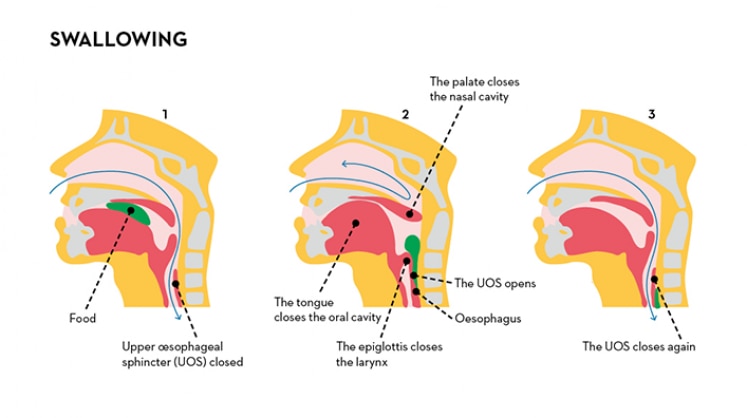
<div class="field-collection"><p><strong>The pharynx</strong></p>

<p>Having entered through the mouth, food passes back to the pharynx, via a route also taken by liquids and air. The pharyngeal constrictor muscles that form the outer layer of the pharynx enable food to be propelled downwards into the oesophagus.</p>

<div data-embed-button="paragraph_library_item" data-entity-embed-display="view_mode:paragraphs_library_item.render" data-entity-type="paragraphs_library_item" data-entity-uuid="0dc6f6f8-ef64-4b27-92c1-5b76f4c6961d" data-langcode="en" data-entity-embed-display-settings="[]" class="embedded-entity" xmlns:xlink="http://www.w3.org/1999/xlink">

            <div class="image-gallery-item">
        <a href="/sites/default/files/media/image/2016-05/alm_esa_corps_en_deglutition_0.png" class="opener lightboxed" data-caption="
&nbsp;">
      <span class="svg-icon">
        <svg>
          <use xlink:href="svg/sprite.min.svg#icon-resize" />
        </svg>
      </span>
          
  <img loading="lazy" src="/sites/default/files/media/image/2016-05/alm_esa_corps_en_deglutition_0.png" width="747" height="418" alt="alm_esa_corps_en_deglutition.png" typeof="foaf:Image">


        </a>
      </div>
              <h6 class="gallery-caption">
          
&nbsp;
        </h6>
            </div>


<p><strong>The oesophagus</strong></p>

<p>This muscular tube is approximately 25 cm in length and 2 to 2.5 cm in diameter, links the pharynx to the stomach and has the purpose of moving the food downwards, thanks to peristalsis, to the cardia, the opening that connects it to the stomach. This unique digestive function is accomplished during the process of swallowing, thanks to the relaxation of the upper oesophageal sphincter (the circular muscle that surrounds the oesophagus) and the closure of the larynx, at the entrance to the respiratory tract, by the epiglottis. Following a passage of 4 to 8 seconds for solids and 1 to 2 seconds for liquids, the food reaches the lower oesophageal sphincter, which relaxes in order to facilitate passage into the stomach.</p>

<p>It is worth noting that while the mouth is involved in both breathing and swallowing, these two processes cannot take place at the same time, in order to prevent food from entering our lungs.</p>

<p></p>

<p></p>
</div>
      </div>
,   <div class="paragraph paragraph--type--wysiwyg paragraph--view-mode--detailed-preview">
          
<p>Elaine N. Marieb, <em>Anatomie et physiologie humaines</em>, adaptation de la 6<sup>e</sup> édition américaine par René Lachaîne, Edition du Renouveau Pédagogique, 2005.</p>&#13;
&#13;
<p>Propositions d’illustrations, de tableaux, d’objets de la collection ou de photos</p>&#13;
&#13;
<p><a href="http://www.futura-sciences.com/magazines/sante/infos/dico/d/biologie-%C5%93sophage-6851/" target="_blank">http://www.futura-sciences.com</a></p>&#13;
&#13;
<p></p>&#13;

      </div>
]]></field_content></item><item key="3"><title> Organes sensoriels</title><field_image></field_image><field_index>CP0-M26</field_index><field_card_description>Les organes servant de capteurs pour les go&#xFB;ts, les odeurs, les sons et ce que l&#x2019;on voit et touche sont appel&#xE9;s organes sensoriels.</field_card_description><field_subtitle></field_subtitle><field_content><![CDATA[  <div class="paragraph paragraph--type--wysiwyg paragraph--view-mode--detailed-preview">
          
<div class="field-collection"><p>Les organes servant de capteurs pour les goûts, les odeurs, les sons et ce que l’on voit et touche sont appelés organes sensoriels. Les êtres humains sont très sensibles aux stimuli qui les entourent et leur système nerveux ne cesse de les capter et les interpréter. Les différents organes impliqués dans la réception et la transmission de ces stimuli sont la langue, le nez, les oreilles, les yeux et la peau. Ils sont eux-mêmes parsemés de nombreux récepteurs sensoriels, des structures détectant spécifiquement un type de stimulus, qui informent l’organisme de son état interne ainsi que de son environnement externe.</p>&#13;
&#13;
<p>Certains animaux possèdent des organes sensoriels différents, leur permettant de s’orienter dans le noir par exemple. En effet, les vibrisses, ou moustaches, des chats leur permettent de juger les variations de l’air et ainsi de détecter tout objet ou être proche de lui.</p>&#13;
</div>
      </div>
,   <div class="paragraph paragraph--type--wysiwyg paragraph--view-mode--detailed-preview">
          
<p>Elaine N. Marieb, <em>Anatomie et physiologie humaines</em>, adaptation de la 6<sup>e</sup> édition américaine par René Lachaîne, Edition du Renouveau Pédagogique, 2005.</p>&#13;

      </div>
]]></field_content></item><item key="4"><title> Stomach</title><field_image><![CDATA[  <img loading="lazy" src="/sites/default/files/styles/course_tile/public/media/image/2016-05/alm_esa_estomac_05_fr_0.png?itok=2YzRwdJS" width="277" height="277" alt="alm_esa_estomac_05_fr.png" typeof="foaf:Image" />


]]></field_image><field_index>CP0-M06</field_index><field_card_description>The stomach is a temporary reservoir between 15 and 25 cm in length, in which food is transformed in to semifluid mass known as chyme.</field_card_description><field_subtitle></field_subtitle><field_content><![CDATA[  <div class="paragraph paragraph--type--wysiwyg paragraph--view-mode--detailed-preview">
          
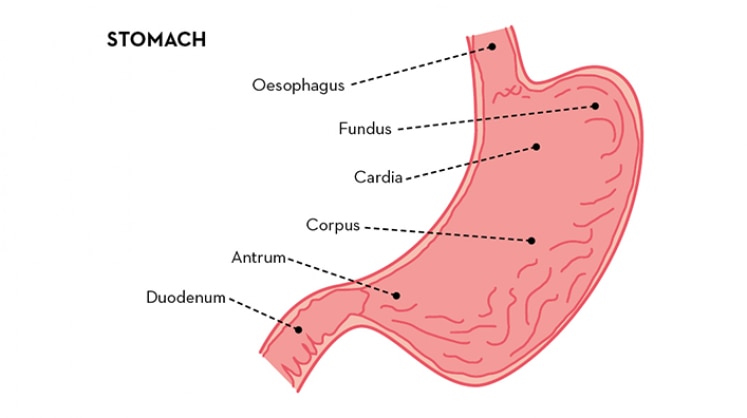
<div class="field-collection"><p>The stomach is a temporary reservoir between 15 and 25 cm in length, in which food is transformed in to semifluid mass known as chyme. The digestion of proteins starts here, and the stomach performs the vital function of producing intrinsic factor, a substance necessary for the absorption of vitamin B12, which is required by the body to produce red blood cells. The stomach is approximately 50 ml in volume when empty, and can expand to up to 4 litres following a particularly heavy meal. It is divided into four parts: the cardia, which is the area in which the food enters the stomach from the oesophagus, the fundus, the body and the pylorus, which in turn is connected to the small intestine. Having reached the stomach, food does not stay there for long, as it starts to drain again just a few minutes after a meal and is completely empty within less than four hours. What is more, the speed at which the stomach is emptied can be accelerated if the meal is particularly heavy and liquid, while it can be slowed down by the contents of the small intestine.</p>

<div data-embed-button="paragraph_library_item" data-entity-embed-display="view_mode:paragraphs_library_item.render" data-entity-type="paragraphs_library_item" data-entity-uuid="df6ba929-377a-4d2f-9590-99406099b03c" data-langcode="en" data-entity-embed-display-settings="[]" class="embedded-entity" xmlns:xlink="http://www.w3.org/1999/xlink">

            <div class="image-gallery-item">
        <a href="/sites/default/files/media/image/2016-05/alm_esa_estomac_05_en_0.png" class="opener lightboxed" data-caption="
&nbsp;">
      <span class="svg-icon">
        <svg>
          <use xlink:href="svg/sprite.min.svg#icon-resize" />
        </svg>
      </span>
          
  <img loading="lazy" src="/sites/default/files/media/image/2016-05/alm_esa_estomac_05_en_0.png" width="747" height="418" alt="alm_esa_estomac_05_en.png" typeof="foaf:Image">


        </a>
      </div>
              <h6 class="gallery-caption">
          
&nbsp;
        </h6>
            </div>


<p>The form and position of the stomach varies from one person to another, and it is particularly elongated and in a more vertical position in individuals who are tall and thin.</p>
</div>
      </div>
,   <div class="paragraph paragraph--type--wysiwyg paragraph--view-mode--detailed-preview">
          
<p>Elaine N. Marieb, <em>Anatomie et physiologie humaines</em>, adaptation of the 6th American edition by René Lachaîne, edition by Renouveau Pédagogique, 2005.</p>&#13;

      </div>
]]></field_content></item><item key="5"><title>A food journey through the body  </title><field_image><![CDATA[  <img loading="lazy" src="/sites/default/files/styles/course_tile/public/media/image/2016-05/alm_esa_digestion_villi_fr_0.png?itok=zfaMO4_6" width="277" height="277" alt="alm_esa_digestion_villi_fr.png" typeof="foaf:Image" />


]]></field_image><field_index>CP0-M22</field_index><field_card_description>The journey continues into the intestines, starting with the small intestine.</field_card_description><field_subtitle></field_subtitle><field_content><![CDATA[  <div class="paragraph paragraph--type--wysiwyg paragraph--view-mode--detailed-preview">
          
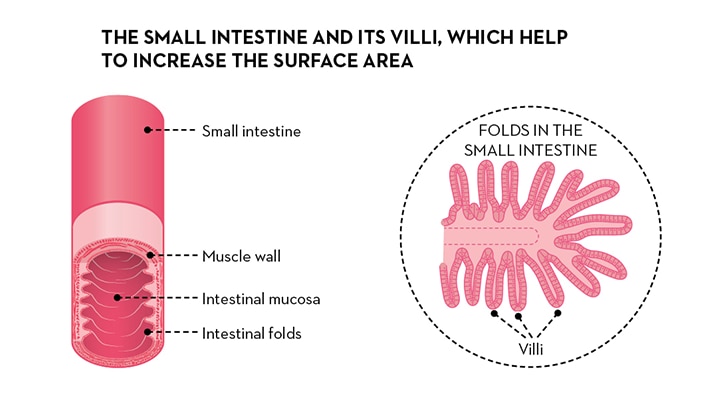
<div class="field-collection"><p>The journey continues into the intestines, starting with the small intestine. Can you imagine that your small intestine is around 5 meters long? And that its total surface area amounts to approximately 200 m2, roughly equivalent to the size of a tennis court, due to folds and other projections (villi)? This 400-fold increase in surface area is important when it comes to ensuring that nutrients from our food can be absorbed in sufficient quantities.</p>

<div data-embed-button="paragraph_library_item" data-entity-embed-display="view_mode:paragraphs_library_item.render" data-entity-type="paragraphs_library_item" data-entity-uuid="26f7df5f-d552-4388-b006-3ceece77256b" data-langcode="en" data-entity-embed-display-settings="[]" class="embedded-entity" xmlns:xlink="http://www.w3.org/1999/xlink">

            <div class="image-gallery-item">
        <a href="/sites/default/files/media/image/2016-05/alm_esa_digestion_villi_en_0.png" class="opener lightboxed" data-caption="
&nbsp;">
      <span class="svg-icon">
        <svg>
          <use xlink:href="svg/sprite.min.svg#icon-resize" />
        </svg>
      </span>
          
  <img loading="lazy" src="/sites/default/files/media/image/2016-05/alm_esa_digestion_villi_en_0.png" width="707" height="396" alt="alm_esa_digestion_villi_en.png" typeof="foaf:Image">


        </a>
      </div>
              <h6 class="gallery-caption">
          
&nbsp;
        </h6>
            </div>


<p>The small intestine is divided into three sections: the duodenum, the jejunum and the ileum. On leaving our stomach, the chyme first enters the duodenum, where the small intestine is connected to the pancreas and the gallbladder, organs that are important for the digestive process in the intestines. The pancreas produces enzymes that are released into the small intestine and supports the breakdown of proteins, fats and carbohydrates. In addition to this, via the bicarbonate contained in the pancreatic juice neutralises the acidic chyme as it leaves the stomach. The gallbladder stores the bile fluid that is produced in the liver and enters the small intestine through the bile duct. The most important components of the bile fluid are the bile acids that are important for fat digestion.&nbsp; The chyme is thus combined with and digested by the digestive juices of the pancreas, bile fluid and the enzymes produced in the intestine. The large majority of nutrients, i.e. protein, fat and carbohydrates and vitamins, minerals and trace elements, are broken down into smaller components in the small intestine and transported to the body through the intestinal wall .<br>
The final section of the gastrointestinal tract is the large intestine (colon), which is approximately 1.50 meters long and ends at the rectum. The large intestine contains the intestinal flora - i.e. your large intestine is occupied by approximately 10 billion intestinal bacteria for every millilitre of colonic fluid . The role of the intestinal flora is to ferment fibers.</p>

<p><br>
In comparison with the small intestine, not so much takes place in here in terms of digestion. The primary function of the large intestine is to remove water from the remaining chyme and thereby make it more concentrated, producing the faeces that are excreted through the anus. The length of time that the faeces remain in the anal canal depends on the amount of fibre in your diet – if you eat a high-fibre diet, the transport time is faster. By way of comparison, the chyme transit time in the large intestine is 2 – 3 days with a diet that is low in fibre, or 1 – 2 days with a high-fibre diet . The European Food Safety Authority (EFSA) recommends daily consumption of 25g of fibre&nbsp; .</p>
</div>
      </div>
,   <div class="paragraph paragraph--type--wysiwyg paragraph--view-mode--detailed-preview">
          
<p>Biesalski, H-K; Grimm, P: Taschenatlas Ernährung. Thieme Verlag Stuttgart, 2011</p>&#13;
&#13;
<p>European Food Safety Authority (EFSA; Hrsg.:): Scientific Opinion on Dietary Values for carbohydrates and dietary fibre. EFSA Journal 8, 3 (2010) 1462; <a href="http://www.efsa.europa.eu/en/efsajournal/doc/1462.pdf" target="_blank">http://www.efsa.europa.eu</a><br />&#13;
 </p>&#13;

      </div>
]]></field_content></item><item key="6"><title>A history of restriction</title><field_image><![CDATA[  <img loading="lazy" src="/sites/default/files/styles/course_tile/public/media/image/2017-07/cp020-02-regime-intro_0.jpg?itok=v0vdlS7O" width="277" height="277" alt="cp020-02 regime intro.jpg" typeof="foaf:Image" />


]]></field_image><field_index>CP020-02_TA2017</field_index><field_card_description>A question of restriction</field_card_description><field_subtitle><![CDATA[<p>The notion of ‘diet’ simply defines the range of food we eat, of any kind, shape, or form. However, our natural and socioeconomic environment has led the general public to understand the term ‘diet’ as something restrictive, namely as a method for losing weight.</p>
]]></field_subtitle><field_content><![CDATA[  <div class="paragraph paragraph--type--wysiwyg paragraph--view-mode--detailed-preview">
          
<div class="field-collection">
<div data-embed-button="paragraph_library_item" data-entity-embed-display="view_mode:paragraphs_library_item.render" data-entity-type="paragraphs_library_item" data-entity-uuid="baccc8bd-61a7-4e49-b861-8bd9e16aecf9" data-langcode="en" data-entity-embed-display-settings="[]" class="embedded-entity" xmlns:xlink="http://www.w3.org/1999/xlink">

            <div class="image-gallery-item">
        <a href="/sites/default/files/media/image/2017-07/cp020-02-regime-intro_0.jpg" class="opener lightboxed" data-caption="
© Getty Images / Hulton Archive - Family meal in Ancient&nbsp;Greece, circa&nbsp;500&nbsp;AEC">
      <span class="svg-icon">
        <svg>
          <use xlink:href="svg/sprite.min.svg#icon-resize" />
        </svg>
      </span>
          
  <img loading="lazy" src="/sites/default/files/media/image/2017-07/cp020-02-regime-intro_0.jpg" width="1008" height="365" alt="cp020-02 regime intro.jpg" typeof="foaf:Image">


        </a>
      </div>
              <h6 class="gallery-caption">
          
© Getty Images / Hulton Archive - Family meal in Ancient&nbsp;Greece, circa&nbsp;500&nbsp;AEC
        </h6>
            </div>

</div>

<div class="field-collection">
<h4>Une histoire de restrictions</h4>

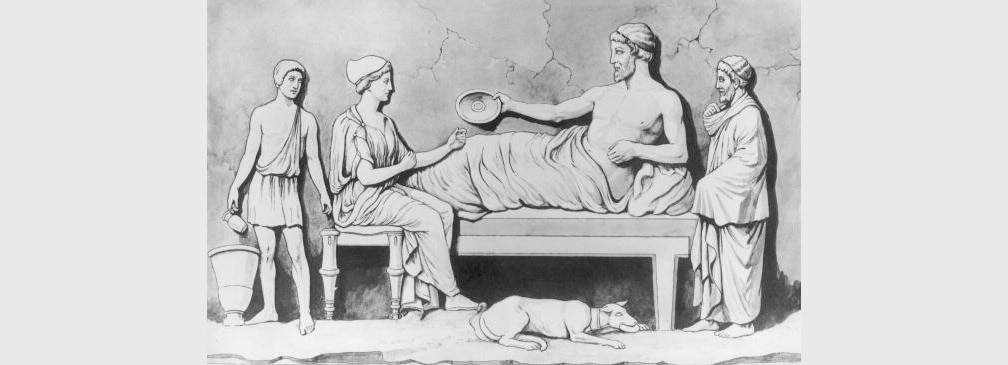
<p>The Ancient Greeks and Romans already understood that food and physical exercise influence our health and our weight. The Greek ‘diatia’ (from which the word ‘diet’ is derived) referred to a whole way of living focused on self-control and eating in moderation. With Christian asceticism, this moderation was translated into self-denial, whereby the body was seen as an obstacle to the elevation of the soul, as with the example of Saint&nbsp;Anthony in the late&nbsp;3<sup>rd</sup>&nbsp;century&nbsp;CE. <a class="pop" href="/en/node/1408">The sin of gluttony</a> continues to haunt the Christian world today.</p>

<p>In&nbsp;1474, the Italian humanist Bartolomeo&nbsp;Sacchi, aka Il&nbsp;Platina, wrote the first bestselling diet book. Advances in printing techniques meant that his <em>De honesta voluptate&nbsp;e&nbsp;valetudine</em> was read throughout Europe, and high society became obsessed with his recommendations regarding the relationship between gastronomic pleasure (voluptate) and health (valetudine). However, it is <em>How to Live One Hundred Years&nbsp;–&nbsp;Discourses on the Sober Life</em>&nbsp;(1558) by Alvise (Luigi) Cornaro that continues to be cited today. After realising the risks he was taking with his self-indulgent lifestyle, this Venetian aristocrat adopted a frugal diet and lived to become a centenarian. His book makes reference to the ancient writers and thus revives the Ancient Greek principles of moderation to show that a healthy lifestyle starts with a healthy diet.</p>

<p>Scientific advances, notably in medicine, led to discoveries (proteins, <a class="pop" href="/en/node/1113">carbohydrates</a>, lipids, vitamins,&nbsp;etc.) that altered our perception not only of the human body but also of what we eat. The&nbsp;20<sup>th</sup>&nbsp;century then saw the emergence of a plethora of diets that focused on these compounds and their energetic properties. In&nbsp;1918, Lulu Hunt&nbsp;Peters published <em>Diet&nbsp;&amp;&nbsp;Health:&nbsp;With Key to the Calories</em>. She urged her female readers to consider food in terms of calories and not to consume more than&nbsp;1200&nbsp;a day (to put this in perspective, the consensus today is for&nbsp;1600 to&nbsp;2500&nbsp;kcal a day, depending on age, physical activity and health). She paved the way for other methods to lose weight, such as the Weight&nbsp;Watchers diet that allocates points to foodstuffs according to their calorie and nutritional content. Some diets advocate the consumption of particular foodstuffs for the nutrients they may or may not contain. As an example, in gluten-free diets, the Atkins diet of the&nbsp;1970s or the Dukan diet of the&nbsp;2000s, it is the nutrient that counts and the form it takes is of secondary importance. Other diets involve abstinence from certain foodstuffs on ethical principles:&nbsp;Veganism goes far beyond a simple refusal to eat any products derived from animals and makes a plant-based diet a real lifestyle choice.</p>
</div>

      </div>
]]></field_content></item><item key="7"><title>A time of family conviviality</title><field_image><![CDATA[  <img loading="lazy" src="/sites/default/files/styles/course_tile/public/media/image/2016-03/WEB_ramadan_commensalite_communaute.png?itok=UvOWZDIK" width="277" height="277" alt="Ramadan – commensalité - communauté" typeof="foaf:Image" />


]]></field_image><field_index>ST002-09</field_index><field_card_description>Ramadan, a month of fasting and community sharing</field_card_description><field_subtitle><![CDATA[<p>Ramadan is not just about depriving oneself of food, it is also a matter of taste. During Ramadan, the day is devoted to asceticism, strictly forbidding eating, drinking and addictive or pleasurable pursuits. Night, however, is a time of conviviality and sharing with family and friends, where careful attention is paid to the purity of the food served in iftar and suhur, the two night-time meals.</p>
]]></field_subtitle><field_content><![CDATA[  <div class="paragraph paragraph--type--wysiwyg paragraph--view-mode--detailed-preview">
          
<div class="field-collection"><!-- scald=40:sdl_editor_representation --><!-- END scald=40 -->
<div data-embed-button="paragraph_library_item" data-entity-embed-display="view_mode:paragraphs_library_item.render" data-entity-type="paragraphs_library_item" data-entity-uuid="e6192dd3-1bb5-4eea-ac73-507b3f9c6d65" data-langcode="en" data-entity-embed-display-settings="[]" class="embedded-entity" xmlns:xlink="http://www.w3.org/1999/xlink">

            <div class="image-gallery-item">
        <a href="/sites/default/files/media/image/2016-05/WEB_ramadan_commensalite_communaute_0_0.png" class="opener lightboxed" data-caption="
©Getty Images / François Nel - Iftar during Ramadan, Dubai, 2014&nbsp;">
      <span class="svg-icon">
        <svg>
          <use xlink:href="svg/sprite.min.svg#icon-resize" />
        </svg>
      </span>
          
  <img loading="lazy" src="/sites/default/files/media/image/2016-05/WEB_ramadan_commensalite_communaute_0_0.png" width="1400" height="560" alt="WEB_ramadan_commensalite_communaute.png" typeof="foaf:Image">


        </a>
      </div>
              <h6 class="gallery-caption">
          
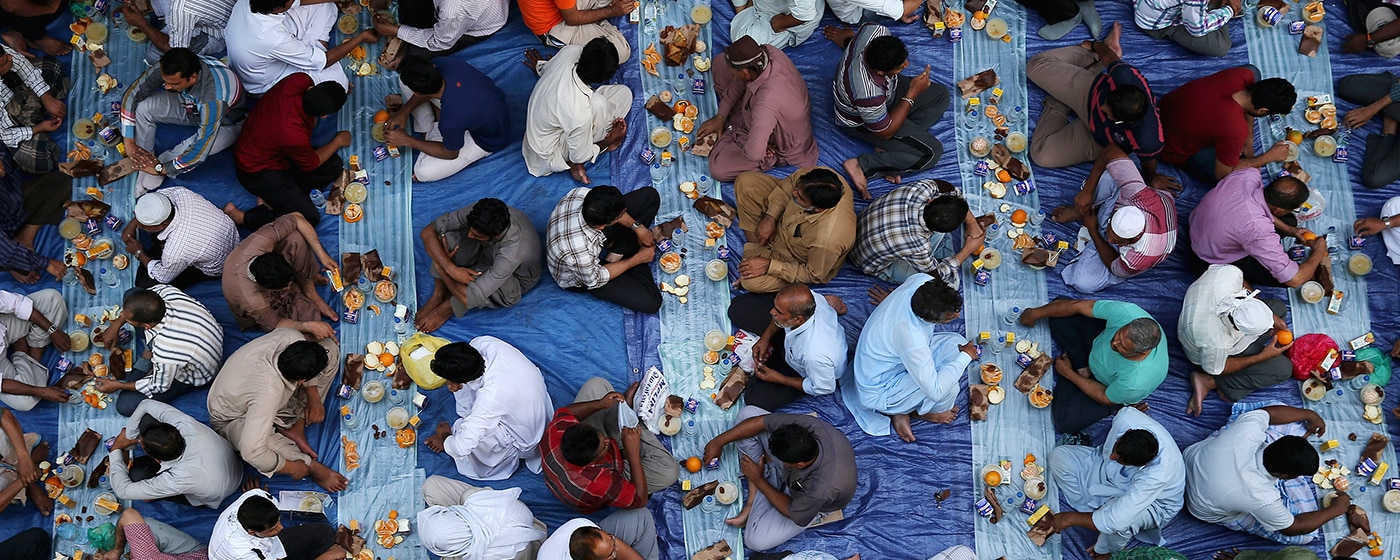
©Getty Images / François Nel - Iftar during Ramadan, Dubai, 2014&nbsp;
        </h6>
            </div>


</div><div class="field-collection"><h4>Eating together: Commensality as a precept </h4><p>The act of ‘eating together’ is advocated in Islamic sources. The <b>Hadith</b> recounts the word of the Prophet Muhammad, and states that “Whoever has food enough for two persons, should take a third and whoever has food enough for four persons, should take a fifth or a sixth for blessing is in Jamma’a (gatherings, being together).”</p>
</div><div class="field-collection"><h4>Preparing for Ramadan</h4><p>On the one hand, Ramadan is a time for <b>tempering</b> pleasures. On the other, for many practising Muslims it is the opportunity to cook their favourite or traditional dishes. Great <b>care </b>is taken with regard to the choice of food, which must be <b><a href="/en/node/1042">halal</a> </b>and of good quality. In general, the food is bought during the month before Ramadan. <a href="/en/node/1044">Sales of halal meat</a> are particularly high during this period. Shops and grocery stores display the staples of Muslim cuisine, including rice, dates, candied fruit, <a href="/en/node/1066">semolina</a> and <a href="/en/node/1321">sugar</a>. In some Muslim countries, such as Egypt, products are sold at very affordable prices as they are subsidised by the government. The trend in Western countries is to sell new products targeting the ‘Muslim consumer’, ranging from packets of spices to frozen pizza, all bearing the halal stamp.</p>
</div><div class="field-collection"><h4>Meal to break the fast</h4><p>At nightfall, the <b>family </b>gathers to break the fast by eating dates and drinking a glass of <a href="/en/node/1276">water</a>. This is said to be how the Prophet Muhammad broke his fast and there are different variations of this practice throughout the Arab world. In Morocco, for example, people eat harira, a soup made from tomatoes, pulses, meat and onions. Those observing Ramadan eat two meals during the night, iftar<i> </i>and suhur. <b>Iftar<i> </i></b>is the meal eaten at nightfall and is usually composed of a variety of dishes reflecting the <b>socio-economic status of the family</b>. The tables of poorer families feature dishes made from starchy food and cereals, with or without meat, such as falafels, <a href="/en/node/1067">bread</a>, lentil soup and rice. More affluent families prepare dishes based mainly on meat, fish and seafood, such as squid salad, stuffed pigeon or chicken soup. The richness and finesse of the food take precedent over the quantity, as excess must be avoided at all cost. The <b>complexity </b>of the meal often means it needs to be prepared in advance, during the day. Traditionally, <b>women </b>are the ‘guardians of the stoves’ and must ensure they do not swallow any of the food tasted during its preparation, due to the risk of breaking the fast. <b>Suhur</b>, the meal eaten just before morning prayer, is much lighter than iftar. It mainly consists of <b>dairy products</b> such as yoghurts and <a href="/en/node/1325">cheese</a>, together with dates, bread and jam, <a href="/en/node/1033">tea</a> or a glass of milk. Each region and country has its own <b>variations </b>of dishes. In Morocco, people eat rghaif, a stuffed pancake, and in Lebanon, manaïch, a flatbread seasoned with zataar, a blend of thyme and other spices.</p>
</div><div class="field-collection"><h4>Public feasts as an act of generosity</h4><p>Showing generosity towards others is not limited to the circle of family or friends. Non-governmental associations in Arab countries organise huge free public <b>feasts</b> called <b>mawa’id al-rahman</b> to feed the poor and orphans.</p>
</div>
      </div>
,   <div class="paragraph paragraph--type--wysiwyg paragraph--view-mode--detailed-preview">
          
<p>MASSON, Denise, 1967. <i>Coran</i>. Paris : Gallimard.</p>&#13;
&#13;
<p></p>&#13;
&#13;
<p>ASSOULY, Olivier, 2002. <i>Les nourritures divines. Essai sur les interdits alimentaires</i>. Paris : Actes Sud.</p>&#13;
&#13;
<p>CAMPO, Juan E., CAMPO, Magda, 2015. Food and Cuisine. In : <i>The Cambridge Companion to Modern Arab Culture</i>. Cambridge : Cambridge University Press. pp. 268-292.</p>&#13;

      </div>
]]></field_content></item><item key="8"><title>Agriculture biologique</title><field_image><![CDATA[  <img loading="lazy" src="/sites/default/files/styles/course_tile/public/media/image/2017-04/AL033-01_Ferme_association_Terre-de-liens_agriculture_biologique_Haute-Loire_2016_0.jpg?itok=AcmIs2Ow" width="277" height="277" alt="AL033-01 Ferme association Terre-de-liens agriculture biologique Haute-Loire 2016" typeof="foaf:Image" />


]]></field_image><field_index>AL033-01_TA2017</field_index><field_card_description>L&#x2019;agriculture biologique, un syst&#xE8;me de production alimentaire du pass&#xE9; pour le futur ?</field_card_description><field_subtitle><![CDATA[<p>L’agriculture biologique démarre vers 1900 puis se développe particulièrement à partir des années 1970 en réaction aux impacts environnementaux causés par l’agriculture intensive. Plus qu’une pratique qui n’use pas de produits chimiques de synthèse, elle recouvre un ensemble de techniques agricoles qui favorisent la santé des sols et la biodiversité. Elle se mue en projet sociétal assurant le bien-être animal, des rapports sociaux équitables et le bien-être des générations futures.</p>
]]></field_subtitle><field_content><![CDATA[  <div class="paragraph paragraph--type--wysiwyg paragraph--view-mode--detailed-preview">
          
<div class="field-collection"><div data-embed-button="paragraph_library_item" data-entity-embed-display="view_mode:paragraphs_library_item.render" data-entity-type="paragraphs_library_item" data-entity-uuid="fa4f8c88-835c-4173-a22d-ffddaa73e859" data-langcode="fr" data-entity-embed-display-settings="[]" class="embedded-entity" xmlns:xlink="http://www.w3.org/1999/xlink">

            <div class="image-gallery-item">
        <a href="/sites/default/files/media/image/2017-04/AL033-01_Ferme_association_Terre-de-liens_agriculture_biologique_Haute-Loire_2016_0.jpg" class="opener lightboxed" data-caption="
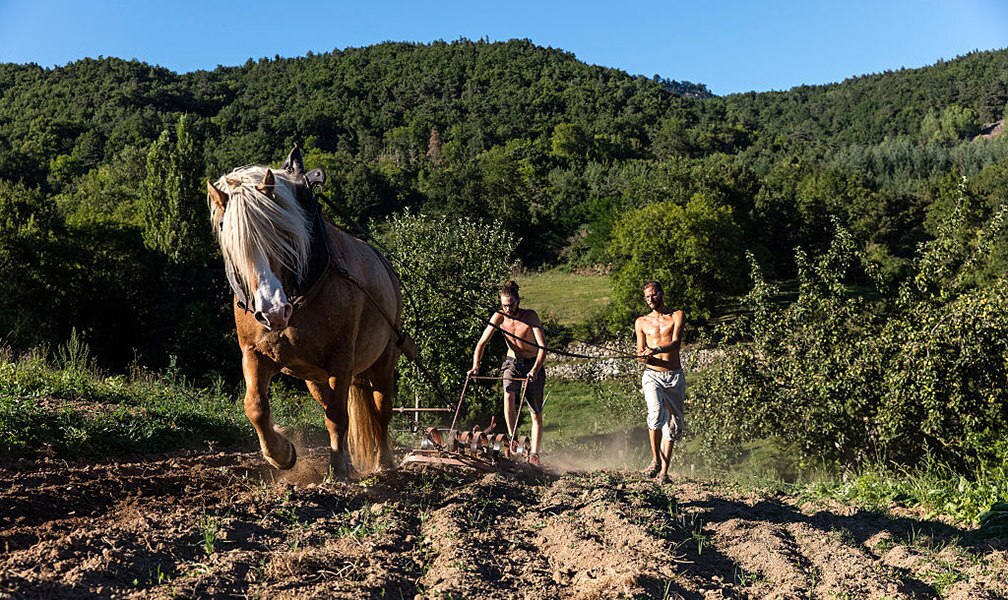
© Getty Images / Paris Match / Alvaro Canovas - Ferme biologique de Terre de Liens, association promouvant l’agriculture biologique, Haute-Loire, France, 2016">
      <span class="svg-icon">
        <svg>
          <use xlink:href="svg/sprite.min.svg#icon-resize" />
        </svg>
      </span>
          
  <img loading="lazy" src="/sites/default/files/media/image/2017-04/AL033-01_Ferme_association_Terre-de-liens_agriculture_biologique_Haute-Loire_2016_0.jpg" width="1008" height="600" alt="AL033-01 Ferme association Terre-de-liens agriculture biologique Haute-Loire 2016" typeof="foaf:Image">


        </a>
      </div>
              <h6 class="gallery-caption">
          
© Getty Images / Paris Match / Alvaro Canovas - Ferme biologique de Terre de Liens, association promouvant l’agriculture biologique, Haute-Loire, France, 2016
        </h6>
            </div>


</div><div class="field-collection"><h4>Une nouvelle approche</h4><p>L’un des courants fondateurs de l’agriculture biologique est l’agriculture biodynamique créée dans les années&nbsp;1920 par <b>Rudolf Steiner</b>. La <b>biodynamie</b> considère philosophiquement la terre comme une unité, dont l’évolution serait influencée par les forces de l’univers. Ainsi elle cherche à produire des aliments dans le respect de la <b>terre</b>, des plantes et des animaux, en utilisant diverses <b>méthodes</b> <b>écologiques</b>. Dès les années&nbsp;1940, trois associations contribuent au développement de l’agriculture biologique. En Angleterre, la <b>Soil Association</b> promeut une <b>agriculture paysanne autonome</b> et porte une attention particulière à l’humus pour maintenir les sols fertiles. L’agriculture <b>organo-biologique</b> en Suisse vise l’indépendance économique des paysans et encourage des <b>circuits courts</b> entre agriculteurs et consommateurs. Au Japon, l’agriculteur <b>Masanobu Fukuoka</b>, dont les travaux influenceront la <b>permaculture</b>, développe une agriculture du <b>non-agir</b>, s’adaptant au calendrier naturel et rejetant le désherbage et le labour.</p>
</div><div class="field-collection"><h4>Des conceptions contrastées de l’agriculture biologique</h4><p>L’agriculture biologique intéresse de plus en plus les consommateurs et les gouvernements à partir des années&nbsp;1970, suite à l’observation d’une <b>dégradation</b> <b>des sols</b> et de la <b>pollution des eaux</b> liées à l’agriculture intensive. La <b>Fédération internationale des mouvements d’agriculture biologique</b> (IFOAM) est fondée en&nbsp;1972 pour coordonner les associations soutenant l’agriculture biologique au niveau global et favoriser l’échange de connaissances.<br>
&nbsp;</p>

<div data-embed-button="paragraph_library_item" data-entity-embed-display="view_mode:paragraphs_library_item.render" data-entity-type="paragraphs_library_item" data-entity-uuid="83273444-6283-41cf-adb6-1139cbbd0b73" data-langcode="fr" data-entity-embed-display-settings="[]" class="embedded-entity" xmlns:xlink="http://www.w3.org/1999/xlink">

            <div class="image-gallery-item">
        <a href="/sites/default/files/media/image/2017-04/AL033-01_compost_fertilisant_biologique_0.jpg" class="opener lightboxed" data-caption="
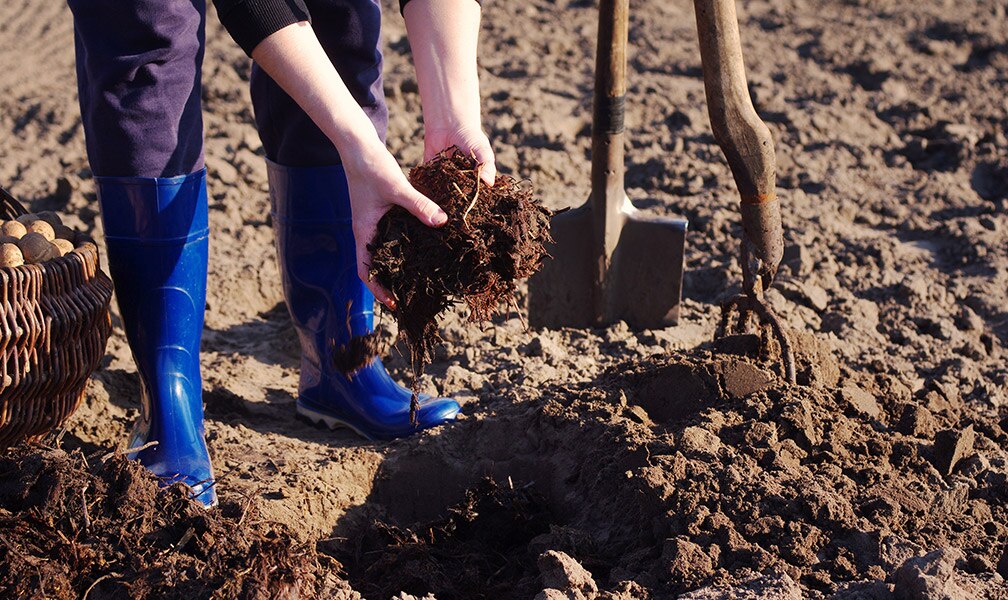
© Shutterstock / savitskaya iryna - Le compost comme fertilisant biologique">
      <span class="svg-icon">
        <svg>
          <use xlink:href="svg/sprite.min.svg#icon-resize" />
        </svg>
      </span>
          
  <img loading="lazy" src="/sites/default/files/media/image/2017-04/AL033-01_compost_fertilisant_biologique_0.jpg" width="1008" height="600" alt="AL033-01 compost fertilisant biologique" typeof="foaf:Image">


        </a>
      </div>
              <h6 class="gallery-caption">
          
© Shutterstock / savitskaya iryna - Le compost comme fertilisant biologique
        </h6>
            </div>


<p><br>
Jusqu’alors associée à une agriculture ne recourant pas aux intrants chimiques de synthèse, l’agriculture biologique est spécifiée pour la première fois en&nbsp;1982 par l’IFOAM qui liste <b>sept standards</b>&nbsp;: travailler le plus possible dans un système fermé et local (réutilisation des ressources), maintenir durablement la fertilité des sols, éviter toutes formes de pollution, produire un nombre suffisant d’aliments de haute qualité nutritionnelle, réduire l’usage d’énergie fossile, assurer le bien-être des animaux d’élevage et permettre aux producteurs de gagner leur vie décemment. Sur cette base, la Commission du <i>Codex Alimentarius</i> créée par l’OMS et la FAO définit l’agriculture biologique en&nbsp;1999 comme un système de gestion de production holistique qui favorise la <b>santé</b> <b>de l'agroécosystème</b>. Ce système doit également préconiser des méthodes agronomiques localement adaptées, biologiques et mécaniques, par opposition à l'utilisation de matériaux synthétiques. Parallèlement, elle établit des <b>pratiques recommandées</b> (usage de légumineuses fixatrices d’azote pour augmenter la fertilité du sol), <b>autorisées sous conditions</b> (utilisation de déchets organiques issus de la transformation agroalimentaire comme fertilisants) et <b>interdites</b> (emploi d’intrants de synthèse et d’OGM) dans des listes annexes. Pour les puristes, cette définition limite l’agriculture biologique à une <b>technique agricole</b> répondant à un cahier des charges, alors qu’elle est, d’après eux, à la base d’un <b>projet sociétal alternatif</b> au système socio-économique actuel. En ce sens, l’agriculture biologique vise également le développement de circuits courts de distribution, l’<b>autonomie alimentaire </b>des populations, la <b>réduction des pertes alimentaires</b>, la valorisation des cultures locales ou encore la <b>protection des petits producteurs</b>. <b>Ces différentes définitions</b> <b>et applications</b> de l’agriculture biologique restent peu accessibles aux consommateurs. Néanmoins, l’agriculture biologique dévolue principalement aux produits de la terre et de l’élevage régionaux et saisonniers montre dans l’ensemble un meilleur bilan environnemental que l’agriculture intensive. Il reste toutefois difficile de savoir si l’agriculture biologique pourrait conserver ce bilan tout en opérant un changement d’échelle requis pour <b>nourrir la planète</b> au même titre que l’agriculture intensive. Par ailleurs, si le <b>rendement</b> de l’agriculture biologique tend à être&nbsp;20&nbsp;à&nbsp;25%&nbsp;plus faible que l’agriculture conventionnelle à l’échelle parcellaire, la généralisation de ces résultats à l’échelle internationale reste un problème.</p>
</div><div class="field-collection"><h4>Des idées reçues</h4><p>Dans leur ensemble, les produits issus de l’agriculture biologique ne montrent pas non plus de valeurs nutritionnelles supérieures aux produits issus de l’agriculture conventionnelle. Contrairement à ce que les consommateurs pensent souvent, l’agriculture biologique peut recourir à des produits chimiques. En effet seuls sont exclus les produits chimiques de synthèse ou ceux déjà interdits dans l’agriculture conventionnelle. Certains des produits employés peuvent avoir une toxicité (ou écotoxicité) attestée, parfois supérieure à celle de leur équivalent de synthèse. De même qu’en agriculture conventionnelle, leur utilisation est strictement encadrée. Il en va ainsi de la pyréthrine, de l’azadirachtine, ou encore du cuivre de la fameuse&nbsp;bouillie bordelaise.</p>
</div>
      </div>
,   <div class="paragraph paragraph--type--wysiwyg paragraph--view-mode--detailed-preview">
          
<p>ANGLADE, Jean-Pierre, 2014. La bio, un projet de société [en ligne]. <em>Nature &amp; Progrès</em>. Novembre-décembre 2014 / janvier 2015. n°100. pp. 8-11 [Consulté le 17 mars 2017]. Disponible à l’adresse : <a href="http://www.natureetprogres.org/revue_nature_progres/articles/article55.pdf">http://www.natureetprogres.org/revue_nature_progres/articles/article55.pdf</a></p>&#13;
&#13;
<p>DEMETER, 2017. <em>Mouvement de l’Agriculture Bio-Dynamique</em> [en ligne]. Colmar : Demeter [Consulté le 13 mars 2017]. Disponible à l’adresse : <a href="http://www.bio-dynamie.org/wp-content/uploads/2017/01/WEB_catalogue2.pdf">http://www.bio-dynamie.org/wp-content/uploads/2017/01/WEB_catalogue2.pdf</a></p>&#13;
&#13;
<p>DORE, Thierry, 2013. Une agriculture en débat. In : <em>Agriculture biologique : espoir ou chimère ?</em> [en ligne]. Paris : Le Muscadier. [Consulté le 23 mars 2017]. Disponible à l’adresse : <a href="https://goo.gl/vn2MUT">https://goo.gl/vn2MUT</a></p>&#13;
&#13;
<p>FAO, DATE ?, Questions fréquemment posées sur l'agriculture biologique [en ligne]. [Consulté le 13 mars 2017]. Disponible à l’adresse : <a href="http://www.fao.org/organicag/oa-faq/fr/">http://www.fao.org/organicag/oa-faq/fr/</a></p>&#13;
&#13;
<p>THE WALL STRETT JOURNAL, “Can Organic Food Feed the World? Catherine Badgley says it’s our best hope; Steve Savage says the yields are too low”, July 10 2015 (accessed on March 14 2017): https://www.wsj.com/articles/can-organic-food-feed-the-world-1436757046</p>&#13;
&#13;
<p>IFOAM, 2005. Les principes de l’agriculture biologique [en ligne]. [Consulté le 13 mars 2017]. Disponible à l’adresse : <a href="https://www.ifoam.bio/sites/default/files/poa_french_web.pdf">https://www.ifoam.bio/sites/default/files/poa_french_web.pdf</a></p>&#13;
&#13;
<p>IFOAM, June 2008. Definition of Organic Agriculture [en ligne]. Vignola : IFOAM [Consulté le 13 mars 2017]. Disponible à l’adresse : <a href="http://infohub.ifoam.bio/sites/default/files/page/files/doa_french.pdf">http://infohub.ifoam.bio/sites/default/files/page/files/doa_french.pdf</a></p>&#13;
&#13;
<p>LE BUANEC, Bernard 2012. <em>Le tout bio est-il possible ? : 90 clés pour comprendre l'agriculture biologique </em>[en ligne]. Versailles : Quae [Consulté le 13 mars 2017]. Disponible à l’adresse : <a href="https://books.google.ch/books?id=9dwiCwAAQBAJ&amp;pg=PA9&amp;hl=fr&amp;source=gbs_toc_r&amp;cad=4#v=onepage&amp;q&amp;f=false">https://books.google.ch/books?id=9dwiCwAAQBAJ&amp;pg=PA9&amp;hl=fr&amp;source=gbs_toc_r&amp;cad=4#v=onepage&amp;q&amp;f=false</a></p>&#13;
&#13;
<p>LOCKERETZ, William (dir.), 2007. <em>Organic farming : an international history</em> [en ligne]. Oxfordshire : CABI [Consulté le 13 mars 2017]. Disponible à l’adresse : <a href="http://base.dnsgb.com.ua/files/book/Agriculture/Organic-Agriculture/Organic-Farming-An-International-History.pdf">http://base.dnsgb.com.ua/files/book/Agriculture/Organic-Agriculture/Organic-Farming-An-International-History.pdf</a></p>&#13;
&#13;
<p>SYLVANDER, Bertil, FRANCOIS, Martine, MORIN, Jean-Marie, 2005. <em>Les bases de l’agriculture biologique : définitions, réglementations, histoire et état des lieux</em> [en ligne]. Fort-de-France : Institut de Recherche pour le Développement [Consulté le 13 mars 2017]. Disponible à l’adresse : <a href="http://horizon.documentation.ird.fr/exl-doc/pleins_textes/divers10-04/010035421.pdf">http://horizon.documentation.ird.fr/exl-doc/pleins_textes/divers10-04/010035421.pdf</a></p>&#13;
&#13;
<p>UNCTAD, FAO, IFOAM, 2009. <em>International Task Force on Harmonization and Equivalence in Organic Agriculture 2003-2008 </em>[en ligne]. Geneva : United Nations Conference on Trade and Development (UNCTAD), Rome : Food and Agriculture Organization of the United Nations (FAO), Bonn : International Federation of Organic Agriculture Movements (IFOAM) [Consulté le 13 mars 2017]. Disponible à l’adresse : <a href="http://www.fao.org/3/a-ak255e.pdf">http://www.fao.org/3/a-ak255e.pdf</a></p>&#13;
&#13;
<p>WILLER, Helga, LERNOUD, Julia, February 2017. <em>The World of Organic Agriculture Statistics and Emerging Trends 2017</em> [en ligne]. Frick : FIBL – Bonn : IFOAM [Consulté le 13 mars 2017]. Disponible à l’adresse : <a href="https://shop.fibl.org/fileadmin/documents/shop/3503-organic-world-2017.pdf" target="_blank">https://shop.fibl.org/fileadmin/documents/shop/3503-organic-world-2017.pdf</a></p>&#13;
&#13;
<p>BAHLAI, Christine A., XUE, Yingen, MCCREARY, Cara M., et al. Choosing organic pesticides over synthetic pesticides may not effectively mitigate environmental risk in soybeans. PLoS One, 2010, vol. 5, no 6, p. e11250.</p>&#13;
&#13;
<p>Disponible à l’adresse : <a href="http://journals.plos.org/plosone/article?id=10.1371/journal.pone.0011250">http://journals.plos.org/plosone/article?id=10.1371/journal.pone.0011250</a></p>&#13;
&#13;
<p>SEZNEC Erwan, "Toxiques, naturellement", magazine Que Choisir, septembre 2016</p>&#13;
&#13;
<p>https://www.quechoisir.org/enquete-traitements-bio-toxiques-naturellement-n22221/</p>&#13;
&#13;
<p>Disponible à l’adresse : <a href="https://erwanseznec.wordpress.com/2016/09/29/toxiques-naturellement/">https://erwanseznec.wordpress.com/2016/09/29/toxiques-naturellement/</a></p>&#13;
&#13;
<p>DANGOUR, Alan D., DODHIA, Sakhi K., HAYTER, Arabella, <em>et al.</em> Nutritional quality of organic foods: a systematic review. <em>The American journal of clinical nutrition</em>, 2009, vol. 90, no 3, p. 680-685.<br />&#13;
Disponible a l’adresse : <a href="http://ajcn.nutrition.org/content/90/3/680.long">http://ajcn.nutrition.org/content/90/3/680.long</a></p>&#13;
&#13;
<p>SMITH-SPANGLER, Crystal, BRANDEAU, Margaret L., HUNTER, Grace E., <em>et al.</em> Are organic foods safer or healthier than conventional alternatives?: a systematic review. <em>Annals of internal medicine</em>, 2012, vol. 157, no 5, p. 348-366.<br />&#13;
Disponible a l’adresse : <a href="http://www.leb.esalq.usp.br/disciplinas/Casimiro/LFN/Leitura_complementar/acp75_study.pdf">http://www.leb.esalq.usp.br/disciplinas/Casimiro/LFN/Leitura_complementar/acp75_study.pdf</a></p>&#13;

      </div>
]]></field_content></item><item key="9"><title>Agriculture intensive</title><field_image><![CDATA[  <img loading="lazy" src="/sites/default/files/styles/course_tile/public/media/image/2017-04/AL033-03_agriculture_intensive_aerien_0.jpg?itok=W-aCqNZw" width="277" height="277" alt="AL033-03 Agriculture intensive aerien" typeof="foaf:Image" />


]]></field_image><field_index>AL033-03_TA2017</field_index><field_card_description>L&#x2019;intensification de l&#x2019;agriculture : augmenter la productivit&#xE9; et r&#xE9;pondre aux besoins alimentaires croissants</field_card_description><field_subtitle><![CDATA[<p>Face aux besoins alimentaires croissants dans le monde, l’agriculture intègre progressivement des méthodes industrielles afin d’augmenter la productivité. Elle vise alors à accroître les rendements par unité de travailleur et à l&#039;hectare. Pour ce faire, elle améliore la performance des sols, des végétaux et des animaux par divers moyens issus d’innovations technologiques et scientifiques : produits phytosanitaires, sélection variétale ou encore ingénierie génétique.</p>
]]></field_subtitle><field_content><![CDATA[  <div class="paragraph paragraph--type--wysiwyg paragraph--view-mode--detailed-preview">
          
<div class="field-collection"><div data-embed-button="paragraph_library_item" data-entity-embed-display="view_mode:paragraphs_library_item.render" data-entity-type="paragraphs_library_item" data-entity-uuid="84de1136-4e35-47bd-af1c-186037ffcc4f" data-langcode="fr" data-entity-embed-display-settings="[]" class="embedded-entity" xmlns:xlink="http://www.w3.org/1999/xlink">

            <div class="image-gallery-item">
        <a href="/sites/default/files/media/image/2017-04/AL033-03_agriculture_intensive_aerien_0.jpg" class="opener lightboxed" data-caption="
© Getty Images / JamesBrey - Culture intensive">
      <span class="svg-icon">
        <svg>
          <use xlink:href="svg/sprite.min.svg#icon-resize" />
        </svg>
      </span>
          
  <img loading="lazy" src="/sites/default/files/media/image/2017-04/AL033-03_agriculture_intensive_aerien_0.jpg" width="1008" height="600" alt="AL033-03 Agriculture intensive aerien" typeof="foaf:Image">


        </a>
      </div>
              <h6 class="gallery-caption">
          
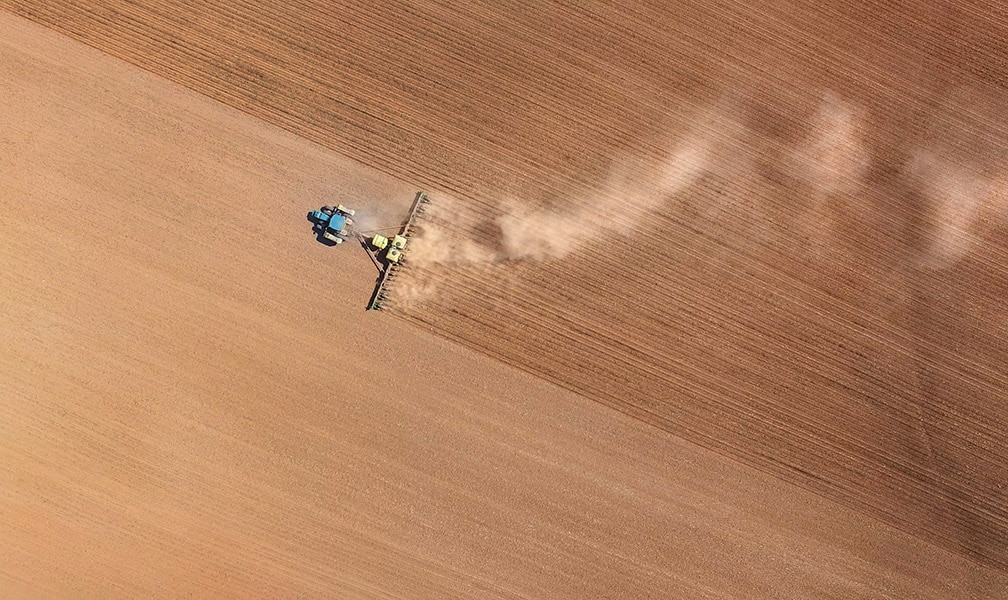
© Getty Images / JamesBrey - Culture intensive
        </h6>
            </div>


</div><div class="field-collection"><h4>Rentable et productive, mais cause d’impacts environnementaux, sociaux et sanitaires</h4><p>Au début du&nbsp;20<sup>e</sup>&nbsp;siècle dans les pays occidentaux, l’agriculture est essentiellement représentée par des petites et moyennes exploitations pratiquant la polyculture au moyen de la traction animale. Dans la seconde partie du 20<sup>e&nbsp;</sup>siècle, ce type d’agriculture est progressivement remplacé par de <strong>grandes productions marchandes spécialisées</strong>, qui utilisent des machines agricoles puissantes ainsi que des engrais et des pesticides de synthèse sur d’immenses surfaces cultivées. Ce changement de système découle d’une volonté politique aspirant à augmenter la <strong>productivité agricole</strong> pour répondre aux <strong>besoins alimentaires croissants</strong> dans le monde. Après la Deuxième Guerre mondiale, la plupart des pays industrialisés adoptent des politiques favorisant l’intensification de l’agriculture mettant à profit les <strong>progrès technologiques et scientifiques</strong> dans l’industrie mécanique et chimique ainsi qu’en génétique. Ces <strong>politiques</strong> consistent à encourager l’écoulement des produits, à assurer des <strong>prix</strong> avantageux et relativement stables ainsi qu’à favoriser l’acquisition de nouveaux moyens de production (systèmes de crédits à bas taux d’intérêt, subventionnements) tout en poussant les exploitations non rentables à terminer leurs activités. Après le remplacement progressif des animaux de trait par des tracteurs à moteur dans l’entre-deux-guerres, les <strong>machines</strong> deviennent toujours plus puissantes et perfectionnées (auto-chargeuse, épandeur d'engrais, herse rotative) dès les années&nbsp;1950. Ces innovations diminuent la pénibilité du travail des agriculteurs et favorisent les <strong>cultures à grande échelle</strong> avec une main-d’œuvre restreinte. Par ailleurs, les croisements et la sélection variétale, déjà à l’œuvre depuis des siècles, s’intensifie et se rationalise grâce à l’utilisation des outils de l’ingénierie génétique. Sont créées de nouvelles variétés aux performances améliorées, plus résistantes, s’adaptant à différents milieux physiques ou biologiques.</p>

<p>Les <strong>engrais chimiques</strong> sont inventés au&nbsp;19<sup>e</sup>&nbsp;siècle pour combler le manque d’engrais organiques utiles à la fertilisation des sols. De plus en plus employés à partir des années&nbsp;1950, ils participent à l’accroissement des récoltes. De la même façon, les <strong>pesticides</strong> (herbicides, insecticides, fongicides) facilitent le travail des cultivateurs dans l’élimination des adventices et des insectes indésirables et protègent les plantes contre des maladies. Toutes ces transformations permettent d’améliorer les performances des sols, des plantes et des animaux et d’augmenter les <strong>rendements</strong> par unité de travailleur et à l'hectare. Cependant, l’agriculture intensive amplifie les inégalités économiques et sociales en permettant aux exploitations et aux régions plus avantagées de progresser, tandis que les <strong>productions moins bien situées</strong>, moins capitalisées et moins productives, demeurent dans l’incapacité d’investir et de se développer en l’absence de subventions et se voient alors contraintes de fermer. De plus, l’emploi à grande échelle et dans des proportions excessives d’engrais, de produits phyto- et zoo-sanitaires ainsi que de machines lourdes, posent à terme des <strong>problèmes environnementaux</strong>&nbsp;: désertification, pollution des eaux, réduction de la biodiversité, compaction des sols, destruction d'habitats de certaines espèces. D’un point de vue sanitaire, l’exposition à long terme à certains pesticides, de synthèse ou non, peut augmenter le risque de développer des cancers, des maladies neurologiques et des troubles de la reproduction.</p>

<p>L’identification de tels impacts, notamment sur le plan écologique, couplé au besoin toujours soutenu de produire suffisamment, conduit à la recherche de solutions. Celles-ci garantiraient une productivité élevée tout en rationnalisant au mieux l’utilisation des engrais et produits phytosanitaires existants, ainsi qu’en recherchant des produits phytosanitaires plus efficaces à moindre concentration. Des solutions qui recourent à l’ingénierie génétique déjà développées et proposées sur le marché soulèvent de vives oppositions du grand public qui estime que les risques relatifs à l’usage des organismes génétiquement modifiés (OGM) dans la production alimentaire ont encore été peu étudiés.</p>
</div>
      </div>
,   <div class="paragraph paragraph--type--wysiwyg paragraph--view-mode--detailed-preview">
          
<p>BAIROCH, Paul, 1989. Les trois révolutions agricoles du monde développé : rendements et productivité de 1800 à 1985. <em>Annales. Économies, Sociétés, Civilisations</em>. 1989. n°2, pp. 317-353. doi : 10.3406/ahess.1989.283596</p>&#13;
&#13;
<p>FRIOUD, Élise.2013. Les OGM continuent à faire débat [en ligne]. <em>Agrihebdo.</em>[Consulté le 16 mars 2017]. Disponible à l’adresse : <a href="http://www.agrihebdo.ch/genie">http://www.agrihebdo.ch/genie</a></p>&#13;
&#13;
<p>MATTMÜLLER, Markus, INEICHEN, Andreas, 2011. Engrais [en ligne]. DHS І Dictionnaire Historique Suisse [Consulté le 16 mars 2017]. Disponible à l’adresse : <a href="http://www.hls-dhs-dss.ch/textes/f/F13856.php">http://www.hls-dhs-dss.ch/textes/f/F13856.php</a></p>&#13;
&#13;
<p>MAZOYER, Marcel, ROUDART, Laurence, 1997. Histoire des agricultures du monde. Du néolitique à la crise contemporaine. Paris : Seuil.</p>&#13;
&#13;
<p>OMS І Organisation mondiale de la Santé, 2005. <em>Biotechnologie alimentaire moderne, santé et développement : étude à partir d'exemples concrets  Impacts sur la santé</em> [en ligne] Genève : OMS. [Consulté le 17 mars 2017]. Disponible à l’adresse : <a href="http://www.who.int/foodsafety/publications/biotech/biotech_fr.pdf">http://www.who.int/foodsafety/publications/biotech/biotech_fr.pdf</a></p>&#13;
&#13;
<p>PERVANCHON, Frank, BLOUET, André, NGUYEN, Geneviève, SARTHOU, Jean-Pierre, FÉRET, Samuel, 2002. Lexique des qualificatifs de l'agriculture [en ligne]. <em>Courrier de l'environnement de l'INRA</em>. Février 2002. n°45. pp. 117-136. [Consulté le 16 mars 2017]. Disponible à l’adresse : <a href="https://hal.archives-ouvertes.fr/hal-01202642/file/C45Blouet.pdf">https://hal.archives-ouvertes.fr/hal-01202642/file/C45Blouet.pdf</a></p>&#13;
&#13;
<p>ROVILLÉ, Manuelle, 2008. Agriculture intensive et déforestation au banc des accusés [en ligne]. CNRS/sagascience. [Consulté le 16 mars 2017]. Disponible à l’adresse : <a href="http://www.cnrs.fr/cw/dossiers/dosbiodiv/?pid=decouv_chapC_p3_d1&amp;zoom_id=zoom_d1_1">http://www.cnrs.fr/cw/dossiers/dosbiodiv/?pid=decouv_chapC_p3_d1&amp;zoom_id=zoom_d1_1</a></p>&#13;
&#13;
<p>ROVILLE, Manuelle, AUFRAY, Renan, 2008. Modes de gestion agricole et influences sur la biodiversité du sol [en ligne]. CNRS/sagascience. [Consulté le 16 mars 2017]. Disponible à l’adresse : <a href="http://www.cnrs.fr/cw/dossiers/dosbiodiv/?pid=decouv_chapC_p5_d1&amp;zoom_id=zoom_d1_2">http://www.cnrs.fr/cw/dossiers/dosbiodiv/?pid=decouv_chapC_p5_d1&amp;zoom_id=zoom_d1_2</a></p>&#13;
&#13;
<p>TISSIER, Maryvonne, 2008. Agriculture productiviste : et la biodiversité dans tout ça ? [en ligne]. CNRS/sagascience. [Consulté le 16 mars 2017]. Disponible à l’adresse : <a href="http://www.cnrs.fr/cw/dossiers/dosbiodiv/?pid=decouv_chapC_p4_d1&amp;zoom_id=zoom_d1_6">http://www.cnrs.fr/cw/dossiers/dosbiodiv/?pid=decouv_chapC_p4_d1&amp;zoom_id=zoom_d1_6</a></p>&#13;
&#13;
<p>TISSIER, Maryvonne, 2008. OGM, alimentation, polémique [en ligne]. CNRS/sagascience [Consulté le 16 mars 2017]. Disponible à l’adresse : <a href="http://www.cnrs.fr/cw/dossiers/dosbiodiv/?pid=decouv_chapC_p4_d1&amp;zoom_id=zoom_d1_8">http://www.cnrs.fr/cw/dossiers/dosbiodiv/?pid=decouv_chapC_p4_d1&amp;zoom_id=zoom_d1_8</a></p>&#13;

      </div>
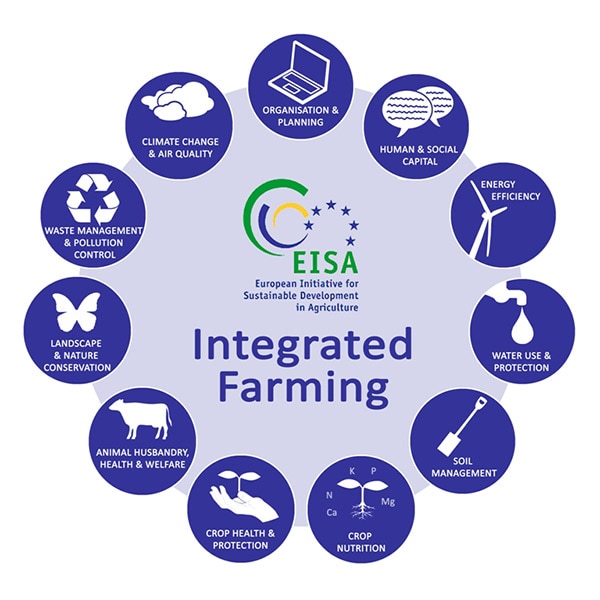
]]></field_content></item><item key="10"><title>Agricultures int&#xE9;gr&#xE9;e et raisonn&#xE9;e</title><field_image><![CDATA[  <img loading="lazy" src="/sites/default/files/styles/course_tile/public/media/image/2017-04/AL033-02_EISA_Vision_ensemble_production_agricole_integree_0.jpg?itok=uey8xyru" width="277" height="277" alt="AL033-02 EISA Vision ensemble production agricole integree" typeof="foaf:Image" />


]]></field_image><field_index>AL033-02_TA2017</field_index><field_card_description>L&#x2019;agriculture int&#xE9;gr&#xE9;e, un syst&#xE8;me combinant des m&#xE9;thodes culturales et des moyens de lutte naturels et chimiques contre les ravageurs</field_card_description><field_subtitle><![CDATA[<p>À mi-chemin entre l’agriculture intensive et l’agriculture biologique, l’agriculture intégrée et l’agriculture raisonnée apparaissent après la Seconde Guerre mondiale. La première vise à réduire l’usage de produits chimiques en préconisant des méthodes culturales préventives et des moyens de lutte biologiques. La seconde, moins radicale, prône un usage de produits chimiques en fonction du seuil de tolérance des cultures.</p>
]]></field_subtitle><field_content><![CDATA[  <div class="paragraph paragraph--type--wysiwyg paragraph--view-mode--detailed-preview">
          
<div class="field-collection"><div align="center">
<div data-embed-button="paragraph_library_item" data-entity-embed-display="view_mode:paragraphs_library_item.render" data-entity-type="paragraphs_library_item" data-entity-uuid="9d45c175-5512-4961-8341-43e5bf8917e9" data-langcode="fr" data-entity-embed-display-settings="[]" class="embedded-entity" xmlns:xlink="http://www.w3.org/1999/xlink">

            <div class="image-gallery-item">
        <a href="/sites/default/files/media/image/2017-04/AL033-02_EISA_Vision_ensemble_production_agricole_integree_0.jpg" class="opener lightboxed" data-caption="
CC BY-SA / EISA І European Initiative for Sustainable Development in Agriculture - Vision d’ensemble de la production agricole intégrée">
      <span class="svg-icon">
        <svg>
          <use xlink:href="svg/sprite.min.svg#icon-resize" />
        </svg>
      </span>
          
  <img loading="lazy" src="/sites/default/files/media/image/2017-04/AL033-02_EISA_Vision_ensemble_production_agricole_integree_0.jpg" width="600" height="600" alt="AL033-02 EISA Vision ensemble production agricole integree" typeof="foaf:Image">


        </a>
      </div>
              <h6 class="gallery-caption">
          
CC BY-SA / EISA І European Initiative for Sustainable Development in Agriculture - Vision d’ensemble de la production agricole intégrée
        </h6>
            </div>


</div>

<p></p>
</div><div class="field-collection"><h4>La quête d’une production soucieuse de l’environnement et de la santé</h4><p>Les <strong>déséquilibres environnementaux</strong> (pollution des eaux, érosion des sols, diminution de la biodiversité, etc.) et les risques sanitaires engendrés par l’usage intensif de pesticides après la Seconde Guerre mondiale conduit les agriculteurs à remettre en cause l’usage systématique d’<strong>intrants</strong> chimiques de synthèse. Dès les années&nbsp;1950, des entomologistes engagés pour une <strong>lutte biologique</strong> contre les ravageurs développent la notion de lutte intégrée. Elle combine l’usage de traitements chimiques avec des traitements biologiques de façon à limiter les coûts économiques ainsi que les dégâts écologiques induits par une utilisation d’intrants chimiques en grande quantité. L’Organisation Internationale de Lutte Biologique et intégrée (OILB), fondée en&nbsp;1955, développe la notion de protection intégrée. Celle-ci promeut des <strong>méthodes </strong><strong>préventives</strong> de culture afin de limiter les traitements contre les ravageurs. La protection intégrée propose un ensemble de méthodes culturales qui sont défavorables aux ravageurs (sélection de plantes plus résistantes, rotation et répartition des cultures, désherbage mécanique, irrigation, etc.), tout en répondant aux exigences socio-économiques, écologiques et toxicologiques des exploitations.</p>

<p>À la fin des années&nbsp;1970, l’OILB élargit la protection intégrée à celle de production agricole intégrée. Ainsi, le système de production agricole est considéré dans son ensemble en tenant compte de tous les facteurs de production et vise une <strong>agriculture viable</strong> sur le long terme. Cependant, la <strong>mise en œuvre</strong> des méthodes de production agricole intégrée varie énormément d’un pays à l’autre en raison d’interprétations et de régulations différentes. En Europe, par exemple, certains pays favorisent l’agriculture intégrée dans son ensemble (Autriche, Portugal), alors que d'autres se concentrent sur certaines pratiques&nbsp;: la rotation des cultures en France ou la mise en place de zones tampons en vue de limiter la contamination des eaux par les pesticides au Danemark.</p>
<p>Se disant plus respectueuse de l’environnement et économiquement viable, l’<strong>agriculture raisonnée</strong> est souvent confondue avec la production intégrée. Cependant, contrairement à l’approche intégrée, l’agriculture raisonnée ne promeut pas un recours exclusif à des méthodes biologiques de culture et de lutte, mais elle autorise un usage d’intrants chimiques selon le <strong>seuil de tolérance des cultures</strong>. La notion d’agriculture raisonnée est apparue dans les années&nbsp;1990&nbsp;en France sous l’initiative de la FARRE, association regroupant des <strong>producteurs de produits phytosanitaires</strong> ainsi que des organismes et des syndicats de professions agricoles, avant de se répandre dans d’autres pays européens (Luxembourg, Suède, Hongrie, Royaume-Uni, Pays-Bas).</p>
</div><div class="field-collection"><div data-embed-button="paragraph_library_item" data-entity-embed-display="view_mode:paragraphs_library_item.render" data-entity-type="paragraphs_library_item" data-entity-uuid="7966aa2c-c3dd-45f0-95ab-11dab519ca27" data-langcode="fr" data-entity-embed-display-settings="[]" class="embedded-entity" xmlns:xlink="http://www.w3.org/1999/xlink">

            <div class="image-gallery-item">
        <a href="/sites/default/files/media/image/2017-05/ip-suisse_0.jpg" class="opener lightboxed" data-caption="
© IP-Suisse - Logo de l’agriculture intégrée en Suisse">
      <span class="svg-icon">
        <svg>
          <use xlink:href="svg/sprite.min.svg#icon-resize" />
        </svg>
      </span>
          
  <img loading="lazy" src="/sites/default/files/media/image/2017-05/ip-suisse_0.jpg" width="840" height="630" alt="IP-SUISSE_logo_label_suisse_production_integree_cropped.jpg" typeof="foaf:Image">


        </a>
      </div>
              <h6 class="gallery-caption">
          
© IP-Suisse - Logo de l’agriculture intégrée en Suisse
        </h6>
            </div>


</div>
      </div>
,   <div class="paragraph paragraph--type--wysiwyg paragraph--view-mode--detailed-preview">
          
<p>ANGELUCCI, Marie-Alix, MUNDLER, Patrick, 2007. La qualification au titre de l’agriculture raisonnée : limites et enjeux des études prospectives.<i> Courrier de l’environnement de l’INRA. </i>Septembre 2007 n° 54, pp. 19-31.</p>&#13;
&#13;
<p>BAGGIOLINI, Mario, 1990. Production Intégrée en Suisse : I. aperçu historique de la "production agricole intégrée". <i>Bulletin de la Société Entomologique Suisse</i>. 1990. n°63, pp. 493-500. <a href="http://doi.org/10.5169/seals-402422">http://doi.org/10.5169/seals-402422</a></p>&#13;
&#13;
<p>BERNARD DE RAYMOND, Antoine, 2011. L’Agriculture Raisonnée, un échec ? La concurrence entre normes environnementales sur le marché des fruits et légumes. In : <i>Normaliser au nom du développement durable, Versailles</i>, Quae, 2012, pp. 65-82.</p>&#13;
&#13;
<p>BIRKMIRE, Alexandra, 2013. Guide des pratiques européennes de production intégrée [en ligne]. AREFLH І Assemblée des Régions Européennes Fruitières, Légumières et Horticoles. [Consulté le 16 mars 2017]. Disponible à l’adresse : <a href="http://www.areflh.org/images/stories/PDF/Dossiers/Protection_des_plantes/Production_integree/Production_int%C3%A9gr%C3%A9e_2013_FINAL_FR.pdf">http://www.areflh.org/images/stories/PDF/Dossiers/Protection_des_plantes/Production_integree/Production_int%C3%A9gr%C3%A9e_2013_FINAL_FR.pdf</a></p>&#13;
&#13;
<p>FARRE І Forum des Agriculteurs Responsables Respectueux de l'Environnement, Date ?. 10 Questions-réponses. [en ligne]. [Consulté le 16 mars 2017]. Disponible à l’adresse : <a href="http://www.farre.org/index.php?id=93">http://www.farre.org/index.php?id=93</a></p>&#13;
&#13;
<p>FERRON, Pierre, 1999. Protection intégrée des cultures : évolution du concept et de son application. <i>Cahiers Agricultures</i>. 1999. n°8, pp. 389-396 [en ligne]. [Consulté le 16 mars 2017]. Disponible à l’adresse : <a href="https://www7.inra.fr/dpenv/ferpid19.htm">https://www7.inra.fr/dpenv/ferpid19.htm</a></p>&#13;
&#13;
<p>HOULLIER, François, 2007. La recherche en protection intégrée des cultures à l'INRA. Défis d’une approche systémique : modéliser, expérimenter, innover, évaluer, collaborer. <i>Innovations agronomiques</i>. 2007, n°1, pp. 3-14.</p>&#13;
&#13;
<p>LEFEBVRE, Marianne, LANGRELL, Stephen, GOMEZ-Y-PALOMA, Sergio, 2013. Lutte intégrée : une nouvelle norme pour l'agriculture européenne?. In : <i>19èmes Controverses européennes de Marciac</i>. [en ligne]. Marciac, France. 30-31 Juillet 2013. pp. 1-2. [Consulté le 16 mars 2017]. Disponible à l’adresse : <a href="http://www.agrobiosciences.org/img/pdf/contribution_Marianne_Lefebvre_Marciac.pdf">http://www.agrobiosciences.org/img/pdf/contribution_Marianne_Lefebvre_Marciac.pdf</a></p>&#13;
&#13;
<p>LUCAS, Philippe, 2007. Le concept de la protection intégrée des cultures. <i>Innovations Agronomiques</i>. 2007. n°1, pp. 15-21.</p>&#13;
&#13;
<p>MABY, Jacques, 2002. <i>Agriculture raisonnée : raisons d'espace, raisons d'acteurs</i> [en ligne]. [Consulté le 16 mars 2017]. Disponible à l’adresse : <a href="http://www.univ-avignon.fr/fileadmin/documents/Users/Fiches_X_P/Agriculture_raisonnee__raisons_d_espace__raisons_d_acteurs.pdf">http://www.univ-avignon.fr/fileadmin/documents/Users/Fiches_X_P/Agriculture_raisonnee__raisons_d_espace__raisons_d_acteurs.pdf</a></p>&#13;
&#13;
<p>POULAIN, Cécile, 2014. La protection intégrée sous toutes les cultures. INRA І Institut National de Recherche Agronomique [en ligne]. 6 février 2014. [Consulté le 16 mars 2017]. Disponible à l’adresse : <a href="http://www.inra.fr/Grand-public/Agriculture-durable/Tous-les-dossiers/Dependance-aux-pesticides">http://www.inra.fr/Grand-public/Agriculture-durable/Tous-les-dossiers/Dependance-aux-pesticides</a></p>&#13;
&#13;
<p>PERVANCHON, Frank, BLOUET, André, NGUYEN, Geneviève, SARTHOU, Jean-Pierre, FÉRET, Samuel, 2002. Lexique des qualificatifs de l'agriculture [en ligne]. <i>Courrier de l'environnement de l'INRA</i>. Février 2002. n°45. pp. 117-136. [Consulté le 16 mars 2017]. Disponible à l’adresse : <a href="https://hal.archives-ouvertes.fr/hal-01202642/file/C45Blouet.pdf">https://hal.archives-ouvertes.fr/hal-01202642/file/C45Blouet.pdf</a></p>&#13;

      </div>
]]></field_content></item><item key="11"><title>Ahorn</title><field_image><![CDATA[  <img loading="lazy" src="/sites/default/files/styles/course_tile/public/media/image/2016-06/erable-web-2_0.png?itok=SkQaq6q1" width="277" height="277" alt="erable-web-2.png" typeof="foaf:Image" />


]]></field_image><field_index>AL012-08</field_index><field_card_description>Ahornsirup &#x2013; ein Produkt des besonderen kanadischen Klimas</field_card_description><field_subtitle><![CDATA[<p>Saft und Holz des Ahorns bringen den Menschen Nutzen; Tiere ernähren sich von seiner Rinde, den Knospen, Zweigen und Früchten.</p>
]]></field_subtitle><field_content><![CDATA[  <div class="paragraph paragraph--type--wysiwyg paragraph--view-mode--detailed-preview">
          
<div class="field-collection"><div data-embed-button="paragraph_library_item" data-entity-embed-display="view_mode:paragraphs_library_item.render" data-entity-type="paragraphs_library_item" data-entity-uuid="f7b65633-ebd2-45d7-95ec-2c6d611047cf" data-langcode="de" data-entity-embed-display-settings="[]" class="embedded-entity" xmlns:xlink="http://www.w3.org/1999/xlink">

            <div class="image-gallery-item">
        <a href="/sites/default/files/media/image/2016-06/erable-web-1_0.png" class="opener lightboxed" data-caption="
© Shutterstock / Le Do">
      <span class="svg-icon">
        <svg>
          <use xlink:href="svg/sprite.min.svg#icon-resize" />
        </svg>
      </span>
          
  <img loading="lazy" src="/sites/default/files/media/image/2016-06/erable-web-1_0.png" width="1400" height="560" alt="erable-web-1.png" typeof="foaf:Image">


        </a>
      </div>
              <h6 class="gallery-caption">
          
© Shutterstock / Le Do
        </h6>
            </div>


</div><div class="field-collection"><h4>Ursprungsort des Zucker-Ahorn-Anbaus</h4><p>85 % der Weltproduktion von <strong>Ahornsirup</strong> kommt aus Kanada (Québec, Ontario, New Brunswick und Nova Scotia). Schon lange vor der Ankunft von Siedlern fingen die Ureinwohner Kanadas den Ahornsaft auf und kochten ihn, um Sirup herzustellen. Ahornzucker war der erste <a href="/de/node/1321">Zucker</a>, der im Osten von Nordamerika produziert wurde. Man verwendete ihn als <strong>Haushaltszucker</strong>, bis 1875 der Rohrzucker auf den Markt kam.</p>
</div><div class="field-collection"><h4>Ernte und Produktion von Ahornsirup</h4><p>Durch <strong>Photosynthese</strong> (Synthese von Zucker aus Kohlendioxid und Wasser durch Sonnenlicht) produziert der Ahorn den Sommer über Zucker, den er im Herbst in den Wurzeln zu Stärke umwandelt. Im Frühjahr entnimmt der Zucker-Ahorn dem gespeicherten Zucker die benötigte Energie: er zieht <a href="/de/node/1276">Wasser</a> aus dem Boden, was den Stoffwechsel neu anregt und den Saft wieder zirkulieren lässt. Im Frühling wird daher nicht der Saft, sondern das Wasser des Zucker-Ahorns aufgefangen. Dieses Wasser besteht aus etwa 97 % Wasser, 2 % Zucker, organischen Säuren, Mineralien und Vorstufen des Ahornaromas. Sobald der bitterere Saft den Stamm erreicht, wird die Flüssigkeit nicht mehr aufgefangen. Ein Baum enthält fast 500 Liter Wasser, von denen jedes Jahr nur etwa 10 % entnommen werden. Übrigens benötigt man 40 Liter Ahorn-Wasser, um einen Liter Ahornsirup herzustellen.</p>
</div><div class="field-collection"><h4>Ahornsorten und ihre Produkte</h4><p></p>

<p>Ahorne gehören zur Familie der Seifenbaumgewächse. Die meisten sind <strong>blattabwerfend</strong>. Ihre kleinen gelben, orangefarbenen, roten oder grünen <strong>Blüten </strong>ziehen Insekten an, von denen sie bestäubt werden. Ihre <strong>Nussfrucht</strong>, die Samara, ist trocken und geflügelt (man nennt sie oft „Flügelflieger“).</p>

<p>Es gibt viele verschiedene Ahornsorten, die aus den europäischen Gebirgen, dem Mittelmeerraum, Nordamerika und Asien stammen. Eine der bekanntesten ist der<strong><em> </em></strong>Zucker- oder kanadische Ahorn. Er ist einer der bedeutendsten Bäume Ontarios und ganz Kanadas, der ausserdem zum <strong>Nationalbaum des Landes</strong> ernannt wurde (die kanadische Flagge zeigt ein Ahornblatt). Er hat hartes, blasses Laubholz mit dichten Fasern, wird bis zu 35&nbsp;Meter hoch und bis zu 400 Jahre alt. Da er tiefe und feuchte Böden bevorzugt, kann er im Schatten überleben, auch wenn er zum Wachsen Sonnenlicht braucht.</p>

<p>In Nordamerika werden Ahornbäume für die Produktion von <strong>Ahornsirup</strong> und seiner Folgeprodukte wie z.B. Zucker, Bonbons oder Ahornbutter genutzt. Ihr <strong>Holz</strong> dient zur Herstellung von Bodenbelägen oder Möbeln, aber auch als Brennholz, da es viel Wärme liefert und langsam brennt. Manche Sorten mit besonders schönen Blättern und Blüten werden als <strong>Ziersträucher</strong> verwendet.</p>
</div>
      </div>
,   <div class="paragraph paragraph--type--wysiwyg paragraph--view-mode--detailed-preview">
          
<p>AGRICULTURE ET AGROALIMENTAIRE CANADA, 2011. <em>Le sirop d’érable canadien. De l’or liquide pur </em>[en ligne]<em>. </em>[Consulté le 23 février 2016]. Disponible à l’adresse : <a href="http://www5.agr.gc.ca/resources/prod/Internet-Internet/MISB-DGSIM/CB-MC/PDF/4689-fra.pdf" target="_blank">http://www5.agr.gc.ca</a></p>&#13;
&#13;
<p>Centre de ressources pour propriétaires fonciers, en collaboration avec le Sir Sanford Flemming College, 1995. L’érable à sucre<em>.</em> <em>Bulletin de diffusion</em> [en ligne]. [Consulté le 23 février 2016]. Disponible à l’adresse : <a href="http://www.lrconline.com/Extension_Notes_French/pdf_F/sgr_mpl_F.pdf" target="_blank">http://www.lrconline.com</a></p>&#13;
&#13;
<p>MOLLÉ, Philippe, en collaboration avec la Fédération des producteurs acéricoles du Québec, 2013. <em>Le grand livre de l’érable</em>. <em>Cuisiner avec l’érable tous les jours de l’année.</em> Montréal : Éditions du Trécarré</p>&#13;
&#13;
<p>LANDOUER, Pierre-Yves, 2000. <em>Érable</em> [en ligne]<em>. </em>[Consulté le 24 février 2016]. Disponible à l’adresse : <a href="http://www.lesarbres.fr/erable.html" target="_blank">http://www.lesarbres.fr</a></p>&#13;

      </div>
]]></field_content></item><item key="12"><title>Alcohol and religion</title><field_image><![CDATA[  <img loading="lazy" src="/sites/default/files/styles/course_tile/public/media/image/2017-04/ST031-01_Benediction_vin_grand_rabbin_Eliezer_Zev_Israel_2016_0.jpg?itok=516MDk48" width="277" height="277" alt="ST031-01 Benediction vin grand rabbin Eliezer Zev Israel 2016" typeof="foaf:Image" />


]]></field_image><field_index>ST031-01_TA2017</field_index><field_card_description>An offering to the gods, a promise of heaven, or communicating with ancestors: the many facets of alcoholic drinks</field_card_description><field_subtitle><![CDATA[<p>Alcoholic drinks are highly symbolic in many religions. Islam and Buddhism reject alcohol for its psychotropic properties. However, it features in rituals in other religions. The Fali people use beer in all their ceremonies, while wine plays a sacred role in Judaism.</p>
]]></field_subtitle><field_content><![CDATA[  <div class="paragraph paragraph--type--wysiwyg paragraph--view-mode--detailed-preview">
          
<div class="field-collection"><div data-embed-button="paragraph_library_item" data-entity-embed-display="view_mode:paragraphs_library_item.render" data-entity-type="paragraphs_library_item" data-entity-uuid="7d620741-7d2d-4438-9f11-28cb6e6d647b" data-langcode="en" data-entity-embed-display-settings="[]" class="embedded-entity" xmlns:xlink="http://www.w3.org/1999/xlink">

            <div class="image-gallery-item">
        <a href="/sites/default/files/media/image/2017-04/ST031-01_Benediction_vin_grand_rabbin_Eliezer_Zev_Israel_2016_0.jpg" class="opener lightboxed" data-caption="
© Shutterstock / david156 - Rabbi Eliezer Zev blesses the wine, Israel,&nbsp;9&nbsp;November&nbsp;2016">
      <span class="svg-icon">
        <svg>
          <use xlink:href="svg/sprite.min.svg#icon-resize" />
        </svg>
      </span>
          
  <img loading="lazy" src="/sites/default/files/media/image/2017-04/ST031-01_Benediction_vin_grand_rabbin_Eliezer_Zev_Israel_2016_0.jpg" width="1008" height="600" alt="ST031-01 Benediction vin grand rabbin Eliezer Zev Israel 2016" typeof="foaf:Image">


        </a>
      </div>
              <h6 class="gallery-caption">
          
© Shutterstock / david156 - Rabbi Eliezer Zev blesses the wine, Israel,&nbsp;9&nbsp;November&nbsp;2016
        </h6>
            </div>


</div><div class="field-collection"><h4>The two sides of alcohol</h4><p>Alcoholic drinks feature in many religions. Whether beer, wine, <em>pulque </em>(made from agave sap) in Central America, <em>chicha </em>(made from corn) in the Andes, or rice-based spirits in the Far&nbsp;East, all these fermented drinks are highly <strong>symbolic</strong>. The complex fermentation process requires skill and, if the result is sometimes unpredictable, this has been attributed to divine intervention. Wine very soon replaced the sacrificial offering of animal blood to the gods and was a way for people to commune with deities. The Catholic Church gave wine a sacred dimension, recalling the blood of Jesus Christ.</p>

<p>Alcohol can also be a symbol of excess and confusion. Consuming alcohol has <strong>psychotropic effects </strong>that can be pleasantly liberating or cause debauchery and social disorder. Some of the world’s religions have made a distinction between temperance, inebriation and drunkenness. They disapprove of disorderly consumption of alcohol and only tolerate a certain level of intoxication in a clearly defined context. Buddhism and <a class="pop" href="/en/node/1047">Islam</a> condemn alcohol because it induces a loss of self-control. In the Sunni tradition, “alcohol is the mother of all vices and it is the most shameful vice” (<em>Sounan Ibn-Majah</em>, Hadith&nbsp;3371). However, wine remains the promised drink in heaven.</p>
</div><div class="field-collection"><h4>Ceremonial use of alcohol</h4><p>Alcohol played an important role in <strong>ancient</strong> <strong>rituals</strong>. It was offered as a libation and would accompany the deceased on their final journey, or play a role in rites of passage, the cycles of life or the seasons, for example. It could also induce mystical intoxication. The link between religion and alcohol remains present to this day, as in some animist and polytheist religions. Among the <strong>Fali</strong> people in Cameroon, millet beer (known as <em>bolo</em>) is a festive drink that features in every ritual. They use it to warm up the body during initiation ceremonies. It can be an offering and help people make contact with their ancestors and with supernatural powers. The <strong>Shamanic</strong> ritual uses other psychotropic beverages to access the afterlife and make contact with the spirits, as is the case with ayahuasca (a drink made from vines) in the Amazon rainforest.</p>

<p><a class="pop" href="/en/node/1062">Wine</a> is a central part of Judeo-Christian religions. In <strong>Judaism</strong>, wine is sanctified and consumed as part of rituals. Festive and Sabbath meals always begin with the ‘kiddush’, the blessing of the wine before blessing the bread. The participants then pass the wine cup around. During the <a class="pop" href="/en/node/1261">Passover</a> Seder meal, one of the most widely observed feasts in Judaism, adults and children drink from four cups of wine at specific times. This custom serves, among other things, as a means of expressing the joy of freedom regained, of rejoicing and praising God’s generosity. Wine also takes pride of place during the feasts of Purim, which commemorate the salvation of the Jewish people in the ancient Persian Empire, and Simhat Torah, which celebrates the receipt of the Torah. At Purim, guests are even encouraged to become slightly inebriated as this is seen as an expression of joy. However, aside from these more permissive festivals, in general, drinking alcohol, even in moderation, remains heavily codified. Christianity permits the consumption of alcohol during convivial moments of sharing, but condemns drunkenness as part of the <a class="pop" href="/en/node/1408">sin of gluttony</a>, given that it merely serves to provide selfish, carnal pleasure.</p>
</div>
      </div>
,   <div class="paragraph paragraph--type--wysiwyg paragraph--view-mode--detailed-preview">
          
<p>Bahloul, Joëlle, 1983. <i>Le culte de la Table Dressée</i>. Paris : Éditions A.-M. Métailié.</p>&#13;
&#13;
<p>Bologne, Jean-Claude, 1991. <i>Histoire culturelle et morale de nos boissons</i>. Paris : Éditions Robert Laffont.</p>&#13;
&#13;
<p>Fournier, Dominique, D’Onofrio, Salvatore (dir.), 1989. <i>Le ferment divin</i>. Paris : Éditions de la Maison des sciences de l’homme.</p>&#13;
&#13;
<p>Gauthier, Jean-Gabriel, 1999. Chez les Fali du Cameroun : <i>dora an djo bolo,</i> viens boire de la bière. In <i>Ferments en folie</i>. Vevey : Fondation Alimentarium.</p>&#13;
&#13;
<p>Logette, Lucien (dir.), 1988. <i>La vigne et le vin</i>. Lyon : La manufacture.</p>&#13;
&#13;
<p>Obadia, Lionel, Le « boire ». <i>Socio-anthropologie</i>, numéro 15, 2004</p>&#13;
&#13;
<p><a href="https://socio-anthropologie.revues.org/421"><i>https://socio-anthropologie.revues.org/421</i></a><i>, </i>consulté le 10 mars 2017.<b><i> </i></b></p>&#13;

      </div>
]]></field_content></item><item key="13"><title>Allergien und Nahrungsmittel-unvertr&#xE4;glichkeit</title><field_image><![CDATA[  <img loading="lazy" src="/sites/default/files/styles/course_tile/public/media/image/2016-06/aliments-allerg%C3%A8nes-2-web_0.png?itok=7ZPtwT2b" width="277" height="277" alt="aliments-allergènes-2-web.png" typeof="foaf:Image" />


]]></field_image><field_index>CP000-01</field_index><field_card_description>Unvertr&#xE4;glichkeiten werden anders als Allergien nicht von der Immunreaktion des K&#xF6;rpers ausgel&#xF6;st und setzen auch keine vorangehende Sensibilisierung (Stimulierung des Immunsystems) voraus.</field_card_description><field_subtitle><![CDATA[<p>Eine Nahrungsmittelallergie ist eine anomale Reaktion auf ein bestimmtes Nahrungsmittel, das der Organismus als Fremdkörper identifiziert. Unverträglichkeiten werden anders als Allergien nicht von der Immunreaktion des Körpers ausgelöst und setzen auch keine vorangehende Sensibilisierung (Stimulierung des Immunsystems) voraus. Eine Allergie reagiert bereits auf eine geringe Menge aufgenommener Nahrung, während sich die Symptome einer Unverträglichkeit parallel zur aufgenommenen Dosis verstärken. Ein weiterer Unterschied liegt ausserdem in der Schwere der Reaktion: Allergien sind von gravierenderen Auswirkungen begleitet als Unverträglichkeiten.</p>
]]></field_subtitle><field_content><![CDATA[  <div class="paragraph paragraph--type--wysiwyg paragraph--view-mode--detailed-preview">
          
<div class="field-collection"><div data-embed-button="paragraph_library_item" data-entity-embed-display="view_mode:paragraphs_library_item.render" data-entity-type="paragraphs_library_item" data-entity-uuid="03b95e01-c981-40a4-9b8d-c4c71e876270" data-langcode="de" data-entity-embed-display-settings="[]" class="embedded-entity" xmlns:xlink="http://www.w3.org/1999/xlink">

            <div class="image-gallery-item">
        <a href="/sites/default/files/media/image/2016-06/aliments-allerg%C3%A8nes-2-web_0.png" class="opener lightboxed" data-caption="
© Shutterstock / Africa Studio">
      <span class="svg-icon">
        <svg>
          <use xlink:href="svg/sprite.min.svg#icon-resize" />
        </svg>
      </span>
          
  <img loading="lazy" src="/sites/default/files/media/image/2016-06/aliments-allerg%C3%A8nes-2-web_0.png" width="1400" height="560" alt="aliments-allergènes-2-web.png" typeof="foaf:Image">


        </a>
      </div>
              <h6 class="gallery-caption">
          
© Shutterstock / Africa Studio
        </h6>
            </div>


</div><div class="field-collection"><h4>Was sind Allergien?</h4><p>Eine Nahrungsmittelallergie ist eine anomale Reaktion auf ein bestimmtes Nahrungsmittel (z. B. harmlos scheinende Krabben, Kiwis oder Fisch), das der Organismus als Fremdkörper identifiziert. Das Auftreten einer Nahrungsmittelallergie hängt von der genetischen Veranlagung, den in der Umgebung vorkommenden Pflanzen sowie von Ernährungsgewohnheiten ab. Sellerie, der in Mitteleuropa häufig als Gemüse vorkommt, führt bspw. dort im Vergleich zur übrigen Welt zu einer höheren Allergierate.</p>

<p></p>

<p>Die ererbte familiäre Disposition wird Atopie genannt. Dabei handelt es sich um die körperliche Veranlagung, Antikörper gegen bestimmte Substanzen in der Umwelt zu bilden. Hat einer der beiden Elternteile eine Allergie, besteht bei ihrem Kind eine 30%ige Wahrscheinlichkeit, auch eine Allergie zu entwickeln. Dementsprechend steigt das Risiko auf 70%, wenn beide Eltern allergisch sind.</p>
</div><div class="field-collection"><h4>Auslöser und Symptome </h4><p>Die häufigsten Auslöser von allergischen Reaktionen sind pflanzliche oder tierische Proteine, wie sie in Hühnerei, Fisch, Banane oder auch Sellerie vorkommen. Nuss- und Erdnussallergien sind schwerwiegende Allergien und können in seltenen Fällen sogar tödlich sein.</p>

<p>Die häufigsten Symptome bei Nahrungsmittelallergien treten in der Regel zwei Stunden nach dem Essen auf: geschwollene Lippen, Augenlider, Ohren oder Zunge sowie Bauchschmerzen, raue Stimme, Prickeln in Mund oder Kehle, Ekzeme, Übelkeit, Durchfall und Erbrechen. Sie können also alle Organe betreffen und Auswirkungen auf die Verdauung, Haut, Atemwege oder auch das Allgemeinbefinden haben. In der Regel sind sie störend, aber harmlos. Meist treten die ersten Allergiesymptome in Kindheit oder Jugend auf. Wenn die Symptome mit Nesselfieber, einem Anschwellen des Kehlkopfs, einem Asthmaanfall oder einem anaphylaktischen Schock (eine schwerwiegende allergische Reaktion) einhergehen, ist es ratsam, die auslösenden Nahrungsmittel zu vermeiden.</p>
</div><div class="field-collection"><h4>Wer ist von einer Nahrungsmittelallergie betroffen?</h4><p>5 bis 8% aller Kinder sind von Nahrungsmittelallergien betroffen – gegenüber 2 bis 4% bei Erwachsenen. Zumeist entwickeln Kindern Allergien gegen Milcheiweiss, Hühnerei und Erdnüsse, die oft im Lauf der Kindheit verschwinden. Viele Kinder zeigen auch Allergien gegen Nüsse, Soja, Fisch und Meeresfrüchte, die jedoch auch im Erwachsenenalter bestehen bleiben. Bei Erwachsenen finden sich Allergien gegen Erdnüsse, Nüsse, Fisch und Meeresfrüchte, aber auch gegen Äpfel, Kiwis, Pfirsiche, Sellerie, Möhren oder Soja. Eine spontane Allergieentwicklung gegen ein Nahrungsmittel kommt selten vor.</p>
</div><div class="field-collection"><h4>Allergie oder Nahrungsmittelunverträglichkeit?</h4><p>Während ungefähr 20% der befragten Personen erklärten, gegen ein Nahrungsmittel allergisch zu sein, litten nur 2 bis 8% an einer Unverträglichkeit. Eines der geläufigsten Beispiele ist Gluten: weniger als 1% der europäischen Bevölkerung entwickelt eine wirkliche Allergie gegen dieses Protein, während 1% unverträglich reagiert.</p>

<p>Laut dem Bundesamt für Gesundheit BAG sind über eine Million Personen in der Schweiz von einer Nahrungsmittelunverträglichkeit betroffen. Unverträglichkeiten werden anders als Allergien nicht von der Immunreaktion des Körpers ausgelöst und setzen auch keine vorangehende Sensibilisierung (Stimulierung des Immunsystems) voraus. Eine Allergie reagiert bereits auf eine geringe Menge aufgenommener Nahrung, während sich die Symptome einer Unverträglichkeit parallel zur aufgenommenen Dosis verstärken. Ein weiterer Unterschied liegt ausserdem in der Schwere der Reaktion: Allergien sind von gravierenderen Auswirkungen begleitet als Unverträglichkeiten.</p>

<p>Übrigens: Eine Lebensmittelvergiftung ist weder eine Allergie noch eine Unverträglichkeit, sondern die normale Reaktion des Organismus auf verdorbene Nahrung.</p>
</div><div class="field-collection"><h4>Wie entwickelt sich eine Allergie?</h4><p>Eine Allergie ist ein Gegenschlag des Immunsystems, das Antikörper gegen Substanzen bildet, die normalerweise harmlos sind (Allergene genannt). Die allergische Reaktion zeigt sich nicht beim ersten, sondern erst beim zweiten Kontakt mit dem Allergen. Das erste Zusammentreffen löst eine Sensibilisierung des Immunsystems gegenüber dem Allergen aus, so dass es beim nächsten Kontakt reagieren kann, auch wenn dieser erst lange Zeit später erfolgt.</p>
</div><div class="field-collection"><h4>Die unterschiedlichen Formen von Nahrungsmittelallergien</h4><p>Weizenallergie</p>

<p>Eine <strong>Weizenallergie </strong>ist nicht zu verwechseln mit einer Glutenunverträglichkeit. Sie wird von Weizenproteinen verursacht. Kindern entwickeln sie häufiger als Erwachsene. Bei letzteren treten die Allergiesymptome meist direkt nach dem Essen auf, sie können sich aber auch fünf bis sechs Stunden später erst zeigen. Weizen bei der Ernährung zu vermeiden ist schwierig, da er in zahlreichen Lebensmitteln vorkommt.</p>

<p></p>

<p>Kuhmilchallergie</p>

<p>Eine Kuhmilchallergie wird von Milchproteinen verursacht. Meist entwickeln Kinder sie sehr früh, bei 90% verschwindet sie ab einem Alter von ungefähr drei Jahren wieder. Die einzige Therapie besteht in der konsequenten Vermeidung der Milchproteine; für eine gesunde Entwicklung des Kindes müssen sie aber durch andere Proteinquellen pflanzlichen Ursprungs wie Soja oder Reis ersetzt werden. Für Neugeborene gibt es hypoallergene Milchersatzprodukte (HA-Milch), deren Proteine teilweise hydrolysiert, das heisst mit Wasser gespalten wurden, so dass das Immunsystem sie nicht mehr erkennt.</p>

<p></p>

<p>Hühnerei-Allergie</p>

<p><strong>Eier </strong>und insbesondere bestimmte Proteine aus dem Eiweiss rufen allergische Reaktionen hervor, die häufiger bei Kindern als bei Erwachsenen beobachtet werden. Ihr Anteil bei den Nahrungsmittelallergien beläuft sich auf 30% bei unter Fünfzehnjährigen. Diese Allergie verschwindet üblicherweise mit der Zeit – etwa im Alter von vier bis sieben Jahren. Sie kann jedoch auch fortbestehen. Bei Erwachsenen macht sie 7% der Nahrungsmittelallergien aus.</p>

<p align="center"></p>

<p>Erdnuss-Allergie</p>

<p>Aufgrund ihrer gravierenden Folgen zählt die Allergie gegen <strong>Erdnüsse </strong>zu den gefährlichsten. Diese Form der Nahrungsmittelallergie steigt konstant und hat sich in den letzten 10 Jahren verdoppelt. Leider verschwindet sie nicht mit dem Älterwerden.</p>

<p></p>

<p>Soja-Allergie</p>

<p><strong>Soja </strong>ruft bei Kindern häufig allergische Reaktionen hervor. Meist entwickelt sich aber eine Toleranz, bevor das Kind das Schulalter erreicht.</p>

<p></p>

<p>Allergie gegen <strong>Schalenfrüchte</strong></p>

<p>Schalenfrüchte wie Nüsse, Haselnüsse, Mandeln oder Pistazien zählen zu den bekannten Nahrungsmittelallergenen. Die von ihnen ausgelösten Symptome sind häufig hartnäckig und dauern lebenslang an. Wie bei den meisten Allergien besteht die einzige Therapie in der konsequenten Vermeidung des Allergens. Gut zu wissen: Kokosnüsse gehören nicht zu Schalenfrüchten.</p>

<p></p>

<p>Allergien gegen Fisch und Meeresfrüchte</p>

<p><strong>Fische</strong>, <strong>Schalentiere </strong>und <strong>Weichtiere </strong>verursachen ebenfalls häufig Nahrungsmittelallergien, die lebenslang bestehen. Wer auf Fisch allergisch reagiert, muss nicht unbedingt eine Meeresfrüchteallergie haben (und umgekehrt), aber er ist häufig gegen verschiedene Fischarten allergisch. Auch hier besteht die einzige Behandlung in der Meidung des Allergens.</p>

<p></p>

<p>Sesam-Allergie</p>

<p><strong>Sesam</strong>, ein Samen, kommt oft in asiatischen Gerichten sowie in salzigem Gebäck vor. Er enthält Proteine, die allergische Reaktionen hervorrufen können. Eine einmal entwickelte Allergie besteht auch im Erwachsenenalter weiter. Dagegen hilft nur ein kompletter Verzicht auf den Auslöser.</p>
</div><div class="field-collection"><h4>Die unterschiedlichen Formen von Nahrungsmittelunverträglichkeit</h4><p>Laktoseintoleranz</p>

<p><strong>Laktose </strong>(Milchzucker) wird im Dünndarm mithilfe des Enzyms Laktase abgebaut und in Glukose und Galaktose gespaltet. Auch wenn die meisten Menschen diese beiden Moleküle gut vertragen, kann ein Laktasemangel (und damit die Unfähigkeit Laktose zu verdauen) Laktoseintoleranz hervorrufen. Besonders Asiaten und Afrikaner produzieren dieses Enzym in geringen Mengen oder gar nicht; sie sind daher meist laktoseintolerant. Ein grösserer Teil der Europäer verträgt hingegen mittlere Laktosemengen recht gut.</p>

<p>Menschen, die zu geringe Mengen Laktase produzieren oder zu viel Laktose zu sich genommen haben (z.B. beim Käsefondue), erkranken an Übelkeit, Bauchkrämpfen, Blähungen und Durchfällen. 15 bis 20% der Schweizer Bevölkerung leiden daran.</p>

<p></p>

<p></p>

<p>Histaminintoleranz</p>

<p>Etwa 1% der Schweizer Bevölkerung ist von Histaminintoleranz betroffen. Das Molekül Histamin bildet sich beim Fermentieren, Reifen oder Verfaulen in Produkten wie Wurstwaren, Trockenfleisch, reifem Käse, Wein, Sekt, Bier, Essig, aber auch Erdbeeren, Tomaten oder Schokolade.</p>

<p>Zu den möglichen Beschwerden zählen Hautrötungen, Blähungen oder Durchfall, ausgelöst durch eine Funktionsstörung des Enzyms Diaminoxidase, das am Histaminabbau beteiligt ist. Schokolade, einige Käsesorten, Wurstwaren, Rosinen und Wild enthalten eine Tyramin genannte Substanz, die vergleichbare Reaktionen auslöst.</p>

<p></p>

<p>Glutenunverträglichkeit</p>

<p><strong>Gluten </strong>ist Bestandteil verschiedener Getreidesorten (Weizen, Roggen, Hafer) und kann eine komplexe Autoimmun-Reaktion auslösen – der Organismus richtet seine Immunreaktion gegen sich selbst. Diese Krankheit wird Zöliakie genannt. Bei Kindern zeigen sich die Symptome hauptsächlich durch Entwicklungsstörungen und Magen-Darm-Beschwerden, während betroffene Erwachsene oft an Anämie oder Osteoporose leiden. Gegen diese Erkrankung hilft eine Ernährungsumstellung, die Gluten komplett vermeidet.</p>

<p></p>

<p>Sulfit-Intoleranz</p>

<p><strong>Sulfite </strong>sind Zusatzstoffe (Additive), die vor allem in Weisswein und Champagner vorkommen. Sie können zu Kopfschmerzen, Übelkeit oder Asthma führen.</p>
</div><div class="field-collection"><h4>Was sind Kreuzallergien?</h4><p>Wenn Sie einen Apfel gegessen haben, kribbelt Ihre Zunge und Sie leiden gleichzeitig an einer Pollenallergie? Dann leiden Sie nicht an einer plötzlich auftretenden Apfelallergie, sondern an einem seltenen Phänomen: einer Kreuzreaktivität oder Kreuzallergie. Damit wird eine Abwehrreaktion gegen ein weit verbreitetes Allergen (Pollen) bezeichnet, die während des Essens eines Nahrungsmittels (Apfel) auftritt, dessen Proteine dem Allergen ähneln. Das Immunsystem verwechselt also die im Apfel enthaltenen Proteine mit Pollen und löst dadurch eine allergische Reaktion aus, die sich durch Prickeln oder Jucken im Mund, einer geschwollenen Zunge oder gefühllosen Lippen zeigt.</p>

<p></p>

<p>Die unterschiedlichen Formen von Kreuzallergien</p>

<p></p>

<p>Nahrungsmittelallergien bei Erwachsenen und Kindern ab fünf Jahren gehen häufig mit Heuschnupfen oder anderen Atemwegsallergien z.B. gegen Tierhaar, Latex oder auch Milben einher. Schätzungsweise entwickeln 55% der gegen Pollen allergischen Menschen (fast eine halbe Million in der Schweiz) eine Kreuzallergie gegen Nahrungsmittel. Diese Nahrungsmittelallergien werden vermutlich von der Pollenallergie verursacht.</p>

<p>Zu den häufigsten Kreuzallergien gehören einige, die eine gewisse Konsequenz zeigen wie die Abwehrreaktion auf Haselnusspollen und Haselnüssen. Aber es gibt auch andere, die weniger einsichtig sind, wie die Reaktivität zwischen Latex und Kiwis oder zwischen Milben und Krabben. Es handelt sich demzufolge um eine komplexe und schwer zu analysierende Allergie, die dennoch häufig vorkommt.</p>
</div>
      </div>
,   <div class="paragraph paragraph--type--wysiwyg paragraph--view-mode--detailed-preview">
          
<p><strong>Livre</strong></p>&#13;
&#13;
<p>Allergie alimentaire chez l’enfant : quelle prise en charge en 2011 ? J. Wassenberg, M. Hofer, Y. Perrin, P. Eigenmann; Rev Med Suisse 2011.</p>&#13;
&#13;
<p>Les allergies. Suzy Soumaille; J’ai envie de comprendre (Edition MEDECINE &amp; HYGIENE)</p>&#13;

      </div>
]]></field_content></item><item key="14"><title>Almonds</title><field_image><![CDATA[  <img loading="lazy" src="/sites/default/files/styles/course_tile/public/media/image/2017-01/alimentarium_amandes_0.jpg?itok=w0dqJfXF" width="277" height="277" alt="AL025-01 Amande" typeof="foaf:Image" />


]]></field_image><field_index>AL025-01</field_index><field_card_description>Almonds, grown since Antiquity and consumed fresh, dried and for their oil </field_card_description><field_subtitle><![CDATA[<p>Almond trees flower early in the year, marking the onset of spring. Almonds, the fruit of the almond tree, are rich in fats and minerals and are consumed in many different ways. They are also used as an ingredient of cosmetic products and medicines.</p>
]]></field_subtitle><field_content><![CDATA[  <div class="paragraph paragraph--type--wysiwyg paragraph--view-mode--detailed-preview">
          
<div class="field-collection"><div data-embed-button="paragraph_library_item" data-entity-embed-display="view_mode:paragraphs_library_item.render" data-entity-type="paragraphs_library_item" data-entity-uuid="c39ed4e8-549a-4b93-949c-eaa777f3c0fe" data-langcode="en" data-entity-embed-display-settings="[]" class="embedded-entity" xmlns:xlink="http://www.w3.org/1999/xlink">

            <div class="image-gallery-item">
        <a href="/sites/default/files/media/image/2017-01/alimentarium_amandes_0.jpg" class="opener lightboxed" data-caption="
© Shutterstock / Dionisvera">
      <span class="svg-icon">
        <svg>
          <use xlink:href="svg/sprite.min.svg#icon-resize" />
        </svg>
      </span>
          
  <img loading="lazy" src="/sites/default/files/media/image/2017-01/alimentarium_amandes_0.jpg" width="1008" height="403" alt="AL025-01 Amande" typeof="foaf:Image">


        </a>
      </div>
              <h6 class="gallery-caption">
          
© Shutterstock / Dionisvera
        </h6>
            </div>


</div><div class="field-collection"><h4>History of the almond tree</h4><p>The almond tree has been cultivated in Iran and other countries in Western Asia for over 6000&nbsp;years. It was introduced to Greece in the 5<sup>th</sup>&nbsp;century&nbsp;BCE, from where it spread to other European countries after the&nbsp;3<sup>rd</sup>&nbsp;century&nbsp;CE. The fruit of the almond tree was seen as a luxury foodstuff and often presented as a gift.</p>
</div><div class="field-collection"><h4>Farming almond trees </h4><p>Almond trees are sensitive to spring frosts and so grow particularly well in a Mediterranean-type <b>climate</b>. This fruit tree grows to an average height of ten&nbsp;metres and can live for over a hundred years. The almond refers both to the fruit and the nut it contains. Since almond flowers are mainly <b>pollinated</b> by bees, growers often set up beehives nearby. One hectare of almond trees can produce between 800 and&nbsp;1200&nbsp;kilos of almonds, depending on the weather conditions, as the fruit is sensitive to wind. How the fruit is <b>harvested</b> depends on how it is going to be consumed: fresh after an end-of-spring harvest, or dry in late summer. California is currently the largest producer and exporter of almonds, although the Mediterranean rim also contributes to a thriving market.</p>
</div><div class="field-collection"><h4>Varieties and by-products</h4><p>The almond tree, <em>Prunus amygdalus</em>, is a <strong>fruit tree</strong> from the <em>Rosaceae</em> family and exists in many varieties producing very different types of almond. Its pinkish-white <strong>flowers</strong> emerge at the end of winter while the branches are still bare. Then the <strong>leaves</strong> appear, and the velvety, blue-grey-green <strong>fruit</strong>. The mature fruit of the almond tree, the almond, splits in two as it dries, revealing a <strong>core</strong> containing a <strong>seed</strong> (or sometimes two), which is also known as an almond.</p>

<p>The two main varieties of almond come from <em>Prunus amygdalus </em>var. <em>dulcis </em>(sweet almond) and var. <em>amar </em>(bitter almond). <strong>Sweet almonds</strong> are mainly used in confectionery for manufacturing nougat, marzipan and a wide range of other sweet delights. They are also greatly enjoyed fresh, when they are juicy and crunchy, while the dried form is sweeter and slightly bitter. <strong>Bitter almonds</strong> can be pressed to extract oil used in a range of medicines, liqueurs, pastries and confectionery. This oil is also used in cosmetics owing to its skin-nourishing properties. However, bitter almonds should not be eaten in large quantities, as they contain precursor compounds of hydrogen cyanide, a particularly powerful poison that renders them toxic.</p>
</div><div class="field-collection"><h4>Nutrition</h4><p>Fresh sweet almonds are rich in lipids and provide 580&nbsp;kcal per 100&nbsp;g, around 20&nbsp;g of protein and 15&nbsp;g of fibre. They are also rich in a number of minerals including potassium, calcium and magnesium, and have the advantage of containing very little saturated fatty acids.</p>
</div><div class="field-collection"><h4>Almonds in the human body?</h4><p>The almond-shaped amygdalae in the human brain take their name from the Greek word for almonds <i>amygdalē</i>. They play a primary role in the processing of memory and emotional reactions.</p>
</div>
      </div>
,   <div class="paragraph paragraph--type--wysiwyg paragraph--view-mode--detailed-preview">
          
<p>Sources, <strong><em>ouvrage (s) de référence</em></strong></p>&#13;
&#13;
<p><strong>Article</strong><br />&#13;
HOSTALNOU, Eric, 2008. Amande [en ligne]. Production Développée en Languedoc-Roussillon<em>. </em>[Consulté le 1<sup>er</sup> avril 2016]. Disponible à l’adresse: <a href="http://www.gard.chambagri.fr/fileadmin/Pub/CA30/Internet_CA30/Documents_Internet_CA30/Diversification_Fiches/Fiche_Ammande.pdf">http://www.gard.chambagri.fr/fileadmin/Pub/CA30/Internet_CA30/Documents_Internet_CA30/Diversification_Fiches/Fiche_Ammande.pdf</a></p>&#13;
&#13;
<p>MAKOTO, Iris, 2016. Amandier [en ligne]<em>. </em>[Consulté le 1<sup>er</sup> avril 2016]. Disponible à l’adresse: <a href="http://www.gerbeaud.com/jardin/fiches/amandier.php">http://www.gerbeaud.com/jardin/fiches/amandier.php</a></p>&#13;
&#13;
<p></p>&#13;
&#13;
<p><strong>Livre</strong></p>&#13;
&#13;
<p>TONELLI Nicole,GALLOUIN François, 2013. Des fruits et des graines comestibles du monde entier. Editions Lavoisier</p>&#13;

      </div>
]]></field_content></item><item key="15"><title>Amande </title><field_image><![CDATA[  <img loading="lazy" src="/sites/default/files/styles/course_tile/public/media/image/2017-01/alimentarium_amandes_0.jpg?itok=w0dqJfXF" width="277" height="277" alt="AL025-01 Amande" typeof="foaf:Image" />


]]></field_image><field_index>AL025-01</field_index><field_card_description>Connue depuis l&#x2019;Antiquit&#xE9;, l&#x2019;amande consomm&#xE9;e fraiche, s&#xE9;ch&#xE9;e ou encore sous forme d&#x2019;huile</field_card_description><field_subtitle><![CDATA[<p>La floraison de l’amandier a lieu très tôt dans l’année et marque l’arrivée du printemps. Fruit de l’amandier, l’amande est riche en graisses et en minéraux. Consommée sous de nombreuses formes, elle entre également dans la composition de produits cosmétiques et de médicaments.</p>
]]></field_subtitle><field_content><![CDATA[  <div class="paragraph paragraph--type--wysiwyg paragraph--view-mode--detailed-preview">
          
<div class="field-collection"><div data-embed-button="paragraph_library_item" data-entity-embed-display="view_mode:paragraphs_library_item.render" data-entity-type="paragraphs_library_item" data-entity-uuid="5de98dd8-6453-4c7c-a76b-cc157d35aa0c" data-langcode="fr" data-entity-embed-display-settings="[]" class="embedded-entity" xmlns:xlink="http://www.w3.org/1999/xlink">

            <div class="image-gallery-item">
        <a href="/sites/default/files/media/image/2017-01/alimentarium_amandes_0.jpg" class="opener lightboxed" data-caption="
© Shutterstock / Dionisvera">
      <span class="svg-icon">
        <svg>
          <use xlink:href="svg/sprite.min.svg#icon-resize" />
        </svg>
      </span>
          
  <img loading="lazy" src="/sites/default/files/media/image/2017-01/alimentarium_amandes_0.jpg" width="1008" height="403" alt="AL025-01 Amande" typeof="foaf:Image">


        </a>
      </div>
              <h6 class="gallery-caption">
          
© Shutterstock / Dionisvera
        </h6>
            </div>


</div><div class="field-collection"><h4>Histoire de l’amandier</h4><p>Cultivé depuis plus de 6000 ans en Iran et dans d’autres pays de l’Asie occidentale, l’amandier est introduit en Grèce au 5<sup>e</sup> siècle AEC avant de voir sa culture se développer dans d’autres pays d’Europe à partir du 3<sup>e</sup> siècle EC. Les fruits de l’amandier étaient considérés comme des aliments de luxe et étaient fréquemment offerts en cadeau.</p>

<p></p>
</div><div class="field-collection"><h4>Culture de l’amandier</h4><p>Sensible au gel de printemps, l’amandier se cultive particulièrement bien dans un <strong>climat</strong> de type méditerranéen. Cet arbre fruitier a une taille moyenne de dix mètres et peut vivre plus de cent ans. L’amande désigne à la fois son fruit et la graine que celui-ci contient. Les fleurs de l’amandier étant principalement <strong>pollinisées</strong> par les abeilles, les exploitants mettent souvent en place des ruches à proximité. Un hectare d’amandier peut fournir entre 800 et 1200&nbsp;kg d’amandes, en fonction des conditions climatiques, en particulier du vent auquel les fruits sont sensibles. La <strong>récolte</strong> des fruits se fait en fonction de la forme sous laquelle ils vont être consommés&nbsp;: frais après une récolte à la fin du printemps et secs à la fin de l’été. La Californie est actuellement le principal producteur et exportateur d’amandes, mais les pays du pourtour méditerranéen contribuent également à la prospérité de son marché.</p>
</div><div class="field-collection"><h4>Variétés et produits dérivés</h4><p>L’amandier, ou <em>Prunus amygdalus</em>, est un <strong>arbre fruitier</strong> de la famille des rosacées qui peut se décliner en de nombreuses variétés produisant des types d’amandes très différents. Ses <strong>fleurs</strong> blanc rosé naissent à la fin de l’hiver sur les rameaux encore nus. Apparaissent ensuite ses <strong>feuilles</strong> et ses <strong>fruits</strong> veloutés, de couleur vert gris bleuté. Le fruit de l’amandier, l’amande, s’ouvre en deux lorsqu’il sèche après maturité, pour laisser apparaitre un <strong>noyau</strong> contenant une <strong>graine </strong>(parfois deux), appelée également amande.</p>

<p>Les deux variétés principales d’amandes sont issues des <em>Prunus amygdalus </em>var. <em>dulcis </em>(amande douce) et var. <em>amar </em>(amande amère). Les <strong>amandes douces</strong> sont principalement utilisées en confiserie, pour la confection de nougat, de pâte d’amande et de bien d’autres douceurs. Leur consommation sous leur forme fraiche est également prisée, car il s’agit d’un fruit juteux et croquant, alors que leur forme séchée est plus sucrée et légèrement amère. &nbsp;L’<strong>amande amère</strong>, quant à elle, peut être pressée afin d’en extraire de l’huile qui entre dans la composition de certains médicaments, de liqueurs, de pâtisseries et de confiseries. Elle est également utilisée en cosmétique pour ses propriétés nutritives pour la peau. L’amande amère ne doit cependant pas être consommée telle quelle en grande quantité, car elle contient des composés précurseurs du cyanure d'hydrogène, un poison particulièrement puissant, qui la rende toxique.</p>

<p></p>
</div><div class="field-collection"><h4>Nutrition</h4><p>Riche en lipides, l’amande douce fraiche fournit 580&nbsp;kcal pour 100&nbsp;g, environ 20&nbsp;g de protéines et 15&nbsp;g de fibres. Elle est également riche en certains minéraux comme le potassium, le calcium et le magnésium, et elle a l’avantage de ne contenir que peu d’acides gras saturés.</p>
</div><div class="field-collection"><h4>Une amande dans l’être humain ?</h4><p>Les amygdales, organes situés dans le pharynx des humains, tirent leur nom des amandes, ou <i>amygdala</i>, en raison de la similitude de leur forme et de leur aspect.</p>
</div>
      </div>
,   <div class="paragraph paragraph--type--wysiwyg paragraph--view-mode--detailed-preview">
          
<p>Sources, <strong><em>ouvrage (s) de référence</em></strong></p>&#13;
&#13;
<p><strong>Article</strong><br />&#13;
HOSTALNOU, Eric, 2008. Amande [en ligne]. Production Développée en Languedoc-Roussillon<em>. </em>[Consulté le 1<sup>er</sup> avril 2016]. Disponible à l’adresse: <a href="http://www.gard.chambagri.fr/fileadmin/Pub/CA30/Internet_CA30/Documents_Internet_CA30/Diversification_Fiches/Fiche_Ammande.pdf">http://www.gard.chambagri.fr/fileadmin/Pub/CA30/Internet_CA30/Documents_Internet_CA30/Diversification_Fiches/Fiche_Ammande.pdf</a></p>&#13;
&#13;
<p>MAKOTO, Iris, 2016. Amandier [en ligne]<em>. </em>[Consulté le 1<sup>er</sup> avril 2016]. Disponible à l’adresse: <a href="http://www.gerbeaud.com/jardin/fiches/amandier.php">http://www.gerbeaud.com/jardin/fiches/amandier.php</a></p>&#13;
&#13;
<p></p>&#13;
&#13;
<p><strong>Livre</strong></p>&#13;
&#13;
<p>TONELLI Nicole,GALLOUIN François, 2013. Des fruits et des graines comestibles du monde entier. Editions Lavoisier</p>&#13;

      </div>
]]></field_content></item><item key="16"><title>Angst vor dem &#x2018;Anderen&#x2019;, Angst vor der Nahrung</title><field_image><![CDATA[  <img loading="lazy" src="/sites/default/files/styles/course_tile/public/media/image/2017-04/GettyImages_James_Cook-mangeant_avec_Tahitiens_gravure_18e_142081951_web_0.jpg?itok=vk0o-OWj" width="277" height="277" alt="ST028-03 James Cook mangeant avec Tahitiens gravure 18e" typeof="foaf:Image" />


]]></field_image><field_index>ST028-03_TA2017</field_index><field_card_description>Neugier, Einbildung, aber auch Angst, Ekel, Phobie &#x2013; woher kommen solche Reaktionen?</field_card_description><field_subtitle><![CDATA[<p>Ernährungsbezogene und kulinarische Gewohnheiten definieren die Zugehörigkeit zu einer kulturellen Gruppe. Denn jede Esskultur gibt vor, was jeder zu sich nehmen kann. Manche, sich stark vom Vertrauten unterscheidenden Praktiken erschrecken. So ist die Angst vor bestimmten Nahrungsmitteln eng mit der Angst vor dem ‘Anderen’ verbunden.</p>
]]></field_subtitle><field_content><![CDATA[  <div class="paragraph paragraph--type--wysiwyg paragraph--view-mode--detailed-preview">
          
<div class="field-collection"><div data-embed-button="paragraph_library_item" data-entity-embed-display="view_mode:paragraphs_library_item.render" data-entity-type="paragraphs_library_item" data-entity-uuid="80653cdb-8e32-4302-9cd7-a378e97cb460" data-langcode="de" data-entity-embed-display-settings="[]" class="embedded-entity" xmlns:xlink="http://www.w3.org/1999/xlink">

            <div class="image-gallery-item">
        <a href="/sites/default/files/media/image/2017-04/GettyImages_James_Cook-mangeant_avec_Tahitiens_gravure_18e_142081951_web_0.jpg" class="opener lightboxed" data-caption="
© Getty Images / DeAgostini / G. Dagli Orti - James&nbsp;Cook isst mit den Bewohnern von Tahiti, anonymer Stich,&nbsp;18.&nbsp;Jh.">
      <span class="svg-icon">
        <svg>
          <use xlink:href="svg/sprite.min.svg#icon-resize" />
        </svg>
      </span>
          
  <img loading="lazy" src="/sites/default/files/media/image/2017-04/GettyImages_James_Cook-mangeant_avec_Tahitiens_gravure_18e_142081951_web_0.jpg" width="1024" height="610" alt="ST028-03 James Cook mangeant avec Tahitiens gravure 18e" typeof="foaf:Image">


        </a>
      </div>
              <h6 class="gallery-caption">
          
© Getty Images / DeAgostini / G. Dagli Orti - James&nbsp;Cook isst mit den Bewohnern von Tahiti, anonymer Stich,&nbsp;18.&nbsp;Jh.
        </h6>
            </div>


</div><div class="field-collection"><h4>Kollektive Identität und Alterität, Essbares und Nicht-Essbares</h4><p>Essen, sich Nahrung <b>einverleiben,</b> schafft individuelle und kollektive Identität. Wir sind -zum Teil-, was wir essen. <b>Esskultur</b> führt zu kollektivem Zugehörigkeitsgefühl, macht aber auch <b>Andersartiges</b> bewusst. Die kulturelle Praxis des Essens ist ein Indikator der kollektiven Identität.</p>

<p>„Kochen ist universell, aber Küchen sind verschieden“, schrieb Claude&nbsp;Fischler in <i>L’Homnivore</i>. Jede Esskultur gibt vor, was und wie gegessen wird. Innerhalb des generell Essbaren macht sie Unterschiede zwischen Essbarem und Nicht-Essbarem, zwischen reiner, unreiner und tabuisierter Nahrung. Sie gibt nicht nur die Zubereitungsart, sondern auch Reihenfolge und Kontext des Verzehrs vor. Jede Änderung esskultureller Regeln verunsichert, löst Unbehagen, sogar Angst oder <a class="pop" href="/de/node/1072">Ekel</a>&nbsp;z.B.&nbsp;vor einem Nahrungsmittel aus einer fremden Esskultur aus. Solche für Kinder typische <a class="pop" href="/de/node/1341"><b>Nahrungsmittel-Neophobie</b></a> kann bei Konfrontation mit andersartigem Essen auch bei Erwachsenen auftreten.</p>

<p>Die kolonialen Eroberungszüge konfrontierten die Entdecker mit dem ‘Anderen’. Der Erfolg ihrer Unternehmung hing oft von der Fähigkeit ab, sich Unbekanntem anzupassen. Sie trotzten den Schwierigkeiten und überwanden ihren Widerstand gegen Nahrung der ‘Anderen’&nbsp;–&nbsp;so James&nbsp;Cook (1728–1779):&nbsp;„Ich wollte nicht nur weiter gehen, als irgendein Mensch je gegangen war, sondern auch so weit, wie man überhaupt gehen kann“. Am Dienstag, den&nbsp;20.&nbsp;Juni&nbsp;1769 probierten der zunächst zögerliche Kapitän und seine Besatzung auf Aufforderung der Einheimischen in Tahiti Hundefleisch. Cook hielt diese Episode für wichtig genug, um nicht nur das Ereignis, sondern auch die Zubereitungs-&nbsp;und Garmethode in seinem Logbuch festzuhalten.</p>

<p>Das Interesse an fremden Küchen kann in Zeiten politischer Krisen oder auflebendem Nationalismus nachlassen. Fremdenfeindlichkeit und Nahrungsmittel-Neophobie sind eng verknüpft: Wer Mahlzeiten miteinander teilt und fremde Rezepte übernimmt, erkennt das ‘Andere’ an, während die Ablehnung gemeinsamen Essens, Verachtung oder Angst vor der Nahrung des ‘Anderen’ für Zeiten von Unruhe und Krieg gelten.</p>
</div>
      </div>
,   <div class="paragraph paragraph--type--wysiwyg paragraph--view-mode--detailed-preview">
          
<p></p>&#13;
&#13;
<p>Almeida-Topor(d'), Hélène. 2006<strong>. </strong><em>Le goût de l'étranger. Les saveurs venues d'ailleurs depuis la fin du XVIIIe siècle. </em>Paris : Armand Colin, 2006. 2-200-26764-9.</p>&#13;
&#13;
<p>Bruegel, Martin et Laurioux, Bruno. 2002. <em>Histoire et identités alimentaires en Europe. </em>Paris : Hachette Littératures, 2002. 2-01-235653-2.</p>&#13;
&#13;
<p>Cook, James, Lloyd, Christopher, 2005. <em>Relations de voyages autour du monde</em>. Paris : La Découverte.</p>&#13;
&#13;
<p>Ferrières, Madeleine. 2006. <em>Histoire des peurs alimentaires: Du Moyen Age à l'aube du XXe siècle. </em>Paris : Seuil, 2006. 2020788519.</p>&#13;
&#13;
<p>Fischler, Claude. 2001(1990). <em>L'Homnivore. </em>Paris : Odile Jacob, 2001(1990). 978-2-7381-0927-8.</p>&#13;

      </div>
]]></field_content></item><item key="17"><title>Angst vor neuen Nahrungsmitteln (Neophobie)</title><field_image><![CDATA[  <img loading="lazy" src="/sites/default/files/styles/course_tile/public/media/image/2016-06/gar%C3%A7on_rejetant_banane-web_0.png?itok=fSYzMdLy" width="277" height="277" alt="garçon_rejetant_banane-web.png" typeof="foaf:Image" />


]]></field_image><field_index>CP001-01</field_index><field_card_description>Was versteht man unter der Angst vor neuen Nahrungsmitteln (Neophobie)? </field_card_description><field_subtitle><![CDATA[<p>Unter Nahrungsmittel-Neophobie versteht man die Angst, neue Nahrungsmittel zu probieren. Sie tritt vor allem bei Kindern zwischen zwei und sechs Jahren auf.</p>
]]></field_subtitle><field_content><![CDATA[  <div class="paragraph paragraph--type--wysiwyg paragraph--view-mode--detailed-preview">
          
<div class="field-collection"><div data-embed-button="paragraph_library_item" data-entity-embed-display="view_mode:paragraphs_library_item.render" data-entity-type="paragraphs_library_item" data-entity-uuid="cc839d76-489d-4f07-9087-5760a5c8fbe8" data-langcode="de" data-entity-embed-display-settings="[]" class="embedded-entity" xmlns:xlink="http://www.w3.org/1999/xlink">

            <div class="image-gallery-item">
        <a href="/sites/default/files/media/image/2016-06/gar%C3%A7on_rejetant_banane-web_0.png" class="opener lightboxed" data-caption="
© Getty Images / Claudia Rehm">
      <span class="svg-icon">
        <svg>
          <use xlink:href="svg/sprite.min.svg#icon-resize" />
        </svg>
      </span>
          
  <img loading="lazy" src="/sites/default/files/media/image/2016-06/gar%C3%A7on_rejetant_banane-web_0.png" width="1400" height="560" alt="garçon_rejetant_banane-web.png" typeof="foaf:Image">


        </a>
      </div>
              <h6 class="gallery-caption">
          
© Getty Images / Claudia Rehm
        </h6>
            </div>


</div><div class="field-collection"><p>Neophobie (von griechisch <em>neos</em>, neu, und <em>phobein</em>, fürchten) ist die Angst vor allem, was neu oder unbekannt ist. Die Nahrungsmittel-Neophobie oder Angst, noch unvertraute Nahrungsmittel zu probieren, wird als normale Phase in der Entwicklung eines Kindes angesehen und tritt bei 50 bis 75&nbsp;% aller Kinder auf. Sie zeigt sich im Allgemeinen im Alter zwischen zwei und sechs Jahren, lässt dann nach und verschwindet schliesslich ganz. Sie kann jedoch in bestimmten Fällen bis ins Erwachsenenalter fortdauern. Die Ablehnung eines neuartigen Nahrungsmittels entsteht bereits bei dessen Anblick und nicht erst beim Probieren. Es ist wichtig, zwischen Menschen zu unterscheiden, die „schwierig“ sind und unbekannte wie auch bekannte Nahrungsmittel, deren Geschmack sie nicht mögen, zurückweisen und solchen, die an einer Nahrungsmittel-Neophobie leiden und alle ihnen unbekannten Nahrungsmittel ablehnen.</p>
</div><div class="field-collection"><h4>Neophobie bei Kindern </h4><p>Das Phänomen der Neophobie, der Angst vor unbekannten Nahrungsmitteln, ist zunächst ein evolutionär begünstigter Überlebensmechanismus. Er liess Menschen den Verzehr potenziell giftiger Pflanzen vermeiden. Deshalb auch lehnen Kinder Nahrungsmittel mit dem für chemische, giftige oder schädliche Produkte typischen Bittergeschmack ab.</p>

<p>Neophobie kommt bei Neugeborenen sehr selten vor; sie beginnt erst, wenn das Kind von der Muttermilch zu fester Nahrung übergeht. Ihren Höhepunkt erreicht sie mit zwei bis sechs Jahren, mit zunehmendem Alter nimmt sie wieder ab. Neophobie kann zu Nährstoffmangel führen, denn die Ablehnung trifft oft Früchte und Gemüse mit ihren für den Organismus lebenswichtigen Vitaminen.</p>

<p>Studien zufolge konstruieren sich Kinder ein Bild davon, wie ein akzeptables Nahrungsmittel aussehen und riechen sollte. Sie lehnen also ab, was diesem Bild nicht entspricht. Erkennen Kinder ein Nahrungsmittel visuell und akzeptieren es, so kosten sie es auch. Anschliessend beurteilen sie den Geschmack subjektiv positiv oder negativ und verknüpfen diese Erfahrung wiederum mit ihrem Idealbild. Dauerhaft positive Erfahrungen mit einem Nahrungsmittel verringern die Vorbehalte eines Kindes. Studien haben gezeigt, dass ein abgelehntes Nahrungsmittel acht Mal angeboten werden sollte, damit das Kind es zu akzeptieren lernt.</p>

<p>Die positive Präsentation eines unbekannten Nahrungsmittels - sei es durch eine unterhaltsame Zubereitungsart oder eine lustige Präsentation auf dem Teller - scheint die jeweilige Phobie zu mildern. Erzwingt man dagegen den Verzehr einer unbekannten Speise, verstärkt sich die Phobie. Schränken Eltern selbst den Verzehr eines bestimmten Nahrungsmittels dauerhaft oder auch nur für einige Zeit ein, dann scheint das Kind dieses Verhalten zu übernehmen, und seine Neophobie verstärkt sich.</p>
</div><div class="field-collection"><h4>Neophobie bei Erwachsenen</h4><p>Während die Angst vor neuen Lebensmitteln normalerweise in der Jugend verschwindet, kann sie in einigen Fällen bis ins Erwachsenenalter anhalten. Solche Erwachsenen beschränken ihre Ernährung auf wenige vertraute Produkte und lehnen neue Nahrungsmittel ab. Sie leiden oft an Mangelerscheinungen, aber auch an sozialer Ausgrenzung.</p>

<p>Neophobie wird ebenfalls bei älteren Menschen beobachtet. Sie kann zahlreiche Ursachen haben. Schlechte Zahngesundheit oder Magenbeschwerden können ein Grund sein, bestimmte Lebensmittel zu meiden.</p>
</div><div class="field-collection"><h4>Neophobie und Geruchswahrnehmung - Behandlungsmöglichkeiten</h4><p>Gerüche spielen eine wichtige Rolle für menschliche Gefühle und Erinnerungen. Je nach einströmendem Geruch richten wir unser Verhalten danach aus. Der Geruchssinn warnt z.B. bei potenziell gefährlichen Umwelteinflüssen oder hilft, lebenswichtige Nahrungsmittel zu erkennen. Ausserdem hat er über die Wahrnehmung von Aromen Einfluss auf unsere Ernährung. Studien haben gezeigt, dass neophobe Menschen Gerüche (mit und ohne Zusammenhang mit Lebensmitteln) weniger angenehm empfinden und weniger intensiv wahrnehmen als nicht betroffene Menschen. Ihr unterentwickelter Geruchssinn lässt sie Gerüche schlechter identifizieren. Ihre Neophobie könnte also in der Angst vor mit Gerüchen verbundenen schlechten Erfahrungen begründet sein.</p>

<p>Neophobie verschwindet im Allgemeinen mit dem Älterwerden. Dauert die Phobie jedoch an, was in seltenen Fällen vorkommt, empfiehlt sich eine Verhaltenstherapie. Dieser Ansatz zielt darauf, die Patienten neuen Nahrungsmitteln auszusetzen, an ihrer Wahrnehmung zu arbeiten und Ernährungsberatung zu bieten. So lernen die Betroffenen nach und nach ihnen bisher unbekannte Lebensmittel kennen.</p>
</div>
      </div>
,   <div class="paragraph paragraph--type--wysiwyg paragraph--view-mode--detailed-preview">
          
<p>DOVEY Terence M., STAPLES, Paul A., GIBSON E., Leigh , HALFORD, Jason C.G. Halford, 2008. Food neophobia and ‘picky/fussy’ eating in children: A review, <em>Appetite.</em>2008. Vol. 50, n° 2-3), pp.181-193. <a href="http://www.sciencedirect.com/science/article/pii/S0195666307003716" target="_blank">http://www.sciencedirect.com</a></p>&#13;
&#13;
<p>MARCONTELL, Deborah K., LASTER, Alison E., JOHNSON, Jan, 2003. Cognitive-behavioral treatment of food neophobia in adults. <em>Journal of Anxiety Disorders.</em> 2003. Vol. 17, n°2, pp. 243-25. <a href="http://www.sciencedirect.com/science/article/pii/S0887618501000901" target="_blank">http://www.sciencedirect.com</a></p>&#13;
&#13;
<p>DRIDI, L., OULAMARA H., AGLI, A.N., 2014. Relation entre néophobie et préférences alimentaires et pratiques alimentaires maternelles.  <em>Journal de pédiatrie et de puériculture.</em> 2014. Vol. 27, n°1, pp. 16-22.</p>&#13;
&#13;
<p><a href="http://www.sciencedirect.com/science/article/pii/S0987798313001345" target="_blank">http://www.sciencedirect.com</a></p>&#13;

      </div>
]]></field_content></item><item key="18"><title>Animaux de compagnie pour aliments</title><field_image><![CDATA[  <img loading="lazy" src="/sites/default/files/styles/course_tile/public/media/image/2018-11/GettyImages_The%20Asahi_Shimbun_Vente_Chien_festival_viande_Yulin_Chine_20..._0.jpg?itok=r5qzRFrb" width="277" height="277" alt="GettyImages_The Asahi_Shimbun_Vente_Chien_festival_viande_Yulin_Chine_20....jpg" typeof="foaf:Image" />


]]></field_image><field_index>ST028-01_TA2017</field_index><field_card_description>Lapin, cochon d&#x2019;Inde, chien, chat : en peluche ou dans nos assiettes</field_card_description><field_subtitle><![CDATA[<p>Dans toutes les cultures, l’animal à la distance idéale pour être mangeable est l’animal de ferme ou d&#039;élevage, ou encore le gibier, sauvage mais connu, capturable et dominable. Cependant, les catégories du mangeable et de l’immangeable deviennent poreuses dès que les sentiments humains s’en mêlent. Manger un animal de compagnie, peu importe son espèce, peut susciter la peur ou la révulsion.</p>
]]></field_subtitle><field_content><![CDATA[  <div class="paragraph paragraph--type--wysiwyg paragraph--view-mode--detailed-preview">
          
<div class="field-collection"><div data-embed-button="paragraph_library_item" data-entity-embed-display="view_mode:paragraphs_library_item.render" data-entity-type="paragraphs_library_item" data-entity-uuid="629b741e-4d61-4650-be93-79cfa549c622" data-langcode="fr" data-entity-embed-display-settings="[]" class="embedded-entity" xmlns:xlink="http://www.w3.org/1999/xlink">

            <div class="image-gallery-item">
        <a href="/sites/default/files/media/image/2018-11/GettyImages_The%20Asahi_Shimbun_Vente_Chien_festival_viande_Yulin_Chine_20..._0.jpg" class="opener lightboxed" data-caption="
&nbsp;Vente de chiens à la veille du festival annuel de viande de chien à Yulin, Chine, 21 juin 2015 -&nbsp;© GettyImages / The Asahi Shimbun">
      <span class="svg-icon">
        <svg>
          <use xlink:href="svg/sprite.min.svg#icon-resize" />
        </svg>
      </span>
          
  <img loading="lazy" src="/sites/default/files/media/image/2018-11/GettyImages_The%20Asahi_Shimbun_Vente_Chien_festival_viande_Yulin_Chine_20..._0.jpg" width="1024" height="724" alt="GettyImages_The Asahi_Shimbun_Vente_Chien_festival_viande_Yulin_Chine_20....jpg" typeof="foaf:Image">


        </a>
      </div>
              <h6 class="gallery-caption">
          
&nbsp;Vente de chiens à la veille du festival annuel de viande de chien à Yulin, Chine, 21 juin 2015 -&nbsp;© GettyImages / The Asahi Shimbun
        </h6>
            </div>


</div><div class="field-collection"><p>Comestibilité de l’espèce animale&nbsp;:&nbsp;une question de distance émotionnelle</p>

<p>L’une des fonctions remplies par les cultures alimentaires consiste à opérer une classification entre les animaux comestibles et non comestibles. En effet nous, les humains, ne considérons pas toutes les <strong>chairs animales</strong> comme de la <strong>viande</strong>. Ainsi, d’une culture à l’autre le statut d’une espèce animale peut varier. Dans les cultures occidentales l’animal se trouvant à la <strong>distance idéale</strong> est par exemple l’animal de ferme ou d’élevage, dit animal de rente, ou encore le gibier, certes sauvage mais connu, capturable et dominable.</p>
</div><div class="field-collection"><h4>Vous reprendrez bien un peu de Toutou ?</h4><p>En Europe post-industrielle, désormais près d’un foyer sur deux possède un animal dit ‘de compagnie’. En soi, ils n’ont pas d’utilité pratique, on les accueille principalement pour l’affection qu’ils nous portent. La proximité parfois fusionnelle avec ces animaux amène les propriétaires à les considérer comme faisant partie de la famille. Ne dit-on pas qu’on les ‘adopte’&nbsp;? Le développement de <b>liens affectifs</b> forts les rend immangeables, même s’ils appartiennent à une espèce couramment consommée. Ainsi, l’idée même de les manger procure une révulsion semblable à celle que procurerait <a href="/fr/node/1633">l’anthropophagie</a> qui consiste à consommer la chair humaine. Dans les pays occidentaux, le <b>tabou alimentaire</b> est particulièrement fort pour le <b>chien</b> et le <b>chat</b>. Or, avant d’être utilisé comme <b>animal de compagnie</b>, le chien était considéré comme étant suffisamment distant de l’humain pour pouvoir être mangeable. Ainsi la cynophagie était pratiquée en France, en Allemagne et en Suisse jusqu’au&nbsp;20<sup>e</sup>&nbsp;siècle. De nos jours, en Chine, le chien occupe une place particulière. Il est prisé en cuisine par les uns tandis qu’une autre partie de la population fait de chaque chien un être à part. Ainsi, dans un même pays, un animal peut rentrer dans des catégorisations différentes&nbsp;:&nbsp;<b>représentant de son espèce</b> ou <b>individu</b> à part entière.</p>

<p>Ce même tabou alimentaire est également observé dans des sociétés non industrialisées. Dans certaines tribus de chasseurs-cueilleurs, par exemple chez les Matis et les Achuar d’Amazonie, des petits d’animaux chassés sont parfois capturés vivants et allaités par les femmes des chasseurs. Un surnom leur est attribué. Ces pratiques confèrent à ces animaux une individualité. Ils deviennent des ‘personnes’ et des membres du groupe humain. La consommation de ces ‘individus’ se voit alors interdite, même si leur espèce demeure une source alimentaire pour la tribu.</p>
</div>
      </div>
,   <div class="paragraph paragraph--type--wysiwyg paragraph--view-mode--detailed-preview">
          
<p>Brisebarre, Anne-Marie. 2007. Nos animaux de compagnie ont-ils une âme? [auteur du livre] Jean-Pierre Poulain. <em>L'homme, le mangeur, l'animal : qui nourrit l'autre? </em>Paris : Les Cahiers de l'OCHA, 2007.</p>&#13;
&#13;
<p>Cazes-Valette, Geneviève. 2007. Contre la viande, tout contre. [auteur du livre] Jean-Pierre Poulain. <em>L'homme, le mangeur, l'animal : qui nourrit l'autre? . </em>Paris : Les Cahiers de l'OCHA, 2007.</p>&#13;
&#13;
<p>Descola, P. 1986. <em>La nature domestique. Symbolisme et praxis dans l'économie des Achuar</em>. Paris : Éditions de la Maison des Sciences de l'Homme.</p>&#13;
&#13;
<p>Digard, Jean-Pierre. 2005. <em>Les Français et leurs animaux. Ethnologie d'un phénomène de société. </em>Paris : Hachette Littérature, 2005. ISBN/2012792103.</p>&#13;
&#13;
<p>—. 2007. Pourquoi mange-t-on certains animaux et pas d'autres? [auteur du livre] Jean-Pierre Poulain. <em>L'homme, le mangeur, l'animal : qui nourrit l'autre? . </em>Paris : Les Cahiers de l'OCHA, 2007.</p>&#13;
&#13;
<p>Erikson, P. 1987. De l'apprivoisement à l'approvisionnement: chasse, alliance et familiarisation en Amazonie amérindienne. Techniques et Cultures, n°9, pp. 105-140.</p>&#13;
&#13;
<p>Leach, E.R. 1980. <em>L'unité de l'homme et autres essais. </em>Paris : Gallimard, 1980. ISBN/2070214280.</p>&#13;
&#13;
<p>Lévi-Strauss, Claude. 2013. <em>Nous sommes tous des cannibales. </em>Paris : Le Seuil, 2013. ISBN/2021082148.</p>&#13;
&#13;
<p>Milliet, J. 1995. Manger du chien? C'est bon pour les sauvages. <em>Revue Française d'Anthropologie. </em>1995.</p>&#13;
&#13;
<p>Poulain, Jean-Pierre. 2007. <em>L'homme, le mangeur, l'animal, qui nourrit l'autre? </em>Paris : Les Cahiers de l'OCHA, 2007. ISBN/2-911097-61-0.</p>&#13;
&#13;
<p>Vialles, Noelie. 2007. Des invariants du régime carné. [auteur du livre] Jean-Pierre Poulain. <em>L'homme, le mangeur, l'animal : qui nourrit l'autre? . </em>Paris : Les Cahiers de l'OCHA, 2007.</p>&#13;

      </div>
]]></field_content></item><item key="19"><title>Anthropophagie</title><field_image><![CDATA[  <img loading="lazy" src="/sites/default/files/styles/course_tile/public/media/image/2017-04/ST023-02_Cannibale_Amazonie_Theodore_de_Bry_0.jpg?itok=-tD6swkF" width="277" height="277" alt="ST023-02 Cannibale Amazonie Theodore de Bry" typeof="foaf:Image" />


]]></field_image><field_index>ST023-02_TA2017</field_index><field_card_description>La consommation de chair humaine : entre fantasme et r&#xE9;alit&#xE9;</field_card_description><field_subtitle><![CDATA[<p>La consommation de chair humaine se retrouve sur tous les continents au fil des époques, sans toutefois être systématique ni continue. Elle recule dès le 3e millénaire AEC, avec l’émergence des grandes civilisations de Mésopotamie, d’Égypte, et de l’Indus. Encore présente au 16e siècle sur le continent américain et en Océanie surtout, cette pratique devient rare et un tabou culturel.</p>
]]></field_subtitle><field_content><![CDATA[  <div class="paragraph paragraph--type--wysiwyg paragraph--view-mode--detailed-preview">
          
<div class="field-collection"><div align="center">
<div data-embed-button="paragraph_library_item" data-entity-embed-display="view_mode:paragraphs_library_item.render" data-entity-type="paragraphs_library_item" data-entity-uuid="56a83ad3-f3a1-4b7e-9956-12bfba0fcebc" data-langcode="fr" data-entity-embed-display-settings="[]" class="embedded-entity" xmlns:xlink="http://www.w3.org/1999/xlink">

            <div class="image-gallery-item">
        <a href="/sites/default/files/media/image/2017-04/ST023-02_Cannibale_Amazonie_Theodore_de_Bry_0.jpg" class="opener lightboxed" data-caption="
© Getty Images / DeAgostini - Peuple cannibale en Amazonie, gravure de Théodore de Bry (1528-1598), 16e siècle, Biblioteca Nazionale Marciana, Venise">
      <span class="svg-icon">
        <svg>
          <use xlink:href="svg/sprite.min.svg#icon-resize" />
        </svg>
      </span>
          
  <img loading="lazy" src="/sites/default/files/media/image/2017-04/ST023-02_Cannibale_Amazonie_Theodore_de_Bry_0.jpg" width="712" height="550" alt="ST023-02 Cannibale Amazonie Theodore de Bry" typeof="foaf:Image">


        </a>
      </div>
              <h6 class="gallery-caption">
          
© Getty Images / DeAgostini - Peuple cannibale en Amazonie, gravure de Théodore de Bry (1528-1598), 16e siècle, Biblioteca Nazionale Marciana, Venise
        </h6>
            </div>


</div>
</div><div class="field-collection"><h4>L’histoire de l’anthropophagie</h4><p>L’anthropophagie est un <strong>interdit absolu</strong> dans les sociétés post-industrielles que de nombreux pays n’ont même pas considéré de l’inscrire dans leurs codes pénaux. Dès le&nbsp;<strong>16<sup>e</sup>&nbsp;siècle</strong>, lors des grands voyages d’exploration, les Européens découvrent l’anthropophagie sur le <strong>continent américain</strong>, puis en <strong>Afrique</strong> et en <strong>Océanie</strong>. À la fois horrifiés et fascinés, les conquérants, colons, missionnaires, voyageurs et explorateurs en rapportent les faits dans les détails, parfois de manière fantaisiste. Notamment, l’explorateur et naturaliste, Georges Schweinfurth (1868-1871) parle ainsi des Niam-Niam, d’Afrique centrale&nbsp;: «&nbsp;les Niam-Niam, qui ne rougissent pas de leur cannibalisme, avouent que chez eux, tous les cadavres, exceptés ceux des gens atteints de maladie de peau, sont reconnus bons pour la table.&nbsp;». Les anthropologues ont souvent minimisé le phénomène en raison des sources historiques peu fiables.</p>
</div><div class="field-collection"><h4>Anthropophagie et cannibalisme</h4><p>Les ethnologues distinguent l’anthropophagie, le fait de manger de la chair humaine, du cannibalisme, toujours pratiqué en groupe de congénères et considéré comme une institution <strong>rituelle et sociale</strong>. Le terme ‘anthropophagie’ est un emprunt effectué au&nbsp;15<sup>e</sup>&nbsp;siècle, du grec ‘anthropos’ (homme) et ‘phagein’ (manger). Plus tardif, le mot ‘cannibalisme’ vient de l’espagnol <em>canibal</em>, une altération de <em>cariba. Caribe </em>désignait les habitants des Caraïbes et signifiait ‘hardi’, puis, sous l’influence espagnole, il a pris le sens de <strong>‘sauvage’,</strong> cruel’ et a été appliqué aux anthropophages.</p>
</div><div class="field-collection"><h4>Endo- et exocannibalisme</h4><p>Le cannibalisme se manifeste sous deux formes distinctes qui s’excluent&nbsp;:&nbsp;l’endo-&nbsp;et&nbsp;l’exocannibalisme. Dans <strong>l’exocannibalisme</strong>, les victimes appartiennent à un autre groupe social, des ennemis morts au combat ou des <strong>captifs de guerre</strong>, dont on cherche à se venger ou dont on désire assimiler les vertus, comme la force et le courage. Aux îles Fidji, par exemple, on ne mangeait pas les ennemis considérés comme lâches. À l’inverse, l’<strong>endocannibalisme</strong> concerne la consommation rituelle des morts du même groupe social, pour garantir la permanence de l’esprit du mort parmi les vivants, pour perpétuer sa présence ou pour maintenir une continuité entre la vie et la mort. Ce <strong>cannibalisme funéraire</strong> pouvait consister à manger les os des siens, grillés, moulus et dilués.</p>

<p>La plupart des chercheurs considèrent que l’anthropophagie s’inscrit dans une dimension magico-<strong>religieuse</strong>. Cette pratique serait ainsi liée à la représentation de la vie et de la mort, et aux cultes des ancêtres. Elle participe à l’organisation sociale du groupe et à son unité. Or, la consommation de chair humaine présente sous bien des aspects les mêmes caractéristiques ‘réglementaires’ et rituelles que la consommation de <strong>chair animale</strong>, c’est-à-dire celle de créer du lien social. Dans l’échelonnement de la civilisation à la sauvagerie, le stade inférieur revient généralement à l’anthropophagie.</p>
</div><div class="field-collection"><h4>L’anthropophage moderne</h4><p>L’anthropophagie n’a cessé de régresser depuis le&nbsp;16<sup>e</sup>&nbsp;siècle. <strong>Rumeurs</strong> ou faits avérés, des récits d’anthropophagie récente circulent toujours, avec l’exemple marquant de celui surnommé le 'Cannibale de Rotenburg' en&nbsp;2001. Le cinéma s’inspire également de criminels authentiques, comme dans <em>Le</em>&nbsp;<em>Silence des agneaux</em>, avec le personnage d’Hannibal Lecter.</p>
</div>
      </div>
,   <div class="paragraph paragraph--type--wysiwyg paragraph--view-mode--detailed-preview">
          
<p>Ballif, Noël, 1991. L’homme et le cannibalisme. in <i>Histoire des mœurs</i>, Encyclopédie de la Pléiade, 1991, Paris : Éditions Gallimard, pp. 459-498</p>&#13;
&#13;
<p>Calavia Saez, Oscar, 2012. Cannibalisme amérindien. in Poulain Jean-Pierre, 2012, <i>Dictionnaire des cultures alimentaires</i>, Paris : PUF</p>&#13;
&#13;
<p>Guille-Escuret, Georges, 2010. <i>Sociologie comparée du cannibalisme 1-Proies et captifs en</i> <i>Afrique</i>, Paris : PUF</p>&#13;
&#13;
<p>Guille-Escuret, Georges, 2012. <i>Sociologie comparée du cannibalisme 2- La consommation</i> <i>d’autrui en Asie et en Océanie</i>, Paris : PUF</p>&#13;
&#13;
<p>Guille-Escuret, Georges, 2012. <i>Les mangeurs d’autres</i>, Paris : Éditions de l’école des hautes études en sciences sociales</p>&#13;
&#13;
<p>Fischler, Claude, 2001. <i>L’Homnivore,</i> Éditions Odile Jacob</p>&#13;
&#13;
<p>Monestier, Martin, 2000. <i>Cannibales, histoire et bizarreries de l’anthropophagie, hier et aujourd’hui</i>, Paris, le cherche midi éditeur</p>&#13;
&#13;
<p>Villeneuve, Roland, 1979. <i>Les cannibales</i>, Paris : Éditions Pygmalion</p>&#13;

      </div>
]]></field_content></item><item key="20"><title>Anthropophagy</title><field_image><![CDATA[  <img loading="lazy" src="/sites/default/files/styles/course_tile/public/media/image/2017-04/ST023-02_Cannibale_Amazonie_Theodore_de_Bry_0.jpg?itok=-tD6swkF" width="277" height="277" alt="ST023-02 Cannibale Amazonie Theodore de Bry" typeof="foaf:Image" />


]]></field_image><field_index>ST023-02_TA2017</field_index><field_card_description>Consumption of human flesh: between fantasy and reality</field_card_description><field_subtitle><![CDATA[<p>Consumption of human flesh has occurred on all continents over the ages, yet never in a systematic or continuous manner. It declined from the third millennium BCE, with the emergence of the great civilisations of Mesopotamia, Egypt and the Indus valley. Although it continued on the American continent and in Oceania until the 16th century, the practice has now become rare and a cultural taboo.</p>
]]></field_subtitle><field_content><![CDATA[  <div class="paragraph paragraph--type--wysiwyg paragraph--view-mode--detailed-preview">
          
<div class="field-collection"><div align="center">
<div data-embed-button="paragraph_library_item" data-entity-embed-display="view_mode:paragraphs_library_item.render" data-entity-type="paragraphs_library_item" data-entity-uuid="f9304704-9678-4a2b-afc3-c4951cb8d02e" data-langcode="en" data-entity-embed-display-settings="[]" class="embedded-entity" xmlns:xlink="http://www.w3.org/1999/xlink">

            <div class="image-gallery-item">
        <a href="/sites/default/files/media/image/2017-04/ST023-02_Cannibale_Amazonie_Theodore_de_Bry_0.jpg" class="opener lightboxed" data-caption="
© Getty Images / DeAgostini - Cannibals in the Amazon, engraving by Théodore de Bry (1528-1598),&nbsp;16th&nbsp;century, Biblioteca Nazionale Marciana, Venice">
      <span class="svg-icon">
        <svg>
          <use xlink:href="svg/sprite.min.svg#icon-resize" />
        </svg>
      </span>
          
  <img loading="lazy" src="/sites/default/files/media/image/2017-04/ST023-02_Cannibale_Amazonie_Theodore_de_Bry_0.jpg" width="712" height="550" alt="ST023-02 Cannibale Amazonie Theodore de Bry" typeof="foaf:Image">


        </a>
      </div>
              <h6 class="gallery-caption">
          
© Getty Images / DeAgostini - Cannibals in the Amazon, engraving by Théodore de Bry (1528-1598),&nbsp;16th&nbsp;century, Biblioteca Nazionale Marciana, Venice
        </h6>
            </div>


</div>
</div><div class="field-collection"><h4>The history of anthropophagy</h4><p>Anthropophagy is <strong>absolutely forbidden</strong> in post-industrial societies and many countries have not even considered including it in their penal codes. During the great exploratory voyages of the&nbsp;<strong>16<sup>th</sup></strong>&nbsp;<strong>century</strong>, Europeans discovered anthropophagy on the <strong>American continent</strong>, then in <strong>Africa</strong> and <strong>Oceania. </strong>The Conquerors, colonists, missionaries, travellers and explorers were both horrified and fascinated at the same time, and recounted the facts in detail, sometimes putting a fanciful spin on things. In particular, Georges Schweinfurth (1868-1871) an explorer and naturalist, said of the Niam-Niam in Central Africa:&nbsp;“The Niam-Niam, who are unashamed of their cannibalism, admit that all of their corpses are considered fit to eat, except of those who suffered from a skin disease.” Owing to the unreliability of historical sources, anthropologists have often played down the phenomenon.</p>
</div><div class="field-collection"><h4>Anthropophagy and cannibalism </h4><p>Ethnologists make a distinction between anthropophagy, the act of eating human flesh, and cannibalism, which is always practised in groups and is considered a<strong> ritual and social</strong> institution. The term ‘anthropophagy’ was borrowed in the&nbsp;15<sup>th</sup>&nbsp;century from the Ancient Greek ‘anthropos’ (man) and ‘phagein’ (to eat). Later on, the word ‘cannibalism’ came from the Spanish <em>canibal</em>, an alteration of <em>cariba, </em>which referred to the inhabitants of the Caribbean and meant ‘hardy’. Under Spanish influence, it took on the meaning of ‘<strong>savage</strong>’ or ‘cruel’ and designated anthropophagi.</p>
</div><div class="field-collection"><h4>Endocannibalism and exocannibalism</h4><p>Cannibalism exists in two separate forms that are mutually exclusive:&nbsp;endocannibalism and exocannibalism. In <strong>exocannibalism</strong>, the victims belong to another social group, enemies killed in combat or <strong>prisoners of war</strong>, with the aim being to take revenge or assimilate such virtues as their strength or courage. In the Fiji Islands, for example, people did not eat enemies who were considered cowards. Conversely, <strong>endocannibalism</strong> refers to the ritual consumption of the deceased from one’s own social group, to guarantee that the dead person’s spirit would remain amongst the living, in order to perpetuate their presence or maintain continuity between life and death. This <strong>funerary cannibalism</strong> might consist of eating the grilled, ground or diluted bones of fellow tribe members.</p>

<p>Most researchers believe that anthropophagy has a magical-<strong>religious</strong> aspect, linked to the depiction of life and death, and the cults of ancestors. This practice contributes to the social organisation and unity of a group. In many ways, the consumption of human flesh exhibits the same ‘regulatory’ and ritual characteristics as the consumption of <strong>animal&nbsp;flesh</strong>,&nbsp;i.e.&nbsp;it creates social bonds, whether horizontal, between the living, or vertical, between generations. On a scale from civilisation to savagery, the lower stage generally involves anthropophagy.</p>
</div><div class="field-collection"><h4>Modern-day anthropophagy</h4><p>Anthropophagy has been in continual decline since the&nbsp;16<sup>th</sup>&nbsp;century. Whether <strong>rumours</strong> or proven facts, accounts of recent anthropophagy still circulate today, as with the striking example of the ‘Rotenburg Cannibal’ in&nbsp;2001. Films have also taken inspiration from real-life criminals, as with the character Hannibal Lecter in the <em>Silence of the Lambs</em>.</p>
</div>
      </div>
,   <div class="paragraph paragraph--type--wysiwyg paragraph--view-mode--detailed-preview">
          
<p>Ballif, Noël, 1991. L’homme et le cannibalisme. in <i>Histoire des mœurs</i>, Encyclopédie de la Pléiade, 1991, Paris : Éditions Gallimard, pp. 459-498</p>&#13;
&#13;
<p>Calavia Saez, Oscar, 2012. Cannibalisme amérindien. in Poulain Jean-Pierre, 2012, <i>Dictionnaire des cultures alimentaires</i>, Paris : PUF</p>&#13;
&#13;
<p>Guille-Escuret, Georges, 2010. <i>Sociologie comparée du cannibalisme 1-Proies et captifs en</i> <i>Afrique</i>, Paris : PUF</p>&#13;
&#13;
<p>Guille-Escuret, Georges, 2012. <i>Sociologie comparée du cannibalisme 2- La consommation</i> <i>d’autrui en Asie et en Océanie</i>, Paris : PUF</p>&#13;
&#13;
<p>Guille-Escuret, Georges, 2012. <i>Les mangeurs d’autres</i>, Paris : Éditions de l’école des hautes études en sciences sociales</p>&#13;
&#13;
<p>Fischler, Claude, 2001. <i>L’Homnivore,</i> Éditions Odile Jacob</p>&#13;
&#13;
<p>Monestier, Martin, 2000. <i>Cannibales, histoire et bizarreries de l’anthropophagie, hier et aujourd’hui</i>, Paris, le cherche midi éditeur</p>&#13;
&#13;
<p>Villeneuve, Roland, 1979. <i>Les cannibales</i>, Paris : Éditions Pygmalion</p>&#13;

      </div>
]]></field_content></item><item key="21"><title>Antioxidant needs</title><field_image></field_image><field_index>CP0-M32</field_index><field_card_description>Why do we need antioxidants?</field_card_description><field_subtitle></field_subtitle><field_content><![CDATA[  <div class="paragraph paragraph--type--wysiwyg paragraph--view-mode--detailed-preview">
          
<div class="field-collection"><h2>Why do we need antioxidants?</h2>&#13;
&#13;
<p>Oxidation is a natural process that occurs in all living organisms. Breathing, metabolism and cell respiration produce free radicals, but also illness, injury or intensive exercise (humans only!).<br />&#13;
Free radicals are also produced by external factors such as pollution, cigarette smoke, sun (UV) exposure, pesticides and other chemicals.<br />&#13;
At moderate concentrations free radicals play an important role in a number of biological processes, such as smooth muscle relaxation or cellular signaling processes. They can even be produced on purpose by the immune system to kill bacteria or the damaged cells.<br />&#13;
Free radicals are very unstable because they have lost at least one electron in the reaction. To regain their stability, they must react quickly with the nearest compounds to capture the missing electron. When the other molecule loses its electron, it becomes in turn a free radical and a chain reaction can begin.</p>&#13;
&#13;
<h2>What do antioxidants do?</h2>&#13;
&#13;
<p>Plants, animals and humans have developed their own defense systems against oxidation and synthesize powerful molecules called antioxidants. Animals and humans cannot synthesize all the antioxidants they need and must acquire them from plant foods.<br />&#13;
Antioxidants stop the chain reactions by removing free radical intermediates, and inhibiting other oxidation reactions. In the ideal situation, there is a balance between free radical production and the defense mechanism.<br />&#13;
If the free-radical production becomes excessive, or if there is a lack of antioxidants, oxidative stress occurs damaging of lipids, proteins and DNA , and can even cause cell death.<br />&#13;
Free radical accumulation is involved in the development of several disorders such as cardiovascular disease, cancer, diabetes, and is associated with ageing.</p>&#13;
&#13;
<h2>Where do we find antioxidants?</h2>&#13;
&#13;
<p>Vitamins C and E are the best known; they are found in fruits, vegetables and oils for vitamin E.  They work in team with vitamin A and regenerate each other.<br />&#13;
Many carotenoids are also antioxidants, like beta-carotene (precursor of vitamin A) found in carrots or dark green salads, and lycopene found in tomatoes or watermelons.<br />&#13;
Polyphenols are also a large class of antioxidants, such as the isoflavones from soy or the anthocyanins that give the purple colour to blueberries.</p>&#13;
&#13;
<h2>Did you know that plants use carotenoids or polyphenols as “sun-blockers” to protect themselves from oxidation by the sun and burning?</h2>&#13;
&#13;
<p>There are recommended daily amounts for vitamins but not for other antioxidants. Generally a diet rich in grains, fruits and vegetables provides the recommended amount of antioxidant vitamins and plenty of other antioxidant compounds. It is therefore best to stick to dietary sources and if vitamin supplements are really needed, do not overdose, because in this case more is not better. Too much antioxidant can become pro-oxidant and have reverse effect.</p>&#13;
</div>
      </div>
,   <div class="paragraph paragraph--type--wysiwyg paragraph--view-mode--detailed-preview">
          
<p>ILSI EUROPE CONCISE MONOGRAPH SERIES. OXIDANTS, ANTIOXIDANTS, AND DISEASE PREVENTION 1995</p>&#13;
&#13;
<p>Free radicals in the physiological control of cell function.  W. Dröge   Physiological Reviews 2002, 82:47-95</p>&#13;

      </div>
]]></field_content></item><item key="22"><title>Apfel &#x2013; Symbol von Sch&#xF6;nheit und Zwist</title><field_image><![CDATA[  <img loading="lazy" src="/sites/default/files/styles/course_tile/public/media/image/2017-03/ST027-04_Raphael_Three_Graces_CC_web_0.jpg?itok=OlFdrcOs" width="277" height="277" alt="Raphael Three Graces Pomme" typeof="foaf:Image" />


]]></field_image><field_index>ST027-04_TA2017</field_index><field_card_description>Ob gut oder b&#xF6;se &#x2013; eine Frucht zum Reinbeissen!</field_card_description><field_subtitle><![CDATA[<p>In der westlichen Welt gilt der Apfel als Frucht schlechthin. Seit der Antike wird er gern gegessen. In zahlreichen Erzählungen steht er als ambivalentes Symbol: zugleich für Unsterblichkeitsversprechen und für Zwietracht (Zankapfel). Als Nahrungsmittel ist er wegen Geschmack, Nährwert sowie medizinischen und ernährungsphysiologischen Vorzügen geschätzt.</p>
]]></field_subtitle><field_content><![CDATA[  <div class="paragraph paragraph--type--wysiwyg paragraph--view-mode--detailed-preview">
          
<div class="field-collection">
<h4>Eine symbolträchtige Frucht</h4>

<p>Seit der Antike sind die reichlich vorhandenen Äpfel Teil der täglichen Nahrung. Im Griechischen, Englischen und Französischen steht sein Name ganz allgemein für Obst. In der westlichen Welt ist er die durststillende und nahrhafte Frucht schlechthin. In der Ernährung gelten Äpfel als Zeichen von Gesundheit, aber auch von ewiger <strong>Jugend</strong> und <strong>Unsterblichkeit</strong>. Er ging in heidnische Mythen, in die biblische Geschichte, in volkstümliche Märchen und Sagen ein;&nbsp;die kollektive Vorstellung verbindet ihn als starkes, ambivalentes Symbol mit Verführung und Weiblichkeit.<br>
&nbsp;</p>

<div style="float:left; padding-right:50px">
<div data-embed-button="paragraph_library_item" data-entity-embed-display="view_mode:paragraphs_library_item.render" data-entity-type="paragraphs_library_item" data-entity-uuid="9a0994a9-dcb8-42a6-a183-0f2eb009331d" data-langcode="de" data-entity-embed-display-settings="[]" class="embedded-entity" xmlns:xlink="http://www.w3.org/1999/xlink">

            <div class="image-gallery-item">
        <a href="/sites/default/files/media/image/2017-03/ST027-04_Raphael_Three_Graces_CC_web_0.jpg" class="opener lightboxed" data-caption="
CC&nbsp;-&nbsp;Raphael, Die drei Grazien,&nbsp;1503-1508, Musée Condé, Chantilly,Frankreich​&nbsp;">
      <span class="svg-icon">
        <svg>
          <use xlink:href="svg/sprite.min.svg#icon-resize" />
        </svg>
      </span>
          
  <img loading="lazy" src="/sites/default/files/media/image/2017-03/ST027-04_Raphael_Three_Graces_CC_web_0.jpg" width="540" height="544" alt="Raphael Three Graces Pomme" typeof="foaf:Image">


        </a>
      </div>
              <h6 class="gallery-caption">
          
CC&nbsp;-&nbsp;Raphael, Die drei Grazien,&nbsp;1503-1508, Musée Condé, Chantilly,Frankreich​&nbsp;
        </h6>
            </div>

</div>

<p>&nbsp;</p>

<p>In der griechischen Mythologie lösen die goldenen Äpfel der Hesperiden die <b>Begehrlichkeiten </b>von Göttern und Sterblichen aus. Die Urgöttin Gaia überreichte sie Hera und Zeus als Hochzeitsgeschenk;&nbsp;sie werden gehütet von den Hesperiden, den Töchtern der Nacht, und dem hundertköpfigen, nie schlafenden Drachen Ladon. Sie gewähren <b>Unsterblichkeit</b>;&nbsp;wer von ihnen isst, wird weder Hunger, Durst, Leid noch Krankheit verspüren. Nach einer Version des Mythos bemächtigte sich Eris, die Göttin der <b>Zwietracht</b>, eines der Äpfel und versteckte ihn aus Wut, nicht zur Hochzeit von Thetis und Peleus eingeladen worden zu sein, im Hochzeitsmahl. Seine Widmung „Der Schönsten“ sorgte für Aufruhr in der Hochzeitsgesellschaft.</p>

<p><br>
<br>
<br>
Paris sollte den Streit beenden und die schönste Göttin bestimmen. Das <strong>Urteil des Paris</strong> schenkte den goldenen Apfel der Liebesgötting Aphrodite, die ihm dafür die schöne Helena von Sparta zur Frau versprach und so den <strong>Trojanischen Krieg</strong> auslöste. Ein anderer griechischer Mythos lässt <strong>Herakles </strong>(der in der römischen Mythologie Herkules heisst) dieselben Äpfel dem Drachen Ladon entreissen, um eine der <strong>zwölf&nbsp;Arbeiten</strong> zu verrichten, die ihm der König Eurystheus auferlegt hatte. Lug, einer der wichtigsten <strong>keltischen Götter</strong>, wird mit drei Äpfeln in der Hand dargestellt als Zeichen von Unsterblichkeit, <strong>Macht</strong> und <strong>Wohlstand</strong>. In der jüngeren <em>Edda</em> (oder:&nbsp;<em>Snorra-Edda</em>), einer Dichtung der skandinavischen Mythologie des&nbsp;13.&nbsp;Jhs., wacht die Göttin <strong>Iðunn</strong> über die Äpfel der Unsterblichkeit, <strong>die Nahrung der Götter</strong>. Der Riese Þjazi entfernt sie gewaltsam von Asgard; nach diesem Raub altern die Götter.</p>

<p>In der christlichen Tradition, verursacht durch eine Sinnverschiebung in der Vulgata (der lateinischen Bibelübersetzung), vertritt der Apfelbaum den Baum der <strong>Erkenntnis</strong> und der<strong> Versuchung</strong>; er kausiert den menschlichen Sündenfall, als Adam und Eva die <strong>verbotene Frucht</strong> kosten. Im volkstümlichen Märchen beisst Schneewittchen naiv in einen vergifteten Apfel, doch ihrem Tod folgt die Auferstehung.</p>
</div>

<div class="field-collection">
<h4>Ernährungsphysiologische und medizinische Vorzüge</h4>

<p>&nbsp;</p>

<p>Der Apfel wird wegen seiner <strong>geschmacklichen</strong> und ernährungsphysiologischen Vorzüge geschätzt. Roh oder gekocht hat er in der westlichen Welt in süss-sauren Gerichten oder schmackhaften Gebäck- und Dessertvariationen seinen festen Platz.</p>

<p>Daneben bringt er Nutzen für Medizin und Kosmetik. Die <strong>Pommade</strong> (von Französisch <em>la pomme</em>, der Apfel) war im Mittelalter eine aus Apfelfruchtfleisch und Fett hergestellte Salbe zur Pflege von Haut und Haar. Die <strong>medizinischen Vorzüge</strong> des Apfels spiegeln sich noch immer in alltäglichen Gewohnheiten und volkstümlichen Ausdrücken. Die Behauptung, Äpfel beugten Karies vor, wird heute angesichts seines hohen Zuckergehalts kontrovers gesehen. Aber Abbeissen massiert das Zahnfleisch. Roh statt als Mus oder Saft gegessen sättigt er schneller. Wie die meisten Obstsorten ist der Apfel eine gute Vitamin-, Ballaststoff- und Mineralienquelle. Das englische Sprichwort ‚jeden Tag ein Apfel hält den Arzt fern‘ kennt jedermann.</p>
</div>

<div class="field-collection">
<h4>Das ‘Apfel’-Menü: der Erfolg eines multinationalen Konzerns</h4>

<p>Bis heute sind Äpfel vielfältige und suggestive Symbole. In der Werbung steht er für Gesundheit, Jugend, Wissen oder Verlockung. Eines der bekanntesten Logos ist das der US-amerikanischen Computerfirma Apple,. Laut Walter Isaacson, Biograf des Mitgründers und langjärigen&nbsp;CEO Steve Jobs, wurde das Unternehmen rein zufällig nach der Frucht benannt:&nbsp;damals arbeitete Steve Jobs auf einer Apfelplantage und machte eine Obst-Diät. Das erste im Jahr&nbsp;1976 entstandene Logo stellte Isaac&nbsp;Newton unter einem Apfelbaum dar. Es wurde bald zum angebissenen, an den Sündenfall erinnernden Apfel umgearbeitet. Ein moderner Mythos besagt, dass das aktuelle Logo eine Hommage an Alan Turing sei, einen Begründer der modernen Informatik. Er entschlüsselte während des Zweiten Weltkriegs die Codes der Deutschen und soll sich durch einen mit Blausäure vergifteten Apfel getötet haben. Nach anderen Quellen war der angebissene Apfel lediglich ein grafischer Kniff gegen die Verwechslung mit einer Kirsche. Demnach wäre sein Symbolcharakter nichts weiter als ein glücklicher Zufall.</p>
</div>

      </div>
,   <div class="paragraph paragraph--type--wysiwyg paragraph--view-mode--detailed-preview">
          
<p>&nbsp;</p>

<p>&nbsp;</p>

<hr />
<p>Quellen:</p>

<ul>
	<li>Brunel, Sylvie. 2016. <i>Croquer la pomme&nbsp;: l’histoire du fruit qui a perdu le monde et qui le</i> <i>sauvera</i>. Paris&nbsp;: Lattès</li>
	<li>Gignoux, Emmanuel. 1997. <i>L’ABCdaire des fruits</i>. Paris&nbsp;: Flammarion.</li>
	<li>Meiler, Daniel, Vannier, Paul. 1991. <i>Le grand livre des fruits et légumes</i>. Besançon&nbsp;: La Manufacture.</li>
	<li>Toussaint-Samat, Maguelonne. 1997. <i>Histoire naturelle et morale de la nourriture</i>. France&nbsp;: Flammarion.</li>
	<li>Wasserman, Henry, Pastoureau, Michel, Préaud, Maxime, Drouard, François et Tran ky, Buren, Raymond, Lachenal, Louis. 1998. <i>La Pomme Histoire Symbolique Botanique Diététique Cuisine</i>. Paris&nbsp;: Sang de la terre.</li>
</ul>

      </div>
]]></field_content></item><item key="23"><title>Apothecary jar</title><field_image><![CDATA[  <img loading="lazy" src="/sites/default/files/styles/course_tile/public/media/image/2017-04/AL9866_bocal_additif_salpetre_TA2017_aliment_conservation_0.jpg?itok=MTr_vOvB" width="277" height="277" alt="AL9866_bocal_additif_salpetre_TA2017_aliment_conservation.jpg" typeof="foaf:Image" />


]]></field_image><field_index>AL9866</field_index><field_card_description>This jar once contained saltpetre (potassium nitrate) prescribed by chemists for its diuretic properties.</field_card_description><field_subtitle></field_subtitle><field_content><![CDATA[  <div class="paragraph paragraph--type--wysiwyg paragraph--view-mode--detailed-preview">
          
<div class="field-collection"><div data-embed-button="paragraph_library_item" data-entity-embed-display="view_mode:paragraphs_library_item.render" data-entity-type="paragraphs_library_item" data-entity-uuid="6a699288-a7ac-4086-b6d0-ae098982cea2" data-langcode="en" data-entity-embed-display-settings="[]" class="embedded-entity" xmlns:xlink="http://www.w3.org/1999/xlink">

            <div class="image-gallery-item">
        <a href="/sites/default/files/media/image/2017-04/AL9866_bocal_additif_salpetre_TA2017_aliment_conservation_0.jpg" class="opener lightboxed" data-caption="
&nbsp;">
      <span class="svg-icon">
        <svg>
          <use xlink:href="svg/sprite.min.svg#icon-resize" />
        </svg>
      </span>
          
  <img loading="lazy" src="/sites/default/files/media/image/2017-04/AL9866_bocal_additif_salpetre_TA2017_aliment_conservation_0.jpg" width="2111" height="2432" alt="AL9866_bocal_additif_salpetre_TA2017_aliment_conservation.jpg" typeof="foaf:Image">


        </a>
      </div>
              <h6 class="gallery-caption">
          
&nbsp;
        </h6>
            </div>


</div><div class="field-collection">This jar once contained saltpetre (potassium nitrate) prescribed by chemists for its diuretic properties. The food industry refers to it as E252, an <a class="pop" href="/en/node/1399"><u>additive</u></a> to improve the shelf life of meat products.</div><div class="field-collection"><table border="0" cellpadding="0" cellspacing="0" style="width: 476px;" width="384">
	<tbody>
		<tr height="27">
			<td height="27" style="width: 472px;" width="384">DATASHEET</td>
		</tr>
		<tr height="30">
			<td height="30" style="width: 472px;"><strong>Type:</strong> Container</td>
		</tr>
		<tr height="27">
			<td height="27" style="width: 472px;"><strong>Place of origin:</strong> France</td>
		</tr>
		<tr height="28">
			<td height="28" style="width: 472px;"><strong>Materials and techniques:</strong> Glass, Metal, Paper</td>
		</tr>
		<tr height="30">
			<td height="30" style="width: 472px;"><strong>Date:</strong> circa 1925</td>
		</tr>
		<tr height="29">
			<td height="29" style="width: 472px;"><strong>Dimensions:</strong> 24 + 12 cm</td>
		</tr>
	</tbody>
</table>
</div>
      </div>
]]></field_content></item><item key="24"><title>Apothekerglas</title><field_image><![CDATA[  <img loading="lazy" src="/sites/default/files/styles/course_tile/public/media/image/2017-04/AL9866_bocal_additif_salpetre_TA2017_aliment_conservation_0.jpg?itok=MTr_vOvB" width="277" height="277" alt="AL9866_bocal_additif_salpetre_TA2017_aliment_conservation.jpg" typeof="foaf:Image" />


]]></field_image><field_index>AL9866</field_index><field_card_description>Das Glas enthielt Salpeter (Kaliumnitrat), der in der Arzneikunde als harntreibend gilt.</field_card_description><field_subtitle></field_subtitle><field_content><![CDATA[  <div class="paragraph paragraph--type--wysiwyg paragraph--view-mode--detailed-preview">
          
<div class="field-collection"><div data-embed-button="paragraph_library_item" data-entity-embed-display="view_mode:paragraphs_library_item.render" data-entity-type="paragraphs_library_item" data-entity-uuid="cb2aefe5-52fe-4cdf-b576-ef15062d0175" data-langcode="de" data-entity-embed-display-settings="[]" class="embedded-entity" xmlns:xlink="http://www.w3.org/1999/xlink">

            <div class="image-gallery-item">
        <a href="/sites/default/files/media/image/2017-04/AL9866_bocal_additif_salpetre_TA2017_aliment_conservation_0.jpg" class="opener lightboxed" data-caption="
&nbsp;">
      <span class="svg-icon">
        <svg>
          <use xlink:href="svg/sprite.min.svg#icon-resize" />
        </svg>
      </span>
          
  <img loading="lazy" src="/sites/default/files/media/image/2017-04/AL9866_bocal_additif_salpetre_TA2017_aliment_conservation_0.jpg" width="2111" height="2432" alt="AL9866_bocal_additif_salpetre_TA2017_aliment_conservation.jpg" typeof="foaf:Image">


        </a>
      </div>
              <h6 class="gallery-caption">
          
&nbsp;
        </h6>
            </div>


</div><div class="field-collection">Das Glas enthielt Salpeter (Kaliumnitrat), der in der Arzneikunde als harntreibend gilt. Die Lebensmittelindustrie bezeichnet ihn als E252, ein <a class="pop" href="/de/node/1399"><u>Zusatzstoff</u></a> zur Konservierung von Fleischprodukten.</div><div class="field-collection"><table border="0" cellpadding="0" cellspacing="0" style="width: 490px;" width="387">
	<tbody>
		<tr height="27">
			<td height="27" style="width: 486px;" width="387">DATENBLATT</td>
		</tr>
		<tr height="30">
			<td height="30" style="width: 486px;"><strong>Objekttyp:</strong> Glas</td>
		</tr>
		<tr height="27">
			<td height="27" style="width: 486px;"><strong>Herkunft:</strong> Frankreich</td>
		</tr>
		<tr height="28">
			<td height="28" style="width: 486px;"><strong>Material und Technik:</strong> Glas, Metall, Papier</td>
		</tr>
		<tr height="30">
			<td height="30" style="width: 486px;"><strong>Datierung:</strong> um 1925</td>
		</tr>
		<tr height="29">
			<td height="29" style="width: 486px;"><strong>Masse:</strong> 14 + 12 cm</td>
		</tr>
	</tbody>
</table>
</div>
      </div>
]]></field_content></item><item key="25"><title>Appertisation</title><field_image><![CDATA[  <img loading="lazy" src="/sites/default/files/styles/course_tile/public/media/image/2016-10/Appertisation_0.jpg?itok=TiUZcr53" width="277" height="277" alt="WEB Mise_en_conserve.png" typeof="foaf:Image" />


]]></field_image><field_index>AL001-01</field_index><field_card_description>Appertisation, a completely new, long-term preservation process in the early 19th century </field_card_description><field_subtitle><![CDATA[<p>Appertisation is a preservation process for long-term storage of food, named after its inventor Nicolas Appert. It involves sterilisation of food in an airtight container by heat treatment followed by hermetic sealing. This innovative early 19th century process was soon taken up by leading food companies and was the instigation for the canning industry. It also began to be used in households from the early 20th century onwards.</p>
]]></field_subtitle><field_content><![CDATA[  <div class="paragraph paragraph--type--wysiwyg paragraph--view-mode--detailed-preview">
          
<div class="field-collection"><div data-embed-button="paragraph_library_item" data-entity-embed-display="view_mode:paragraphs_library_item.render" data-entity-type="paragraphs_library_item" data-entity-uuid="bb73795f-1712-45a4-9793-6de5d6e901a1" data-langcode="en" data-entity-embed-display-settings="[]" class="embedded-entity" xmlns:xlink="http://www.w3.org/1999/xlink">

            <div class="image-gallery-item">
        <a href="/sites/default/files/media/image/2016-10/Appertisation_0.jpg" class="opener lightboxed" data-caption="
© akg-images / Alfred Strobel -&nbsp;Autoclavee 1963">
      <span class="svg-icon">
        <svg>
          <use xlink:href="svg/sprite.min.svg#icon-resize" />
        </svg>
      </span>
          
  <img loading="lazy" src="/sites/default/files/media/image/2016-10/Appertisation_0.jpg" width="1400" height="1624" alt="WEB Mise_en_conserve.png" typeof="foaf:Image">


        </a>
      </div>
              <h6 class="gallery-caption">
          
© akg-images / Alfred Strobel -&nbsp;Autoclavee 1963
        </h6>
            </div>


</div><div class="field-collection"><h4>History marches on thanks to a competition</h4><p style="margin-left:1.45pt;">The French-German ‘confectioner’<strong> Nicolas Appert </strong>(1749-1842) developed a completely new <strong>process for</strong> <strong>preserving </strong>food using <strong>heat</strong>. He carried out his research in the late 18<sup>th</sup>&nbsp;century, at a time when the provision of food for armies posed a significant problem. The French government launched a competition with a prize of <strong>12&nbsp;000 gold francs</strong> for the person who could find a way of preserving <a href="/en/node/1265">food for soldiers</a>. Appert won this prize in <strong>1810 </strong>and, in the same year, he made his discoveries public in <em>The Book for All Households or The Art of Preserving Animal and Vegetable Substances for Many Years</em>.</p>
</div><div class="field-collection"><h4>Preserving food at home, tinned food</h4><p><strong>Pasteurisation</strong> and<strong> sterilisation </strong>of food involve heat treatment. Appertisation is a <strong>process </strong>which involves <strong>heat treatment </strong>and <strong>hermetic sealing. </strong>The food to be preserved is defined by its bacteriological status and its acidic or alkaline chemical nature, its <strong>pH</strong>. Depending on the type of food to be preserved, the heat treatment is performed at a higher or lower temperature (<strong>T</strong>) for a longer or shorter time (<strong>t</strong>). Appert’s book gives a list of foodstuffs and describes the temperature and the time needed for them to undergo this treatment.</p>

<p>The homemade preserves produced nowadays match the description given by Appert in his 1810 book <em>The Art of Preserving</em>. The process involves <strong>filling </strong>a glass container with the food to be preserved, <strong>sealing</strong> it carefully and hermetically and subjecting it to <strong>heat treatment</strong> at a specified temperature and for a specified length of time, then <strong>cooling</strong> it rapidly. Household sterilising pots can be used for appertisation at temperatures below 100°C. The reduction in pressure produced by condensation of the steam inside the container during cooling maintains the hermetic seal. Throughout the first half of the 20<sup>th</sup>&nbsp;century, popular brochures and advertisements from <strong>glassware </strong>factories and home economics schools encouraged housewives to make preserves. Preparing <strong>homemade preserves </strong>was a national duty during both World Wars and was encouraged by the authorities and taught in classes in towns and villages.</p>

<p></p>

<p>In the 19<sup>th</sup> century, Appert’s method of preserving food was applied before it was actually explained. He was unaware of the scientific principles behind it. In the 1850s, <strong>Louis Pasteur</strong> (1822-1895) a chemist and bacteriologist, demonstrated the biological laws of <strong>appertisation</strong>, which destroys micro-organisms and enables products to be <strong>preserved </strong>at room temperature. While Appert advocated the use of bottles and <strong>glass jars</strong>, the English soon developed the process using <strong>metal containers</strong>. These were filled and <strong>welded </strong>and then sterilised in an <strong>autoclave</strong>, a kind of large <a href="/en/node/1726"><strong>pressure </strong>cooker</a>. This ensured the same pressure both inside and outside the tin during and after sterilisation, thus preventing it from becoming deformed. At that time, welding used a mix of <strong>lead </strong>and pewter which proved to be highly toxic, hence such welding was prohibited from 1879 onwards. Cases of <strong>botulism </strong>and <strong>food falsification </strong>created mistrust in consumers and slowed down the democratisation of tinned food until the First World War.</p>
</div>
      </div>
,   <div class="paragraph paragraph--type--wysiwyg paragraph--view-mode--detailed-preview">
          
<p>Appert, Nicolas (1750?-1841). <em>L'art de conserver, pendant plusieurs années, toutes les substances animales et végétales ; ... Par Appert,....</em> 1810.</p>&#13;
&#13;
<p>-, 1991. <em>Die Geschichte der Bülacher Einmachflasche</em>, Bülach.</p>&#13;
&#13;
<p></p>&#13;
&#13;
<p>CAPATTI, Alberto. Le goût de la conserve. <em>Histoire de l’alimentation</em>. FLANDRIN, Jean-Louis, MONTANARI, Massimo (dir.). Paris : Fayard, 1996.</p>&#13;
&#13;
<p>GIRVEAU, Bruno, CROSNIER LECONTE, Marie-Laure, 2001. <em>À table au 19<sup>e</sup> siècle.</em> Paris : Musée d’Orsay.</p>&#13;
&#13;
<p>SEIFERT, Annatina (éd.), 2008. <em>De la cuisine à l’usine. Les débuts de l’industrie alimentaire en Suisse</em>. Vevey : Alimentarium.</p>&#13;
&#13;
<p>PUJOL Rosemonde, 1985<em>, Nicolas Appert l’inventeur de la conserve</em>. Paris :Denoël</p>&#13;

      </div>
]]></field_content></item><item key="26"><title>Appertisation</title><field_image><![CDATA[  <img loading="lazy" src="/sites/default/files/styles/course_tile/public/media/image/2016-10/Appertisation_0.jpg?itok=TiUZcr53" width="277" height="277" alt="WEB Mise_en_conserve.png" typeof="foaf:Image" />


]]></field_image><field_index>AL001-01</field_index><field_card_description>Au d&#xE9;but du 19e si&#xE8;cle, l&#x2019;appertisation, un tout nouveau proc&#xE9;d&#xE9; de conservation de longue dur&#xE9;e</field_card_description><field_subtitle><![CDATA[<p>L’appertisation est un procédé de conservation de longue durée qui porte le nom de son inventeur Nicolas Appert. Elle consiste en un traitement thermique de stérilisation dans un récipient étanche suivi d’un conditionnement étanche. Ce nouveau procédé du début du 19e siècle est rapidement exploité par de grandes firmes alimentaires pour donner naissance à l’industrie des boîtes de conserve. Au début de 20e siècle elle va aussi trouver une application dans les ménages.</p>
]]></field_subtitle><field_content><![CDATA[  <div class="paragraph paragraph--type--wysiwyg paragraph--view-mode--detailed-preview">
          
<div class="field-collection"><div data-embed-button="paragraph_library_item" data-entity-embed-display="view_mode:paragraphs_library_item.render" data-entity-type="paragraphs_library_item" data-entity-uuid="2e921a48-9f83-48f6-9a55-434a95e6e3c6" data-langcode="fr" data-entity-embed-display-settings="[]" class="embedded-entity" xmlns:xlink="http://www.w3.org/1999/xlink">

            <div class="image-gallery-item">
        <a href="/sites/default/files/media/image/2016-10/Appertisation_0.jpg" class="opener lightboxed" data-caption="
© akg-images / Alfred Strobel -&nbsp;Mise en conserve en 1963">
      <span class="svg-icon">
        <svg>
          <use xlink:href="svg/sprite.min.svg#icon-resize" />
        </svg>
      </span>
          
  <img loading="lazy" src="/sites/default/files/media/image/2016-10/Appertisation_0.jpg" width="1400" height="1624" alt="WEB Mise_en_conserve.png" typeof="foaf:Image">


        </a>
      </div>
              <h6 class="gallery-caption">
          
© akg-images / Alfred Strobel -&nbsp;Mise en conserve en 1963
        </h6>
            </div>


</div><div class="field-collection"><h4>L’histoire avance grâce à un concours</h4><p style="margin-left:1.45pt;">Le 'confiseur' français Nicolas Appert (1749-1842) a mis au point une méthode de conservation tout à fait innovante. Il propose un procédé de conservation des aliments par l’usage de la chaleur. Ses travaux de recherche ont lieu à la fin du 18<sup>e</sup> siècle, alors que les armées ont un important problème de ravitaillement. Le gouvernement français lance un concours doté d’un prix de 12 000 francs or pour la personne qui trouverait le moyen de conserver des <a href="/fr/node/1265">aliments destinés aux soldats</a>. Appert remporte ce prix en 1810, date à laquelle il rend ses découvertes&nbsp;publiques avec la parution de&nbsp;<em>Le livre de tous les ménages ou l’Art de conserver pendant plusieurs années toutes les substances animales et végétales</em>.&nbsp;</p>
</div><div class="field-collection"><h4>Conserve de ménage, boîtes de conserve</h4><p>La <strong>pasteurisation</strong> et la <strong>stérilisation</strong> des aliments sont des traitements thermiques. L’appertisation est un <strong>procédé</strong> incluant un <strong>traitement thermique</strong> avec un <strong>conditionnement étanche.</strong> L’aliment à conserver se caractérise par son état bactériologique et par sa nature chimique acide ou basique, le <strong>pH</strong>. Selon le type d’aliment, le traitement thermique se fait à une température <strong>T</strong> plus ou moins élevée et durant un temps <strong>t</strong> plus ou moins long. Dans son ouvrage, Appert donne une listes de produits et de plats décrivant pour chacun la température et le temps nécessaire requis dans le cadre de son procédé.</p>

<p>Les conserves de ménages telles que confectionnées aujourd’hui, correspondent à la description qu’en donne Appert en 1810 dans son ouvrage <em>l’Art de conserver</em>. Il s’agit de <strong>remplir</strong> un récipient en verre du produit à conserver, de le <strong>fermer</strong> soigneusement et hermétiquement, de le soumettre à un <strong>traitement thermique</strong>, avec une température et un temps défini, et ensuite, de le <strong>refroidir</strong> rapidement. Les marmites à stériliser de ménage permettent un traitement thermique au-dessous de 100°C. L’étanchéité est maintenue grâce à la dépression produite à l’intérieur du récipient par la condensation de la vapeur au cours du refroidissement. Durant toute la première moitié du 20<sup>e</sup> siècle, les ménagères sont incitées à faire des conserves, notamment par des brochures de vulgarisation et de la publicité faite par les verreries et les écoles ménagères. La confection de bocaux était durant les deux guerres mondiales un devoir national encouragé par les autorités et des cours sont organisés dans les communes.</p>

<p></p>

<p>Au 19<sup>e</sup> siècle, l’application de l’appertisation précède son explication. Appert n’en connaissait pas les principes scientifiques. C’est dans les années 1850 que le chimiste et bactériologiste Louis Pasteur (1822-1895) en démontre les lois biologiques. L’appertisation détruit les micro-organismes et permet la conservation à température ambiante des produits. Alors qu’Appert prône l’usage de bouteilles et de bocaux, les Anglais ont rapidement développé le procédé en boîtes métalliques. Celles-ci sont remplies puis soudées. Pour la stérilisation, elles sont placées dans un autoclave, une sorte de grande <a href="/fr/node/1726">marmite à pression</a>. Ainsi la pression sera la même dans la boîte et à l’extérieur de celle-ci, durant et après la stérilisation. Ceci évite que la boîte métallique ne se déforme. L’un des problèmes majeurs de ces boîtes provient des soudures mélangeant plomb et étain qui se révèlent fortement toxiques et sont de ce fait interdites dès 1879. Des cas de botulisme de même que des falsifications alimentaires ont instauré une attitude de méfiance chez le consommateur et ralenti jusqu’à la Première Guerre mondiale la démocratisation de la <a href="/fr/node/2102">boîte de conserve</a>.</p>
</div>
      </div>
,   <div class="paragraph paragraph--type--wysiwyg paragraph--view-mode--detailed-preview">
          
<p>Appert, Nicolas (1750?-1841). <em>L'art de conserver, pendant plusieurs années, toutes les substances animales et végétales ; ... Par Appert,...</em>. 1810.</p>&#13;
&#13;
<p>-, 1991. <em>Die Geschichte der Bülacher Einmachflasche</em>, Bülach.</p>&#13;
&#13;
<p>CAPATTI, Alberto. Le goût de la conserve. <em>Histoire de l’alimentation</em>. FLANDRIN, Jean-Louis, MONTANARI, Massimo (dir.). Paris : Fayard, 1996.</p>&#13;
&#13;
<p>GIRVEAU, Bruno, CROSNIER LECONTE, Marie-Laure, 2001. <em>À table au 19<sup>e</sup> siècle.</em> Paris : Musée d’Orsay.</p>&#13;
&#13;
<p>SEIFERT, Annatina (éd.), 2008. <em>De la cuisine à l’usine. Les débuts de l’industrie alimentaire en Suisse</em>. Vevey : Alimentarium.</p>&#13;
&#13;
<p>PUJOL Rosemonde, 1985<em>, Nicolas Appert l’inventeur de la conserve</em>. Paris : Denoël.</p>&#13;

      </div>
]]></field_content></item><item key="27"><title>Appert&#x2018;sche Konservierung</title><field_image><![CDATA[  <img loading="lazy" src="/sites/default/files/styles/course_tile/public/media/image/2016-10/Appertisation_0.jpg?itok=TiUZcr53" width="277" height="277" alt="WEB Mise_en_conserve.png" typeof="foaf:Image" />


]]></field_image><field_index>AL001-01</field_index><field_card_description>Anfang des 19. Jh. war die Appert&#x2018;sche Konservierung (Einwecken) ein neues Verfahren, mit dem Nahrungsmittel dauerhaft haltbar gemacht wurden.</field_card_description><field_subtitle><![CDATA[<p>Die Appert‘sche Konservierung, benannt nach seinem Erfinder Nicolas Appert, ist ein Verfahren zur dauerhaften Haltbarmachung von Nahrungsmitteln. Sie basiert auf Wärmebehandlung, wodurch das zu konservierende Gut in einem luft- und wasserdichten Gefäss sterilisiert und dann luft- und wasserdicht verpackt wird. Schnell nutzten grosse Nahrungsmittelhersteller das neue Verfahren Anfang des 19. Jh. So entstand die Konservendosen-Industrie. Zu Beginn des 20. Jh. drang dieses Verfahren in die Haushalte.</p>
]]></field_subtitle><field_content><![CDATA[  <div class="paragraph paragraph--type--wysiwyg paragraph--view-mode--detailed-preview">
          
<div class="field-collection"><div data-embed-button="paragraph_library_item" data-entity-embed-display="view_mode:paragraphs_library_item.render" data-entity-type="paragraphs_library_item" data-entity-uuid="887d8b4b-0686-46ec-b75f-985cae653114" data-langcode="de" data-entity-embed-display-settings="[]" class="embedded-entity" xmlns:xlink="http://www.w3.org/1999/xlink">

            <div class="image-gallery-item">
        <a href="/sites/default/files/media/image/2016-10/Appertisation_0.jpg" class="opener lightboxed" data-caption="
© akg-images / Alfred Strobel&nbsp;">
      <span class="svg-icon">
        <svg>
          <use xlink:href="svg/sprite.min.svg#icon-resize" />
        </svg>
      </span>
          
  <img loading="lazy" src="/sites/default/files/media/image/2016-10/Appertisation_0.jpg" width="1400" height="1624" alt="WEB Mise_en_conserve.png" typeof="foaf:Image">


        </a>
      </div>
              <h6 class="gallery-caption">
          
© akg-images / Alfred Strobel&nbsp;
        </h6>
            </div>


</div><div class="field-collection"><h4>Ein Wettbewerb bringt die Entwicklung voran</h4><p style="margin-left:1.45pt;">Der deutsch-französische ‘Zuckerbäcker‘<strong> Nicolas Appert</strong> (1749-1842) entwickelte ein innovatives <strong>Konservierungsverfahren</strong>, wodurch Nahrungsmittel mit Hilfe von <strong>Hitze </strong>haltbar gemacht wurden. Er arbeitete Ende des 18.&nbsp;Jh. daran, als die Armeen Probleme mit der Lebensmittelversorgung hatten. Die französische Regierung schrieb einen mit einem Preisgeld von <strong>12.000 Goldfranken</strong> dotierten Wettbewerb aus. Den Preis sollte erhalten, wer einen Weg zur Haltbarmachung von <a href="/de/node/1265">Nahrungsmitteln für die Soldaten</a> fand. Appert gewann diesen Preis im Jahre <strong>1810</strong>. In jenem Jahr publizierte er auch seine Entdeckungen in ‘Das Buch für jeden Haushalt oder die Kunst des Konservierens jeglicher tierischer und pflanzlicher Produkte über mehrere Jahre hinweg‘.</p>
</div><div class="field-collection"><h4>Konservendosen und Haushaltskonserven</h4><p><strong>Pasteurisierung </strong>und <strong>Sterilisierung </strong>sind Wärmebehandlungsverfahren. Die Appert‘sche Konservierung ist ein <strong>Verfahren</strong>, das ebenfalls mit Hilfe von <strong>Wärme </strong>sowie <strong>luft- und wasserdichter Verpackung</strong> funktioniert. Das zu konservierende Gut besitzt eine bestimmte bakteriologische Verfassung und eine saure bzw. basische Beschaffenheit, den <strong>pH-Wert</strong>. Abhängig vom Nahrungsmittel benötigt das Wärmebehandlungsverfahren eine bestimmte Temperatur <strong>T</strong> und eine bestimmte Dauer <strong>t</strong>, die Appert in seinem Werk minutiös beschreibt.</p>

<p></p>

<p>Die heutigen Haushaltskonserven entsprechen der Beschreibung, die Appert 1810 in seinem Werk ‘Die Kunst des Konservierens‘ lieferte. Dabei wird ein Glasgefäss mit zu konservierenden Nahrungsmitteln <strong>gefüllt</strong>, luftdicht <strong>verschlossen</strong>, bei einer bestimmten Temperatur und Dauer einem <strong>Wärmebehandlungsverfahren </strong>unterzogen und anschliessend schnell <strong>abgekühlt</strong>. Spezielle Einkochtöpfe ermöglichen eine Wärmebehandlung unter 100&nbsp;°C. Dank des Unterdrucks, der im Inneren des Gefässes aufgrund der Kondensierung des Dampfes während des Abkühlens entsteht, bleibt dieses dicht. In der ersten Hälfte des 20.&nbsp;Jh. wurden Hausfrauen vor allem durch Werbung der <strong>Glasfabriken </strong>und Haushaltsschulen zum <strong>Konservieren </strong>animiert. Das Konservieren mit <strong>Einmachgläsern </strong>war während der beiden Weltkriege eine von den Behörden geförderte allgemeine Pflicht; Gemeinden hielten eigens Kurse hierfür ab.</p>

<p></p>

<p>Im 19.&nbsp;Jh. fand die Appert’sche Konservierung bereits Verwendung, ohne allerdings die genauen biologischen Abläufe zu kennen. Auch Appert wusste nichts von den zugrundeliegenden physikalischen Prinzipien. In den 1850er Jahren erbrachte der Chemiker und Bakteriologe <strong>Louis Pasteur</strong> (1822-1895) dessen wissenschaftlichen Nachweis, nach dem <strong>Apperts Verfahren</strong> die Mikroorganismen zerstört und dadurch eine <strong>Haltbarkeit </strong>von Nahrungsmitteln bei Raumtemperatur ermöglicht. Während Appert noch den Gebrauch von Flaschen und Einmachgläsern rühmte, entwickelten die Engländer bereits die Konservierung in <strong>Metalldosen</strong>. Diese wurden zuerst gefüllt und dann verschweisst. Zur Sterilisation wurden sie in einen <a href="/de/node/1726"><strong>Autoklav</strong></a>, eine Art grossen, unter <strong>Druck </strong>stehenden Schnellkochtopf, gestellt. Dadurch war der Druck inner- und ausserhalb der Dose während und nach der Sterilisation derselbe. Dies verhinderte ein Verformen des Metalls. Eines der grössten Probleme der Dosen stellte das Schweissen dar, bei dem <strong>Blei </strong>und Zinn miteinander vermischt wurden, was sich als stark giftig erwies. Daher gab es bereits 1879 ein Verbot dieser Metalle für die Dosenherstellung. Fälle von <strong>Botulismus </strong>ebenso wie Lebensmittelpanscherei sorgten bei den Verbrauchern für Misstrauen und verlangsamten die Verbreitung der Konservendose bis zum Ersten Weltkrieg.</p>
</div>
      </div>
,   <div class="paragraph paragraph--type--wysiwyg paragraph--view-mode--detailed-preview">
          
<p>Appert, Nicolas (1750?-1841). <em>L'art de conserver, pendant plusieurs années, toutes les substances animales et végétales ; ... Par Appert,....</em> 1810.</p>&#13;
&#13;
<p>-, 1991. <em>Die Geschichte der Bülacher Einmachflasche</em>, Bülach.</p>&#13;
&#13;
<p></p>&#13;
&#13;
<p>CAPATTI, Alberto. Le goût de la conserve. <em>Histoire de l’alimentation</em>. FLANDRIN, Jean-Louis, MONTANARI, Massimo (dir.). Paris : Fayard, 1996.</p>&#13;
&#13;
<p>GIRVEAU, Bruno, CROSNIER LECONTE, Marie-Laure, 2001. <em>À table au 19<sup>e</sup> siècle.</em> Paris : Musée d’Orsay.</p>&#13;
&#13;
<p>SEIFERT, Annatina (éd.), 2008. <em>De la cuisine à l’usine. Les débuts de l’industrie alimentaire en Suisse</em>. Vevey : Alimentarium.</p>&#13;
&#13;
<p>PUJOL Rosemonde, 1985<em>, Nicolas Appert l’inventeur de la conserve</em>. Paris :Denoël</p>&#13;

      </div>
]]></field_content></item><item key="28"><title>Aquaculture techniques</title><field_image><![CDATA[  <img loading="lazy" src="/sites/default/files/styles/course_tile/public/media/image/2017-02/AL030-02_elevage_poisson_nourriture_0.jpg?itok=13vga0gY" width="277" height="277" alt="AL030-02_elevage_poisson_nourriture.jpg" typeof="foaf:Image" />


]]></field_image><field_index>AL030-02</field_index><field_card_description>Net pens, ropes and artificial ponds</field_card_description><field_subtitle><![CDATA[<p>Aquaculture, in a natural or artificial lake, in fresh water or in the sea, requires appropriate techniques and equipment. This kind of farming includes establishing fish and molluscs in their place of growth, artificial reproduction and harvesting. Aquaculture enables large quantities of animals of the same species to be produced for their meat or by-products. Caviar is one example. In 2011, half of the fish eaten worldwide had been farmed.</p>
]]></field_subtitle><field_content><![CDATA[  <div class="paragraph paragraph--type--wysiwyg paragraph--view-mode--detailed-preview">
          
<div class="field-collection"><div data-embed-button="paragraph_library_item" data-entity-embed-display="view_mode:paragraphs_library_item.render" data-entity-type="paragraphs_library_item" data-entity-uuid="651f5f72-3d77-427d-b519-6c20b58583e5" data-langcode="en" data-entity-embed-display-settings="[]" class="embedded-entity" xmlns:xlink="http://www.w3.org/1999/xlink">

            <div class="image-gallery-item">
        <a href="/sites/default/files/media/image/2017-02/AL030-02_elevage_poisson_nourriture_0.jpg" class="opener lightboxed" data-caption="
© Getty Images / seraficus - Intensive trout farming in Abruzzo,&nbsp;Southern&nbsp;Italy">
      <span class="svg-icon">
        <svg>
          <use xlink:href="svg/sprite.min.svg#icon-resize" />
        </svg>
      </span>
          
  <img loading="lazy" src="/sites/default/files/media/image/2017-02/AL030-02_elevage_poisson_nourriture_0.jpg" width="1008" height="552" alt="AL030-02_elevage_poisson_nourriture.jpg" typeof="foaf:Image">


        </a>
      </div>
              <h6 class="gallery-caption">
          
© Getty Images / seraficus - Intensive trout farming in Abruzzo,&nbsp;Southern&nbsp;Italy
        </h6>
            </div>


</div><div class="field-collection"><h4>Requirements of sustainable aquaculture</h4><p>Aquaculture has been practised for centuries, but, despite many parallels with agriculture, its evolution has been slow, partly because of a lack of knowledge of the environment and of the specificities of aquatic organisms. Since the latter half of the&nbsp;20<sup>th</sup>&nbsp;century, demand for salmon, prawns, eels and bass has been rising steadily. Aquaculture has helped to gradually reduce <a class="pop" href="/en/node/1301">capture fishing</a>, and now accounts for half of the world's production of fish, molluscs, crustaceans and seaweed for food purposes. Aquaculture systems have the potential to help eradicate <a class="pop" href="/en/node/1358">hunger in the world</a>, which will have a population of over&nbsp;9&nbsp;billion by the year&nbsp;2050, while helping preserve fisheries and, more broadly, the natural environment. To achieve this, farming methods must be turned into a responsible, sustainable activity in harmony with nature.</p>
</div><div class="field-collection"><h4>The advantages and difficulties of certain methods of aquaculture</h4><p><strong>Extensive aquaculture in ponds</strong> is mainly used for farming <strong>freshwater species</strong> and has a long <a href="https://www.alimentarium.org/en/knowledge/history-aquaculture">history</a>, in particular for farming common&nbsp;carp. Ponds are maintained in such a way as to provide fish with an ecosystem and the resources to feed naturally. This type of farming has minimal impact on the environment and allows good biodiversity management. It is also conducive to <strong>polyculture</strong> (the farming of different species whose diets are exclusive and/or complementary) and to <strong>integrated farming</strong> when combined with <a class="pop" href="/en/node/1367">agriculture</a>, livestock farming or barnyard farming.</p>

<p><strong>Intensive freshwater aquaculture</strong> involves creating water reservoirs and joining them to nearby rivers, either in a raceway or in a closed or recirculation system. Fish, such as trout, eel, <a class="pop" href="/en/node/1071">sturgeon</a>&nbsp;and <a class="pop" href="/en/node/1314">tilapia</a>&nbsp;etc., live in the reservoirs until they grow big enough to sell. In a <strong>raceway</strong>, river <a class="pop" href="/en/node/1276">water</a>&nbsp;flows downstream through a series of ponds. The closed system, however, re-uses the same water by filtering it and reinjecting it into the ponds. Raceways are very energy-efficient but can prove unprofitable because the temperature, cleanliness and oxygen content of the water may vary and negatively influence the profitability the fish farm. There is also the risk of accidentally introducing predators. <strong>Recirculation systems</strong>, on the other hand, are very energy-intensive but give farmers total control. The fish there are mainly fed with artificial food products.</p>

<p><strong>Briny water</strong> lends itself well to semi-extensive farming, halfway between capture <a class="pop" href="/en/node/1304">fishing</a>&nbsp;and extensive farming. In Italy, <strong>valliculture</strong>, a practice dating back to Antiquity, takes advantage of the behavioural habits of certain species. It consists in blocking lagoon exits and farming the fish trapped in the lagoon until it is time to eat them. This practice can be optimised by introducing hatchery fry and supplementing the natural food offered by the lagoon with industrial products appropriate to the species being farmed (common sole, prawns, red mullet, molluscs, sturgeon,&nbsp;etc.). By focusing only on indigenous species that coexist and allow polyculture, this type of farming has a minimal influence on the natural environment and preserves the biodiversity of the lagoons.</p>

<p><strong>Marine fish</strong> can be farmed either on land in artificial ponds or at sea by means of net pens. <strong>Artificial ponds supplied with sea&nbsp;water</strong> are suitable for <strong>flat&nbsp;fish</strong>, such as sole. They use the recirculation system in order to maintain optimal control of the environmental conditions necessary for good fish production. Aquaculture in <strong>net&nbsp;pens</strong> is intended for farming fish such as salmon. The closed net is held on the surface by a frame equipped with floats and is tightened and kept in place by a system of ballasting and anchoring to the sea bed. It is necessary to cover the flotation frame with a net, to protect the fish from birds and to stop salmon from escaping by jumping out. Nets are checked, cleaned and replaced as the fish grow, with the netting increasing in size so that the oxygen supply remains constant and waste deposits (droppings, dead fish, leftover food,&nbsp;etc.) do not adversely affect living conditions, by causing eutrophication for example. An excessive accumulation of nutrients could be harmful as it promotes the growth of invasive species and phytoplankton, thus causing water asphyxiation. Fish are fed by hand, in the direction of the current, and the type of food is generally of industrial origin, specifically designed for the species being farmed. This type of facility is inexpensive but runs the risk of theft and is at the mercy of weather conditions, so it requires constant monitoring and maintenance.</p>

<p><strong>Shellfish farming</strong> or mollusc farming, which includes bivalves (oysters, mussels,&nbsp;etc.), involves the passive capture of spat which attach themselves to collectors (sticks, <a class="pop" href="/en/node/2055">cups</a>, ropes,&nbsp;etc.) and are then moved to other farming locations in coastal areas. Bivalves feed on phytoplankton and organic particles suspended in water and thus act as natural filters, sanitising the water and preventing eutrophication.</p>

<div></div>
</div>
      </div>
,   <div class="paragraph paragraph--type--wysiwyg paragraph--view-mode--detailed-preview">
          
<p>BILLARD, Roland, 2010. <i>Derrière chez moi, y’a un étang : les étangs, textes d’hier, regards d’aujourd’hui et de demain</i>, Éditions Quae.</p>&#13;
&#13;
<p>BILLARD, Roland, 1995. <i>Les Carpes : biologie et élevage</i>, Éditions Quae.</p>&#13;
&#13;
<p>FOOD AND AGRICULTURE ORGANISATION (FAO), 1999. <i>Méthodes simples pour l’aquaculture pisciculture continentale : la gestion, la ferme et ses stocks, </i>FAO, ISBN 9782522029953.</p>&#13;
&#13;
<p>FOOD AND AGRICULTURE ORGANISATION (FAO), 2010. <i>World aquaculture 2010</i>. ISBN 978-9251069974.</p>&#13;
&#13;
<p>KNOCKAERT, Camille, 2006. <i>Salmonidés d’aquaculture : de la production à la consommation</i>, Éditions Quae, ISBN 9782759200061.</p>&#13;
&#13;
<p>LARBALETRIER, Albert, 2011. <i>Traité-manuel de pisciculture</i>, Éditiorial MAXTOR, ISBN 9788497619042.</p>&#13;

      </div>
]]></field_content></item><item key="29"><title>Aquakulturtechnik</title><field_image><![CDATA[  <img loading="lazy" src="/sites/default/files/styles/course_tile/public/media/image/2017-02/AL030-02_elevage_poisson_nourriture_0.jpg?itok=13vga0gY" width="277" height="277" alt="AL030-02_elevage_poisson_nourriture.jpg" typeof="foaf:Image" />


]]></field_image><field_index>AL030-02</field_index><field_card_description>Net pens, ropes and artificial ponds</field_card_description><field_subtitle><![CDATA[<p>Aquakultur in Süss- oder Meerwasser, die in natürlichen oder gebauten Becken stattfindet, benötigt spezielle Technik und Hilfsmittel. Vom Einsetzen der Wasserorganismen in ihre Wachstumsumgebung über die künstliche Befruchtung bis zur Entnahme der ausgewachsenen Exemplare züchtet Aquakultur Mengen gleichartiger Tiere zum direkten Verzehr oder für Folgeprodukte wie Kaviar. 2011 stammte weltweit einer von zwei Fischen aus Aufzucht.</p>
]]></field_subtitle><field_content><![CDATA[  <div class="paragraph paragraph--type--wysiwyg paragraph--view-mode--detailed-preview">
          
<div class="field-collection"><div data-embed-button="paragraph_library_item" data-entity-embed-display="view_mode:paragraphs_library_item.render" data-entity-type="paragraphs_library_item" data-entity-uuid="d99f68bd-28d2-48ab-b224-754fb858937c" data-langcode="de" data-entity-embed-display-settings="[]" class="embedded-entity" xmlns:xlink="http://www.w3.org/1999/xlink">

            <div class="image-gallery-item">
        <a href="/sites/default/files/media/image/2017-02/AL030-02_elevage_poisson_nourriture_0.jpg" class="opener lightboxed" data-caption="
© Getty Images / seraficus - Intensive Forellenzucht in den Abruzzen, Italien">
      <span class="svg-icon">
        <svg>
          <use xlink:href="svg/sprite.min.svg#icon-resize" />
        </svg>
      </span>
          
  <img loading="lazy" src="/sites/default/files/media/image/2017-02/AL030-02_elevage_poisson_nourriture_0.jpg" width="1008" height="552" alt="AL030-02_elevage_poisson_nourriture.jpg" typeof="foaf:Image">


        </a>
      </div>
              <h6 class="gallery-caption">
          
© Getty Images / seraficus - Intensive Forellenzucht in den Abruzzen, Italien
        </h6>
            </div>


</div><div class="field-collection"><h4>Die Notwendigkeit nachhaltiger Aquakultur </h4><p>Aquakultur hat eine lange Geschichte, sie wird seit Jahrhunderten betrieben. Trotz zahlreicher Parallelen zur Landwirtschaft entwickelte sie sich wegen mangelnder Kenntnis von Umweltbedingungen und Bedürfnisse der Meeresorganismen langsam. In der zweiten Hälfte des&nbsp;20.&nbsp;Jhs. stieg die Nachfrage nach Lachs, Garnelen, Aalen und Barsch stetig; Aquakultur begann den Fischfang zu entlasten, so dass sie heute die Hälfte der weltweiten Fischproduktion (einschliesslich Weichtieren, Krustentieren, Algen) für den Verzehr erbringt. Da sie Fischbestände und Umwelt schont, kann sie zur Bekämpfung des Hungers beitragen – die Weltbevölkerung wird im Jahr&nbsp;2050 auf mehr als&nbsp;9&nbsp;Milliarden Menschen wachsen. Die Zuchtmethoden sollen in Verantwortung vor und nachhaltig im Einklang mit der Natur stehen.</p>
</div><div class="field-collection"><h4>Aquakulturmethoden - Vorteile und Schwierigkeiten</h4><p><strong>Extensive Aquakultur im Teich</strong> dient in erster Linie der Zucht von <strong>Süsswasserarten</strong>, besonders des Karpfen s. Die Teiche sind so angelegt, dass sie den Fischen ein komplettes Ökosystem und alle Nahrungsressourcen bereitstellen. Diese Kultur beeinflusst die Umwelt wenig und stärkt die Artenvielfalt. Sie eignet sich zudem zur Aufzucht verschiedener Arten in <strong>Mischkultur</strong> mit einseitiger und/oder komplementärer Ernährung sowie für <strong>integrierte Zucht</strong> in Kombination mit Landwirtschaft &nbsp;oder Vieh- oder Geflügelzucht.</p>

<p><strong>Intensive Süsswasser-Aquakultur</strong> legt verbundene Becken nahe bei Gewässern an. Die Fische (Forelle, Aal, <a class="pop" href="/de/node/1071">Stör</a>, <a class="pop" href="/de/node/1314">Tilapia</a> usw.) werden hier bis zur Erreichung der Verkaufsgrösse gezüchtet. Es gibt sie als <strong>Fliesswassersystem</strong> mit durchgeleitetem Flusswasser, Rückführungssystem oder in geschlossener Anordnung an: hierbei wird das Wasser gefiltert in die Becken zurückgeleitet. Das Fliesswassersystem benötigt wenig Energie, erweist sich aber dennoch als unprofitabel, da sich Temperatur, Reinheit und Sauerstoffgehalt des Wassers stetig ändert und somit die Rentabilität der Fischzucht negativ beeinflussen - abgesehen von ungewollt eingeschleusten Fressfeinden. Ein <strong>Rückführungssystem</strong> wiederum verschlingt viel Energie, ermöglicht dem Züchter jedoch die Kontrolle der Wasserqualität. Hier werden die Fische mit künstlichem Futter ernährt und bis zum Verkaufsgewicht gehalten.</p>

<p><strong>Brackwasser</strong> eignet sich gut für semi-extensive Kulturen zwischen Fischfang &nbsp;und extensiver Zucht. Die in Italien praktizierte <strong>Vallikultur</strong> reicht in die Antike zurück und nutzt Verhaltensweisen bestimmter Fischarten: Lagunen werden vom Meerwasser abgeschlossen und die eingefangenen Fische bis zum Verzehrgewicht darin gehalten. Zur Verfahrensoptimierung setzt man zusätzlich Fischbrut aus Brutanlagen ein und ergänzt die natürliche Nahrung in der Lagune durch Zusatzfutter, das den gezüchteten Arten (Seezunge, Garnelen , Rotbarbe, Weichtiere, Stör &nbsp;usw.) entspricht. Vallikultur fokusiert sich auf heimische, natürlich zusammenlebende Arten und ermöglicht so Mischzucht. Sie hat kaum Auswirkungen auf die Umwelt und schützt die Artenvielfalt der Lagunen.</p>

<p><strong>Seefischarten</strong> werden sowohl an Land in Becken, als auch auf offener See in Netzgehegen gezüchtet. <strong>Becken mit Meerwasser</strong> eignen sich für Plattfische wie <strong>Seezunge</strong>. Sie nutzen das Rückführungssystem für optimale Wasserbedingungen, die hohe Produktivität erlauben. Aquakultur in <strong>Netzgehegen</strong> wird z:B. für Lachse eingesetzt. Ein mit Schwimmkörpern besetzter Rahmen hält das geschlossene Netz an der Wasseroberfläche, Gewichte verankern es ortsfest im Meeresgrund. Über den Wasserspiegel wird ein Netz gespannt gegen Vögel und um springende Lachse am Entkommen zu hindern. Die Netze werden überwacht, gereinigt und je nach Fischwachstum durch grössermaschige Typen ersetzt, um konstante Sauerstoffzufuhr zu gewährleisten und Abfallablagerungen (Exkremente, Kadaver, Futterreste usw.) zu verhindern, die die Lebensbedingungen beeinträchtigen und z.B. Eutrophierung verursachen. Unerwünschte Erhöhung von Nährstoffen schadet durch Vermehrung invasiver Arten und Phytoplankton, was wiederum zu Sauerstoffmangel führt. Die Fische werden von Hand unter Beachtung der Strömung in der Regel mit künstlichem, speziell artgerecht ausgerichtetem Futter gemästet. Eine solche Zuchtanlage ist kostengünstig, jedoch anfällig für Diebstahl und Wetterkapriolen; deshalb muss sie ständig überwacht und gewartet werden.</p>

<p>Für die <strong>Zucht von Schalenweichtieren</strong> (Austern, Muscheln usw.) wird Laich von Unterlagen &nbsp;wie Stäben, Schalen, Leinen usw. eingesammelt und in die küstennahe Zuchtanlage gebracht. Die zweischaligen Tiere ernähren sich von Phytoplankton und organischen Partikeln im Wasser. So wirken sie wie ein natürlicher Filter zur Wasserreinigung und gegen Eutrophierung.</p>

<div></div>
</div>
      </div>
,   <div class="paragraph paragraph--type--wysiwyg paragraph--view-mode--detailed-preview">
          
<p>BILLARD, Roland, 2010. <i>Derrière chez moi, y’a un étang : les étangs, textes d’hier, regards d’aujourd’hui et de demain</i>, Éditions Quae.</p>&#13;
&#13;
<p>BILLARD, Roland, 1995. <i>Les Carpes : biologie et élevage</i>, Éditions Quae.</p>&#13;
&#13;
<p>FOOD AND AGRICULTURE ORGANISATION (FAO), 1999. <i>Méthodes simples pour l’aquaculture pisciculture continentale : la gestion, la ferme et ses stocks, </i>FAO, ISBN 9782522029953.</p>&#13;
&#13;
<p>FOOD AND AGRICULTURE ORGANISATION (FAO), 2010. <i>World aquaculture 2010</i>. ISBN 978-9251069974.</p>&#13;
&#13;
<p>KNOCKAERT, Camille, 2006. <i>Salmonidés d’aquaculture : de la production à la consommation</i>, Éditions Quae, ISBN 9782759200061.</p>&#13;
&#13;
<p>LARBALETRIER, Albert, 2011. <i>Traité-manuel de pisciculture</i>, Éditiorial MAXTOR, ISBN 9788497619042.</p>&#13;

      </div>
]]></field_content></item><item key="30"><title>Arable farming techniques</title><field_image><![CDATA[  <img loading="lazy" src="/sites/default/files/styles/course_tile/public/media/image/2016-10/AL022-04%20grandes%20cultures%20techniques_0.jpg?itok=zCiTawJw" width="277" height="277" alt="AL022-04 Grandes Cultures Techniques" typeof="foaf:Image" />


]]></field_image><field_index>AL022-04</field_index><field_card_description>Crop cultivation: farm machinery on parade</field_card_description><field_subtitle><![CDATA[<p>Cereal farming requires vast cultivable expanses, a significant labour force and appropriate tools. This method of farming is nonetheless similar to that of market gardening. Ploughing, sowing, fertilising, irrigating and treating are steps that have been followed for thousands of years to ensure an adequate yield and an abundant harvest. Arable farming in industrialised countries now relies on a variety of specialist mechanical devices.</p>
]]></field_subtitle><field_content><![CDATA[  <div class="paragraph paragraph--type--wysiwyg paragraph--view-mode--detailed-preview">
          
<div class="field-collection">
<div data-embed-button="paragraph_library_item" data-entity-embed-display="view_mode:paragraphs_library_item.render" data-entity-type="paragraphs_library_item" data-entity-uuid="856de787-468d-4abd-aa6c-09ec168bbedb" data-langcode="en" data-entity-embed-display-settings="[]" class="embedded-entity" xmlns:xlink="http://www.w3.org/1999/xlink">

            <div class="image-gallery-item">
        <a href="/sites/default/files/media/image/2016-10/AL022-04%20grandes%20cultures%20techniques_0.jpg" class="opener lightboxed" data-caption="
© Shutterstock / smereka - Modern seeder">
      <span class="svg-icon">
        <svg>
          <use xlink:href="svg/sprite.min.svg#icon-resize" />
        </svg>
      </span>
          
  <img loading="lazy" src="/sites/default/files/media/image/2016-10/AL022-04%20grandes%20cultures%20techniques_0.jpg" width="1000" height="500" alt="AL022-04 Grandes Cultures Techniques" typeof="foaf:Image">


        </a>
      </div>
              <h6 class="gallery-caption">
          
© Shutterstock / smereka - Modern seeder
        </h6>
            </div>

</div>

<div class="field-collection">
<h4>The stages in cultivating cereals and tubers</h4>

<p>From sowing to harvesting, intensive cereal farming follows a similar chain of events to <a class="pop" href="/en/node/1308">market gardening</a>, only on a larger scale. Current <strong>cereal</strong> crops are mostly grown in open fields, whereas tubers, such as <strong>potatoes,</strong> can also be grown in greenhouses. Both practices require a lot of space and tools, as well as a sizeable workforce. A feature of cereal farming is that it varies according to specific type of soil and way of farming each cereal needs.</p>

<p>The first stage in cereal and tuber cultivation is <strong>ploughing</strong>. This involves turning the soil over to aerate it, removing residue from former crops and digging furrows. With intensive farming, chemical fertilizers are then applied to the newly ploughed soil, whereas extensive farming relies on the soil’s natural resources and alternates crops on a yearly basis.</p>

<p>The second stage of intensive farming involves placing <strong>seeds</strong> in the furrows and covering them with earth and solid fertilizer. To accelerate plant growth, liquid <strong>fertiliser</strong> is applied as soon as the first shoots appear. The plants grow with regular watering or<strong> irrigation</strong>, using pipes on the ground, flooding the soil (in the case of <a class="pop" href="/en/node/1374">rice</a>), or with a system or sprinklers to imitate rainfall.</p>

<p><strong>Pesticides</strong> are used to combat parasites and diseases which may affect the plants. However, the use of artificial pesticides pollutes the environment and may make pests more resistant. An alternative way of eliminating them is to use insects which prey on them. Agri-food development and modifications such as the use of genetically modified organisms (<strong>GMOs</strong>) have made some cereals more resistant. However, the validity of GMOs divides both the scientific community and the public arena.</p>
</div>

<div class="field-collection">
<h4>A succession of farm machinery</h4>

<p>Nowadays, the cultivation of cereals and other plants relies on the use of specific machinery for a suitable yield.</p>

<p>In industrialised countries, the agricultural crop cycle depends on the use of a succession of specialist mechanical equipment. The parade begins with the plough, which turns the earth over as it goes along, closely followed by the harrow, tilling the seedbed. Previously, a seed sower planted seeds at regular intervals. This has since been replaced by the modern planting machine. A raised bed cultivator attached to a tractor covers the seeds with earth. Next comes the sprayer to treat the crop with pesticides, as well as fertiliser spreaders or pulverisers for fine powder. Harvesting machines bring up the rear:&nbsp;combine harvesters for cereals, reapers for forage and lifters-leaf strippers-toppers for harvesting beetroot and other tubers.</p>
</div>

      </div>
,   <div class="paragraph paragraph--type--wysiwyg paragraph--view-mode--detailed-preview">
          
<p>&nbsp;</p>

<p>CROCHET, Bernard, 2006. <i>150 ans de machinisme agricole. </i>Paris&nbsp;:<i> </i>Éditions de Lodi. ISBN 9782846902656</p>

<p>MARTIN, Lucie, 2014. <i>Premiers paysans des Alpes<b>&nbsp;: </b>alimentation végétale et agriculture au Néolithique. </i>Rennes&nbsp;: Presses universitaires de Rennes. ISBN 9782753533813</p>

<p>MAZOYET, Marcel et ROUDART, Laurence, 2002. <i>Histoire des agricultures du monde&nbsp;: du néolithique à la crise économique</i>. Paris&nbsp;: Éditions Seuils. ISBN 9782020530613</p>

      </div>
]]></field_content></item><item key="31"><title>Arboriculture techniques</title><field_image><![CDATA[  <img loading="lazy" src="/sites/default/files/styles/course_tile/public/media/image/2016-09/GettyImages_Thomas_Imo_r%C3%A9colte_cacao_157518763_Web_0.jpg?itok=-sWJtt51" width="277" height="277" alt="GettyImages_Thomas_Imo_récolte_cacao_157518763_Web.jpg" typeof="foaf:Image" />


]]></field_image><field_index>AL017-07</field_index><field_card_description>Ancient biotechnology used in fruit arboriculture today</field_card_description><field_subtitle><![CDATA[<p>Arboriculture started in the Neolithic period, at a time when humanity was becoming settled and developing agriculture and livestock farming. Establishing an orchard has long-term implications for a territory. Dating back to the first great ancient civilisations, propagation by cutting, grafting, pruning and irrigation are among the techniques still used to cultivate fruit trees today.</p>
]]></field_subtitle><field_content><![CDATA[  <div class="paragraph paragraph--type--wysiwyg paragraph--view-mode--detailed-preview">
          
<div class="field-collection"><div data-embed-button="paragraph_library_item" data-entity-embed-display="view_mode:paragraphs_library_item.render" data-entity-type="paragraphs_library_item" data-entity-uuid="ff312200-2d84-42df-893b-ec3ad8588db3" data-langcode="en" data-entity-embed-display-settings="[]" class="embedded-entity" xmlns:xlink="http://www.w3.org/1999/xlink">

            <div class="image-gallery-item">
        <a href="/sites/default/files/media/image/2016-09/GettyImages_Thomas_Imo_r%C3%A9colte_cacao_157518763_Web_0.jpg" class="opener lightboxed" data-caption="
© Getty Images / Thomas Imo">
      <span class="svg-icon">
        <svg>
          <use xlink:href="svg/sprite.min.svg#icon-resize" />
        </svg>
      </span>
          
  <img loading="lazy" src="/sites/default/files/media/image/2016-09/GettyImages_Thomas_Imo_r%C3%A9colte_cacao_157518763_Web_0.jpg" width="364" height="512" alt="GettyImages_Thomas_Imo_récolte_cacao_157518763_Web.jpg" typeof="foaf:Image">


        </a>
      </div>
              <h6 class="gallery-caption">
          
© Getty Images / Thomas Imo
        </h6>
            </div>


</div><div class="field-collection"><h4>An ancient biotechnology practice </h4><p>Arboriculture of fruit trees appeared in the <strong>Neolithic </strong>period and developed alongside agriculture and livestock farming. This can be described as the first occurrence of <strong>biotechnology</strong> as humanity started to become organised and began transforming living things in order to better meet its needs. Although the first fruit trees to be cultivated were indigenous, exchanges between civilisations and the perfection of skills gradually led to the selection of certain species.</p>

<p>The <strong>techniques</strong> used to cultivate fruit trees today date back to the first great <strong>ancient</strong> Chinese, Mesopotamian and Egyptian civilisations. These harnessed the natural reproduction methods of ligneous plants by vegetative multiplication, in other words by cloning using grafts.</p>

<p>In <strong>Greece</strong>, the <strong>Hippocrates’ </strong>school of circa 450&nbsp;BCE debated grafting, but the practice is thought to have already existed in <strong>China</strong> a thousand years earlier. It is thought that the development of grafting contributed to a proliferation of fruit trees in temperate climates. Such trees include apple trees, pear trees and plum trees.</p>

<p>In Mesopotamia, <strong>artificial pollination</strong> was mentioned in the <em>Hammurabi Code, </em><strong>a Babylonian law code</strong> dating back to roughly 1750&nbsp;BCE. Fruit tree <strong>pruning</strong> and complex <strong>irrigation</strong> systems were perfected during this period.</p>

<p>As for the <strong>espalier</strong> technique, highly prized by medieval <strong>monks</strong> in <strong>Europe</strong> and still practised to this day, this was already known to the <strong>Egyptians</strong>. This can be deducted from depictions of fig trees in tombs from circa 1400&nbsp;BCE.</p>
</div><div class="field-collection"><h4>Planting a tree, a skill requiring patience</h4><p>Arboriculture requires <strong>planning</strong> and more advanced techniques than cereal cultivation. Establishing an orchard has long-term implications for a territory, especially as some species take years to grow before producing fruit.</p>

<p>The climate determines the <strong>selection</strong> of the cultivar, the variety obtained artificially to then be cultivated.</p>

<p>It is possible to plant seeds to start the cultivation process, but the trees would grow too slowly and the quality of the fruit would be uneven. Propagation by cloning is therefore preferred. It consists of two techniques. Amateurs prefer <strong>propagation of cuttings</strong>, a simpler but slower process, whereas nursery owners practise <strong>grafting</strong>, which is more complicated but more profitable.</p>

<p><strong>Propagation of cuttings</strong> involves taking a young shoot of the plant to be reproduced, the cutting, and then transferring it to a pot so it can put down roots and develop into a new tree, a clone of the first. <strong>Grafting</strong> consists of inserting the cutting (scion) into a host plant (stock) so that the two can become one and develop together. Fruit obtained by grafting is often larger and sweeter than that obtained from cuttings. This procedure requires not only thorough knowledge of the technique, but also of the mutual compatibilities between the scion and the stock.</p>

<p><strong>Pruning</strong> branches and pinching back the buds helps control the shape and fructification of trees. <strong>Espalier</strong> pruning, for example, is used to achieve a flat <strong>crown </strong>so that the tree takes up less space while enjoying maximum <strong>sunshine</strong>. This way trees can also grow against a wall which reflects the heat it stores on sunny days, and thus develop sweeter fruit. This technique also enables species that are sensitive to the cold to grow in harsher climates.</p>

<p>Regular <strong>watering</strong>, insecticide and fungicide <strong>treatments</strong> promote growth and reduce the risk of disease before the cycle ends with the harvest.</p>
</div><div class="field-collection"><h4>Traditional and mechanical tools</h4><p>Dead wood and irregular branches are pruned using a <a href="/en/node/1971"><strong>pruning hook</strong></a>, pruning pole or saw. Mechanical secateurs are used to prune the outside of the tree to give it the best possible shape, whereas&nbsp;manual secateurs are used for propagation of cuttings.</p>

<p>Various tools are used at harvest time, including sticks called <strong>‘pole pickers’</strong> to make the fruit fall, gathering nets and ladders, as well as mechanical instruments such as aspiration machines.</p>
</div>
      </div>
,   <div class="paragraph paragraph--type--wysiwyg paragraph--view-mode--detailed-preview">
          
<p></p>&#13;
&#13;
<p>BREDAUTEAU, Jean, FAURÉS, Yves, 1992. <i> Atlas d’arboriculture fruitière vol. 1 (3e éd.) : généralités sur la culture des arbres fruitiers.</i> Paris : Éditions TEC ET DOC/Lavoisier. ISBN 9782852067851</p>&#13;
&#13;
<p>JULLIEN, Elisabeth, 2014. Cultiver et soigner les arbres. Eyrolles : Éditions Sang de la Terre. ISBN 9782212138719</p>&#13;
&#13;
<p>LEROY, Éric, LOIR, Lore, 2015. <i>Jardin du monde : se nourrir pour survivre. </i>Ebook : Press Leroy Agency. ISBN 9782322014620</p>&#13;
&#13;
<p>TONELLI, Nicole, GALLOUIN, François, 2013. <i>Des Fruits et des graines comestibles du monde entier</i>. Paris : Lavoisier. ISBN 9782743014810</p>&#13;

      </div>
]]></field_content></item><item key="32"><title>Artichaut</title><field_image><![CDATA[  <img loading="lazy" src="/sites/default/files/styles/course_tile/public/media/image/2016-07/Artichaut-web-1_0.jpg?itok=cSHT8qtc" width="277" height="277" alt="Artichaut-web-1.png" typeof="foaf:Image" />


]]></field_image><field_index>AL021-02</field_index><field_card_description>L&#x2019;artichaut, un l&#xE9;gume au c&#x153;ur tendre</field_card_description><field_subtitle><![CDATA[<p>L’artichaut est un légume savoureux qui peut également, grâce à ses magnifiques fleurs violettes, être une superbe plante de jardin ornementale. Il se consomme cru ou cuit selon les variétés, chaud ou froid, seul ou en accompagnement.</p>
]]></field_subtitle><field_content><![CDATA[  <div class="paragraph paragraph--type--wysiwyg paragraph--view-mode--detailed-preview">
          
<div class="field-collection">
<div data-embed-button="paragraph_library_item" data-entity-embed-display="view_mode:paragraphs_library_item.render" data-entity-type="paragraphs_library_item" data-entity-uuid="92cd09a0-fb09-4dc3-976f-a8d54bade5fc" data-langcode="fr" data-entity-embed-display-settings="[]" class="embedded-entity" xmlns:xlink="http://www.w3.org/1999/xlink">

            <div class="image-gallery-item">
        <a href="/sites/default/files/media/image/2016-07/Artichaut-web-2_0.png" class="opener lightboxed" data-caption="
© Alimentarium /&nbsp;Turchany">
      <span class="svg-icon">
        <svg>
          <use xlink:href="svg/sprite.min.svg#icon-resize" />
        </svg>
      </span>
          
  <img loading="lazy" src="/sites/default/files/media/image/2016-07/Artichaut-web-2_0.png" width="1399" height="652" alt="Artichaut-web-2.png" typeof="foaf:Image">


        </a>
      </div>
              <h6 class="gallery-caption">
          
© Alimentarium /&nbsp;Turchany
        </h6>
            </div>

</div>

<div class="field-collection">
<h4>Une origine méditerranéenne</h4>

<p>Originaire du bassin méditerranéen, l’artichaut a probablement été cultivé pour la première fois, en Andalousie ou en Tunisie. Il réapparaît sans conteste en Italie, en pleine Renaissance (milieu du 15<sup>e&nbsp;</sup>siècle), et les grandes tables d'Europe lui réservent rapidement une place de choix. Les colons espagnols et français en ont développé la culture en Amérique, respectivement en Californie et en Louisiane.</p>
</div>

<div class="field-collection">
<h4>Une surprise gustative</h4>

<p>Bien que répartis sur les cinq continents, les plus gros producteurs d’artichauts se concentrent encore dans le bassin méditerranéen. L’Italie, l’Espagne et l’Égypte produisent à elles seules plus de la moitié des 1600 tonnes récoltées annuellement dans le monde. La culture de l’artichaut prend beaucoup d’espace. La récolte des têtes d’artichaut se fait encore à la main et, se faisant en fonction de leur maturation, se déroule sur plusieurs semaines. Cela engendre un coût de production particulièrement élevé, et en fait l’un des légumes les plus chers sur les marchés (à quantité comestible équivalente). Il se récolte en Europe de juin à novembre, et en Californie de mars à mai.</p>

<p>Les têtes d'artichaut sont consommées, soit crues soit cuites. Il faut cependant prendre soin de retirer le foin (pour les plus gros spécimens) et les ‘feuilles’, ou bractées, les plus à l’extérieur qui sont trop coriaces et plutôt amères. Le petit artichaut violet poivrade est consommé entier, ou pelé et cuit rapidement. Certaines variétés violettes italiennes se mangent spécialement crues, tranchées finement, avec du sel, du jus de citron et de l'huile d'olive. L'artichaut peut être cuit à l'eau salée, à la vapeur, au four à micro-ondes, au four, braisé, etc. On le mange chaud, tiède ou froid, seul ou accompagné par exemple d'une vinaigrette ou d'une mayonnaise. Le cœur, fréquemment mis en conserve ou mariné, peut être incorporé aux salades et aux hors-d’œuvres ou employé comme garniture. Les vraies feuilles, celles qui poussent le long de la tige, sont également comestibles une fois blanchies ou cuites.</p>

<p>L’artichaut réserve une surprise à celui qui le consomme&nbsp;: l’eau pure bue après avoir consommé un artichaut présente une saveur sucrée&nbsp;! Cette curieuse particularité s’explique par la présence de cynarine dans l’artichaut. Ce composé inhibe les récepteurs au goût sucré situés sur la langue. Lorsque la cynarine est rincée en buvant de l’eau, les récepteurs sont désinhibés et leur regain d’activité nous fait croire, par contraste, à la présence de sucre.</p>
</div>

<div class="field-collection">
<h4>Un chardon au cœur tendre</h4>

<p>L’artichaut (<em>Cynara scolymus</em>) est une plante vivace de la famille des Astéracées. Tout comme son cousin le cardon (<em>Cynara cardunculus</em>), l’artichaut était à l’origine un chardon sauvage qui, par croisements et améliorations culturales, est devenu la plante que nous connaissons. Cette plante présente une tige dressée d'une hauteur pouvant aller jusqu'à 2&nbsp;m, épaisse et cannelée, avec de grandes feuilles de tailles variables, et une tête.</p>

<p>Lorsqu'on laisse l'artichaut se développer, il se forme à son sommet une magnifique fleur dont la couleur varie du bleu au violet. Il s'agit en fait d'un ensemble de fleurs, chacune d’elles se présentant sous la forme d'une touffe de poils appelée aigrette ayant un minuscule ovaire (futur fruit) à sa base. C'est cet ensemble de fleurs non épanouies qui constitue le foin des artichauts que l'on consomme. Ce que nous appelons généralement le fond ou le ‘cœur de l’artichaut est en fait le réceptacle charnu des fleurs. Et ce que nous nommons ‘feuilles’, dont nous consommons la base, correspond en réalité aux bractées, ou écailles, sortes de sépales protégeant les fleurs.</p>

<p>De nombreuses variétés d’artichaut existent, classées en deux grandes catégories&nbsp;: les artichauts avec un bouton floral de forme ronde (camus de Bretagne pesant près de 500&nbsp;g par pièce, gros vert de Laon, calico d’Espagne, etc.) et ceux de formes coniques souvent plus petits (poivrades, bouquets, violet de Provence, etc.).</p>
</div>

<div class="field-collection">
<h4>Une aide à la digestion</h4>

<p>Reconnu depuis des siècles pour favoriser la digestion, l’artichaut est une bonne source de vitamine B3, magnésium, phosphore, potassium et cuivre, ainsi que de fibres (dont l’inuline) et d’antioxydants (vitamine C et polyphénols). Il est parmi les produits alimentaires les plus riches en acide chlorogénique, un polyphénol dont le pouvoir antioxydant participerait à lutter contre la formation de plaque d’athérome. L’inuline est un ensemble de fibres alimentaires capables d'influer positivement sur les fonctions gastro-intestinales en favorisant le développement des bifido-bacteries dans le côlon.</p>
</div>

<div class="field-collection">
<h4>Une alternative pour la fabrication des fromages</h4>

<p>Saviez-vous que les fleurs d’artichaut peuvent être utilisées pour fabriquer des fromages&nbsp;? Elles contiennent en effet des enzymes, les cynarases, ayant la propriété de faire coaguler le lait. Cette propriété est mise à profit depuis de nombreux siècles dans la production de fromages traditionnels, comme le <em>Queijo Serra da Estrela</em> et l’<em>Azeitão</em> au Portugal, et est maintenant étudiée comme alternative végétale à la présure d’origine animale.</p>
</div>

      </div>
,   <div class="paragraph paragraph--type--image paragraph--view-mode--detailed-preview">
          
  <img loading="lazy" src="/sites/default/files/media/image/2021-09/QrWebVisual_Artichaut.png" width="1024" height="1024" alt="QR code artichaut" typeof="foaf:Image" />


      </div>
,   <div class="paragraph paragraph--type--wysiwyg paragraph--view-mode--detailed-preview">
          
<h3>Ajoute l'artichaut à ton Potionarium en cliquant <a href="potiona://item?id=acafbde40b945ac011c9e138beffafaf">ici</a></h3>

      </div>
,   <div class="paragraph paragraph--type--wysiwyg paragraph--view-mode--detailed-preview">
          
<p>FAO (Food and Agriculture Organization of the United Nations), Statistics Division, FAOSTAT&nbsp;<br />
http://faostat3.fao.org/download/Q/QC/E<br />
(accessed on 2016/06/28)</p>

<p>This H., 2005, Fromages à l'artichaut, Pour la Science, Science et gastronomie, N°330, avril 2005, Regards, Science et gastronomie.<br />
<a href="http://www.pourlascience.fr/ewb_pages/a/article-fromages-a-l-artichaut-20375.php" target="_blank">http://www.pourlascience.fr</a><br />
(accessed on 2016/06/29)</p>

<p>Chazarra, S., Sidrach, L., Lopez-Molina, D., &amp; Rodríguez-López, J. N., 2007, Characterization of the milk-clotting properties of extracts from artichoke (Cynara scolymus, L.) flowers. International Dairy Journal, 17(12), 1393-1400. doi:10.1016/j.idairyj.2007.04.010<br />
<a href="http://www.sciencedirect.com/science/article/pii/S0958694607001045" target="_blank">http://www.sciencedirect.com</a><br />
(accessed on 2016/06/28)</p>

<p>Breland A., 2014, Portugal’s “thistle cheeses”, Anita’s Feast Blog, July 21, 2014<br />
<a href="http://www.anitasfeast.com/blog/2014/07/portugals-thistle-cheeses/" target="_blank">http://www.anitasfeast.com</a><br />
(accessed on 2016/06/29)</p>

<p>R &amp; J Mazza, What is a Globe Artichoke?<br />
<a href="http://www.rjmazza.net.au/" target="_blank">http://www.rjmazza.net.au</a><br />
(accessed on 2016/06/29)</p>

<p>Greenspan D., The Art of the Artichoke: Five simple recipes for one of spring's finest treats. The Wall Street Journal,&nbsp; March 12 2011,<br />
<a href="http://www.wsj.com/articles/SB10001424052748703580004576180800765763680" target="_blank">http://www.wsj.com</a><br />
(accessed on 2016/06/30)</p>

<p>Stewart H., Hyman J., Buzby J.C., Frazão E., Carlson A., (2011), How Much Do Fruits and Vegetables Cost? United States Department of Agriculture, Economic Research Service, Economic Information Bulletin 71, February 2011<br />
<a href="http://www.ers.usda.gov/webdocs/publications/44518/7967_eib71.pdf" target="_blank">http://www.ers.usda.gov</a><br />
(accessed on 2020/03/10)</p>

<p>Foury C., 1978, Quelques aspects de l'histoire des variétés d'artichaut (Cynara scolymus L.). In: Journal d'agriculture traditionnelle et de botanique appliquée, 25ᵉ année, bulletin n°1, Janvier-mars 1978. pp. 25-50; doi : 10.3406/jatba.1978.3754<br />
<a href="http://www.persee.fr/doc/jatba_0183-5173_1978_num_25_1_3754" target="_blank">http://www.persee.fr</a><br />
(accessed on 2016/06/28)</p>

<p>Bartoshuk LM, Lee CH, Scarpellino R., 1972, Sweet taste of water induced by artichoke (Cynara scolymus), Science, 1972 Dec 1; 178(4064):988-9. DOI: 10.1126/science.178.4064.988<br />
<a href="http://science.sciencemag.org/content/178/4064/988.long" target="_blank">http://science.sciencemag.org</a></p>

      </div>
]]></field_content></item><item key="33"><title>Artichoke</title><field_image><![CDATA[  <img loading="lazy" src="/sites/default/files/styles/course_tile/public/media/image/2016-07/Artichaut-web-1_0.jpg?itok=cSHT8qtc" width="277" height="277" alt="Artichaut-web-1.png" typeof="foaf:Image" />


]]></field_image><field_index>AL021-02</field_index><field_card_description>The artichoke, a vegetable with a tender heart</field_card_description><field_subtitle><![CDATA[<p>The artichoke is a flavoursome vegetable and also a superb ornamental garden plant thanks to its lovely purple flowers. It is eaten raw or cooked depending on the variety, hot or cold, alone or as a side dish.</p>
]]></field_subtitle><field_content><![CDATA[  <div class="paragraph paragraph--type--wysiwyg paragraph--view-mode--detailed-preview">
          
<div class="field-collection">
<div data-embed-button="paragraph_library_item" data-entity-embed-display="view_mode:paragraphs_library_item.render" data-entity-type="paragraphs_library_item" data-entity-uuid="7895ff8e-6546-460f-89d2-ac31ec961ebd" data-langcode="en" data-entity-embed-display-settings="[]" class="embedded-entity" xmlns:xlink="http://www.w3.org/1999/xlink">

            <div class="image-gallery-item">
        <a href="/sites/default/files/media/image/2016-07/Artichaut-web-2_0.png" class="opener lightboxed" data-caption="
© Alimentarium /&nbsp;Turchany">
      <span class="svg-icon">
        <svg>
          <use xlink:href="svg/sprite.min.svg#icon-resize" />
        </svg>
      </span>
          
  <img loading="lazy" src="/sites/default/files/media/image/2016-07/Artichaut-web-2_0.png" width="1399" height="652" alt="Artichaut-web-2.png" typeof="foaf:Image">


        </a>
      </div>
              <h6 class="gallery-caption">
          
© Alimentarium /&nbsp;Turchany
        </h6>
            </div>

</div>

<div class="field-collection">
<h4>Mediterranean origins</h4>

<p>Originating in the Mediterranean basin, artichokes were probably first cultivated in Andalusia or Tunisia. They undoubtedly reappeared in Italy during the Renaissance (mid-15<sup>th&nbsp;</sup>century), and had pride of place on all the finest tables in Europe. The Spanish and French colonists developed its cultivation in America, in California and Louisiana respectively.</p>
</div>

<div class="field-collection">
<h4>A tasty surprise</h4>

<p>Although they are spread across the five continents, the biggest artichoke producers are still concentrated in the Mediterranean basin. Italy, Spain and Egypt alone produce more than half of the 1600 tonnes harvested around the world every year. Artichoke cultivation takes up a large amount of space. Artichoke heads are still harvested by hand and, since this depends on their ripening, this may span several weeks. This leads to particularly high production costs, making artichokes among the most expensive vegetables on the market (at equivalent edible quantities). They are harvested in Europe from June to November and in California from March to May.</p>

<p>Artichoke heads are eaten raw or cooked. However, care must be taken to remove the choke (for the largest specimens) and the outermost ‘leaves’ or bracts, which are too tough and rather bitter. The small, purple poivrade artichoke is eaten whole, or peeled and cooked for a short time. Some Italian varieties of purple artichokes are especially eaten raw, thinly sliced, with salt, lemon juice and olive oil. Artichokes can be boiled in salted water, steamed, microwaved, roasted or braised, etc. They are eaten hot, warm or cold, alone or accompanied by vinaigrette or mayonnaise, for example. The heart, frequently preserved or marinated, can be added to salads and appetisers or used as a garnish. The real leaves, the ones that grow along the stem, can also be eaten blanched or cooked.</p>

<p>Artichokes have a surprise in store! If you drink pure water after having eaten an artichoke, the water will taste sweet. This curious effect is explained by the presence of cynarine in artichokes. Cynarine is a compound that inhibits the sweet flavour receptors on the tongue. Once the cynarine is rinsed away with water, the receptors are disinhibited and their reactivation creates a contrast that makes it seem like the water has sugar in it.</p>
</div>

<div class="field-collection">
<h4>A thistle with a tender heart</h4>

<p>The artichoke (<em>Cynara scolymus</em>) is a hardy plant from the <em>Asteraceae</em> family. Just like its cousin, the cardoon (<em>Cynara cardunculus</em>), the artichoke was originally a wild thistle which became the plant we know today through cross-breeding and improvements in cultivation. This plant has a thick, ribbed stem that can grow to a height of 2&nbsp;m, with large leaves of varying sizes, and a head.</p>

<p>When the artichoke is allowed to develop, it forms a magnificent flower at the top which varies in colour from blue to purple. In fact it is a cluster of flowers, each one of them taking the form of a tuft of hair called a pappus, with a minuscule ovary (future fruit) at its base. It is this group of unopened flowers that forms the edible choke of artichokes. What we generally call the centre or heart of the artichoke is in fact the fleshy receptacle of the flowers. We eat the base of what we refer to as the ‘leaves’, but which are actually bracts or scales, a kind of sepal that protects the flowers.</p>

<p>The many varieties of artichoke are divided into two main categories: artichokes with a round flower bud (such as Camus de Bretagne weighing around 500&nbsp;g each, Gros Vert de Laon, Spanish Calico etc.) and conical ones that are often smaller (poivrades, bouquets, Violet de Provence, etc.).</p>
</div>

<div class="field-collection">
<h4>A dietary aide</h4>

<p>Known for its digestive properties for centuries, the artichoke is a good source of vitamin B3, magnesium, phosphorus, potassium and copper, as well as fibre (including inulin) and antioxidants (vitamin C and polyphenols). It is among the food with the highest levels of chlorogenic acid, a polyphenol whose antioxidant power is thought to help combat the formation of atheroma plaques. Inulin is a group of dietary fibres capable of having a positive influence on gastrointestinal function by promoting the development of bifido-bacteria in the colon.</p>
</div>

<div class="field-collection">
<h4>An alternative way of making cheese</h4>

<p>Did you know that artichoke flowers can be used in the cheese-making process? They contain enzymes called cynarases which have milk-clotting properties. These properties have been put to good use for many centuries in the production of traditional cheeses, like <em>Queijo Serra da Estrela</em> and <em>Azeitão</em> in Portugal, and the enzymes are now being studied as a plant alternative to animal rennet.</p>
</div>

      </div>
,   <div class="paragraph paragraph--type--image paragraph--view-mode--detailed-preview">
          
  <img loading="lazy" src="/sites/default/files/media/image/2021-09/QrWebVisual_Artichaut.png" width="1024" height="1024" alt="QR code artichaut" typeof="foaf:Image" />


      </div>
,   <div class="paragraph paragraph--type--wysiwyg paragraph--view-mode--detailed-preview">
          
<h3><a href="potiona://item?id=acafbde40b945ac011c9e138beffafaf">Click here</a> to add artichokes to your Potionarium</h3>

      </div>
,   <div class="paragraph paragraph--type--wysiwyg paragraph--view-mode--detailed-preview">
          
<p>FAO (Food and Agriculture Organization of the United Nations), Statistics Division, FAOSTAT&nbsp;<br />
<a href="http://faostat3.fao.org/download/Q/QC/E" target="_blank">http://faostat3.fao.org</a><br />
(accessed on 2016/06/28)</p>

<p>This H., 2005, Fromages à l'artichaut, Pour la Science, Science et gastronomie, N°330, avril 2005, Regards, Science et gastronomie.<br />
<a href="http://www.pourlascience.fr/ewb_pages/a/article-fromages-a-l-artichaut-20375.php" target="_blank">http://www.pourlascience.fr</a><br />
(accessed on 2016/06/29)</p>

<p>Chazarra, S., Sidrach, L., Lopez-Molina, D., &amp; Rodríguez-López, J. N., 2007, Characterization of the milk-clotting properties of extracts from artichoke (Cynara scolymus, L.) flowers. International Dairy Journal, 17(12), 1393-1400. doi:10.1016/j.idairyj.2007.04.010<br />
<a href="http://www.sciencedirect.com/science/article/pii/S0958694607001045" target="_blank">http://www.sciencedirect.com</a><br />
(accessed on 2016/06/28)</p>

<p>Breland A., 2014, Portugal’s “thistle cheeses”, Anita’s Feast Blog, July 21, 2014<br />
<a href="http://www.anitasfeast.com/blog/2014/07/portugals-thistle-cheeses/" target="_blank">http://www.anitasfeast.com</a><br />
(accessed on 2016/06/29)</p>

<p>R &amp; J Mazza, What is a Globe Artichoke?<br />
<a href="http://www.rjmazza.net.au/" target="_blank">http://www.rjmazza.net.au</a><br />
(accessed on 2016/06/29)</p>

<p>Greenspan D., The Art of the Artichoke: Five simple recipes for one of spring's finest treats. The Wall Street Journal,&nbsp; March 12 2011,<br />
<a href="http://www.wsj.com/articles/SB10001424052748703580004576180800765763680" target="_blank">http://www.wsj.com</a><br />
(accessed on 2016/06/30)</p>

<p>Stewart H., Hyman J., Buzby J.C., Frazão E., Carlson A., (2011), How Much Do Fruits and Vegetables Cost? United States Department of Agriculture, Economic Research Service, Economic Information Bulletin 71, February 2011<br />
<a href="http://www.ers.usda.gov/webdocs/publications/44518/7967_eib71.pdf" target="_blank">http://www.ers.usda.gov</a><br />
(accessed on 2020/03/10)</p>

<p>Foury C., 1978, Quelques aspects de l'histoire des variétés d'artichaut (Cynara scolymus L.). In: Journal d'agriculture traditionnelle et de botanique appliquée, 25ᵉ année, bulletin n°1, Janvier-mars 1978. pp. 25-50; doi : 10.3406/jatba.1978.3754<br />
<a href="http://www.persee.fr/doc/jatba_0183-5173_1978_num_25_1_3754" target="_blank">http://www.persee.fr</a><br />
(accessed on 2016/06/28)</p>

<p>Bartoshuk LM, Lee CH, Scarpellino R., 1972, Sweet taste of water induced by artichoke (Cynara scolymus), Science, 1972 Dec 1; 178(4064):988-9. DOI: 10.1126/science.178.4064.988<br />
<a href="http://science.sciencemag.org/content/178/4064/988.long" target="_blank">http://science.sciencemag.org</a></p>

      </div>
]]></field_content></item><item key="34"><title>Artischocke</title><field_image><![CDATA[  <img loading="lazy" src="/sites/default/files/styles/course_tile/public/media/image/2016-07/Artichaut-web-1_0.jpg?itok=cSHT8qtc" width="277" height="277" alt="Artichaut-web-1.png" typeof="foaf:Image" />


]]></field_image><field_index>AL021-02</field_index><field_card_description>Die Artischocke - ein Gem&#xFC;se mit weichem Herz</field_card_description><field_subtitle><![CDATA[<p>Die Artischocke ist ein schmackhaftes Gemüse, das mit seinen schönen violetten Blüten auch als attraktive Zierpflanze für den Garten dient. Je nach Sorte wird sie roh oder gekocht, heiss oder kalt, pur oder als Beilage verzehrt.</p>
]]></field_subtitle><field_content><![CDATA[  <div class="paragraph paragraph--type--wysiwyg paragraph--view-mode--detailed-preview">
          
<div class="field-collection">
<div data-embed-button="paragraph_library_item" data-entity-embed-display="view_mode:paragraphs_library_item.render" data-entity-type="paragraphs_library_item" data-entity-uuid="7a5005eb-36a8-470e-9f6b-f9c1720e1a75" data-langcode="de" data-entity-embed-display-settings="[]" class="embedded-entity" xmlns:xlink="http://www.w3.org/1999/xlink">

            <div class="image-gallery-item">
        <a href="/sites/default/files/media/image/2016-07/Artichaut-web-2_0.png" class="opener lightboxed" data-caption="
© Alimentarium /&nbsp;Turchany">
      <span class="svg-icon">
        <svg>
          <use xlink:href="svg/sprite.min.svg#icon-resize" />
        </svg>
      </span>
          
  <img loading="lazy" src="/sites/default/files/media/image/2016-07/Artichaut-web-2_0.png" width="1399" height="652" alt="Artichaut-web-2.png" typeof="foaf:Image">


        </a>
      </div>
              <h6 class="gallery-caption">
          
© Alimentarium /&nbsp;Turchany
        </h6>
            </div>

</div>

<div class="field-collection">
<h4>Die mediterrane Herkunft</h4>

<p>Die aus dem Mittelmeerraum stammende Artischocke wurde wahrscheinlich in Andalusien oder Tunesien zum ersten Mal angebaut. In der Renaissance (Mitte des 15. Jahrhunderts) tauchte sie in Italien auf und nahm an den vornehmen Tafeln Europas bald einen Ehrenplatz ein. Die spanischen und französischen Kolonisatoren bauten sie im amerikanischen Kalifornien und Louisiana an.</p>
</div>

<div class="field-collection">
<h4>Eine geschmackliche Überraschung</h4>

<p>Obwohl das Gemüse auf allen fünf Kontinenten vorkommt, konzentrieren sich die Artischockenproduzenten immer noch im Mittelmeerraum. Italien, Spanien und Ägypten produzieren zusammen mehr als die Hälfte der 1600 Tonnen der jährlichen Welternte. Artischockenanbau benötigt viel Platz (1&nbsp;m<sup>2</sup> pro Pflanze). Zudem werden die Artischockenknospen von Hand geerntet - ihrem Reifegrad entsprechend über mehrere Wochen hinweg. Dadurch entstehen Produktionskosten, die das Gemüse – verglichen bei gleicher Verzehrmenge - zu einem der teuersten auf dem Markt machen. In Europa wird die Artischocke von Juni bis November angebaut, in Kalifornien von März bis Mai.</p>

<p>&nbsp;</p>

<p>Die Artischockenknospen werden roh oder gekocht verzehrt. Man muss allerdings das Heu (bei den grösseren Exemplaren) und die am weitesten aussen befindlichen „Blätter“ oder Hüllblätter entfernen, da sie zäh sind und bitter schmecken. Die kleine violette Poivrade-Artischocke wird ganz oder geschält und kurz gegart verzehrt. Manche violetten italienischen Sorten sind ideal für den Rohverzehr: feingeschnitten mit Salz, Zitronensaft und Olivenöl. Artischocken können in Salzwasser gekocht, in Dampf, in der Mikrowelle oder im Ofen gegart oder geschmort werden. Sie werden heiss, lauwarm oder kalt, pur oder mit Beilage wie Vinaigrette oder Mayonnaise verzehrt. Das Herz, oft in Dosen konserviert oder mariniert, kann Salaten und Vorspeisen zugefügt oder als Garnitur verwendet werden. Auch die Laubblätter, die am ganzen Stiel wachsen, sind nach dem Blanchieren oder Kochen essbar.</p>

<p>&nbsp;</p>

<p>Beim Verzehr hält die Artischocke eine Überraschung bereit: Pures Wasser, das danach getrunken wird, schmeckt süss. Diese Besonderheit bewirkt das in der Artischocke enthaltene Cynarin, das die Geschmacksrezeptoren für Süsses auf der Zunge hemmt: Wird das Cynarin von einem Glas Wasser abgespült, werden die Rezeptoren wieder freigesetzt, und ihre wiedererwachte Aktivität täuscht vor, Zucker zu schmecken.</p>
</div>

<div class="field-collection">
<h4>Eine Distel mit weichem Herz</h4>

<p>Die Artischocke (<em>Cynara scolymus</em>) ist eine mehrjährige Pflanze aus der Familie der Korbblütler. Wie ihre Cousine, die Kardone (<em>Cynara cardunculus</em>), war auch die Artischocke ursprünglich eine wilde Distel, die durch Kreuzung und Anbauverbesserung zu der Pflanze wurde, die wir kennen. Die Pflanze besitzt einen aufrechten, bis zu 2 m hohen, dicken und gerillten Stil mit grossen Blättern in verschiedenen Ausmassen sowie einen Blütenkopf.</p>

<p>&nbsp;</p>

<p>Wenn sich die Artischocke entwickelt, bildet sie aus der Knospe eine beeindruckende blaue bis violette Blüte. Es handelt sich eigentlich um eine Ansammlung von Blüten mit einem Haarbüschel, dem Pappus, an der Spitze und einem Fruchtknoten (Ovar) an der Basis. Öffnet sich dieses Blütenensemble nicht zur Blüte, bildet es das „Heu“ der Artischocke, das man nicht verzehrt. Was wir allgemein „Boden“ oder „Herz“ der Artischocke nennen, ist botanisch gesehen der fleischige Blütenstandboden. Und die sogenannten „Blätter“, deren unteren Teil wir verzehren, sind die Hüllblätter, die wie Schuppen die Blüten schützen.</p>

<p>&nbsp;</p>

<p>Es gibt verschiedene Artischockensorten, die man in zwei Gruppen einteilen kann: solche mit runder Blütenknospe (Camus de Bretagne mit einem Gewicht von fast 500&nbsp;g pro Stück, Grosse Grüne aus Laon, Calico aus Spanien etc.) und kegelförmige, die oft kleiner sind (Poivrades, Bouquets, Violet de Provence etc.).</p>
</div>

<div class="field-collection">
<h4>Eine Verdauungshilfe</h4>

<p>Die seit Jahrhunderten als verdauungsfördernd bekannte Artischocke liefert auch Vitamin B3, Magnesium, Phosphor, Kalium und Kupfer sowie Fasern (wie Inulin) und Antioxidantien (Vitamin C und Polyphenole). Sie gehört zu den Nahrungsmitteln mit dem höchsten Gehalt an Chlorogensäure, ein Polyphenol mit antioxidativer Wirkung, das der Bildung von arteriosklerotischer Plaque vorbeugt. Inulin ist ein Gemisch aus Ballaststoffen, die die Physiologie des Magen-Darm-Trakts positiv beeinflussen, da sie die Entwicklung von Bifidobakterien im Darm fördern.</p>
</div>

<div class="field-collection">
<h4>Eine Alternative für die Käseherstellung</h4>

<p>Wussten Sie, dass man Artischockenblüten für die Käseherstellung nutzen kann? Sie enthalten nämlich Cynarasen, Enzyme, die Milch zum Gerinnen bringen. Diese Eigenschaft wird seit vielen Jahrhunderten bei der Herstellung von traditionellen portugiesischen Käsesorten wie Queijo Serra da Estrela und Azeitão genutzt. Studien untersuchen sie jetzt als pflanzliche Alternative zu tierischem Lab für die Käseherstellung.</p>
</div>

      </div>
,   <div class="paragraph paragraph--type--image paragraph--view-mode--detailed-preview">
          
  <img loading="lazy" src="/sites/default/files/media/image/2021-09/QrWebVisual_Artichaut.png" width="1024" height="1024" alt="QR code artichaut" typeof="foaf:Image" />


      </div>
,   <div class="paragraph paragraph--type--wysiwyg paragraph--view-mode--detailed-preview">
          
<h3><a href="potiona://item?id=acafbde40b945ac011c9e138beffafaf">Hier klicken</a>, um Artischocken zum&nbsp;Elixirium hinzuzufügen</h3>

      </div>
,   <div class="paragraph paragraph--type--wysiwyg paragraph--view-mode--detailed-preview">
          
<p>FAO (Food and Agriculture Organization of the United Nations), Statistics Division, FAOSTAT&nbsp;<br />
http://faostat3.fao.org/download/Q/QC/E<br />
(accessed on 2016/06/28)</p>

<p>This H., 2005, Fromages à l'artichaut, Pour la Science, Science et gastronomie, N°330, avril 2005, Regards, Science et gastronomie.<br />
<a href="http://www.pourlascience.fr/ewb_pages/a/article-fromages-a-l-artichaut-20375.php" target="_blank">http://www.pourlascience.fr</a><br />
(accessed on 2016/06/29)</p>

<p>Chazarra, S., Sidrach, L., Lopez-Molina, D., &amp; Rodríguez-López, J. N., 2007, Characterization of the milk-clotting properties of extracts from artichoke (Cynara scolymus, L.) flowers. International Dairy Journal, 17(12), 1393-1400. doi:10.1016/j.idairyj.2007.04.010<br />
<a href="http://www.sciencedirect.com/science/article/pii/S0958694607001045" target="_blank">http://www.sciencedirect.com</a><br />
(accessed on 2016/06/28)</p>

<p>Breland A., 2014, Portugal’s “thistle cheeses”, Anita’s Feast Blog, July 21, 2014<br />
<a href="http://www.anitasfeast.com/blog/2014/07/portugals-thistle-cheeses/" target="_blank">http://www.anitasfeast.com</a><br />
(accessed on 2016/06/29)</p>

<p>R &amp; J Mazza, What is a Globe Artichoke?<br />
<a href="http://www.rjmazza.net.au/" target="_blank">http://www.rjmazza.net.au</a><br />
(accessed on 2016/06/29)</p>

<p>Greenspan D., The Art of the Artichoke: Five simple recipes for one of spring's finest treats. The Wall Street Journal,&nbsp; March 12 2011,<br />
<a href="http://www.wsj.com/articles/SB10001424052748703580004576180800765763680" target="_blank">http://www.wsj.com</a><br />
(accessed on 2016/06/30)</p>

<p>Stewart H., Hyman J., Buzby J.C., Frazão E., Carlson A., (2011), How Much Do Fruits and Vegetables Cost? United States Department of Agriculture, Economic Research Service, Economic Information Bulletin 71, February 2011<br />
<a href="http://www.ers.usda.gov/webdocs/publications/44518/7967_eib71.pdf" target="_blank">http://www.ers.usda.gov</a><br />
(accessed on 2016/06/30)</p>

<p>Foury C., 1978, Quelques aspects de l'histoire des variétés d'artichaut (Cynara scolymus L.). In: Journal d'agriculture traditionnelle et de botanique appliquée, 25ᵉ année, bulletin n°1, Janvier-mars 1978. pp. 25-50; doi : 10.3406/jatba.1978.3754<br />
<a href="http://www.persee.fr/doc/jatba_0183-5173_1978_num_25_1_3754" target="_blank">http://www.persee.fr</a><br />
(accessed on 2016/06/28)</p>

<p>Bartoshuk LM, Lee CH, Scarpellino R., 1972, Sweet taste of water induced by artichoke (Cynara scolymus), Science, 1972 Dec 1; 178(4064):988-9. DOI: 10.1126/science.178.4064.988<br />
<a href="http://science.sciencemag.org/content/178/4064/988.long" target="_blank">http://science.sciencemag.org</a></p>

      </div>
]]></field_content></item><item key="35"><title>Asparagus</title><field_image><![CDATA[  <img loading="lazy" src="/sites/default/files/styles/course_tile/public/media/image/2016-10/shutterstock_Africa_Studio_Cueillette_Asperges_Vertes_284285051_0.jpg?itok=3qUfTgyP" width="277" height="277" alt="Cueillette Asperges Vertes AL022-01" typeof="foaf:Image" />


]]></field_image><field_index>AL022-01</field_index><field_card_description>Asparagus, as tempting as ever!</field_card_description><field_subtitle><![CDATA[<p>Already popular in ancient times, for centuries asparagus was seen as an exceptional dish reserved for the aristocracy or for feast days. The green or white colour depends on the growing method used. Cultivation is complicated and limited to a short season, especially for white asparagus. This delicate vegetable should be consumed as soon as possible after harvest.</p>
]]></field_subtitle><field_content><![CDATA[  <div class="paragraph paragraph--type--wysiwyg paragraph--view-mode--detailed-preview">
          
<p>Carbone, Geneviève, Dufour, Christine, Gignoux, Emmanuel, Jacobsohn, Antoine, Péru, Jean-Jacques, 1997, L’ABCdaire des légumes, Paris&nbsp;: Flammarion.</p>

<p>D’Amico, Serge, 1997, <em>L’encyclopédie des aliments</em>, Paris&nbsp;: Editions Fontaine.</p>

<p>Divincenzo, Maria Vittoria, 1988, <em>Les fruits et les légumes</em>, Paris&nbsp;: Edition Solar.</p>

<p>Doré Claire, Varoquaux, Fabrice, 2206, «&nbsp;Histoire et amélioration de cinquante plantes cultivées&nbsp;«&nbsp;, <a href="https://books.google.ch/books?isbn=2738012159">https://books.google.ch/books?isbn=2738012159</a><cite>, consulté le 10 avril 2016</cite></p>

<p>Neguat, Paule, 2007, <em>Le guide des aliments</em>, France&nbsp;: Editions Atlas.</p>

<p>Pitrat Michel, Foury Claude, 2003, «&nbsp;Histoire de légumes&nbsp;: des origines à l’orée du XXIe siècle&nbsp;»,</p>

<p><a href="https://books.google.ch/books?isbn=2738010660">https://books.google.ch/books?isbn=2738010660</a><cite>, consulté le 10 avril 2016.</cite></p>

<p>Toussaint-Samat, Maguelonne, 1997, <em>Histoire naturelle et morale de la nourriture</em>, France&nbsp;: Larousse</p>
<div class="field-collection"><div data-embed-button="paragraph_library_item" data-entity-embed-display="view_mode:paragraphs_library_item.render" data-entity-type="paragraphs_library_item" data-entity-uuid="b92ee6d2-ef9c-4c56-9e3c-f86f463171a8" data-langcode="en" data-entity-embed-display-settings="[]" class="embedded-entity" xmlns:xlink="http://www.w3.org/1999/xlink">

            <div class="image-gallery-item">
        <a href="/sites/default/files/media/image/2016-10/shutterstock_Africa_Studio_Cueillette_Asperges_Vertes_284285051_0.jpg" class="opener lightboxed" data-caption="
© Shutterstock / Africa Studio - Harvesting green asparagus">
      <span class="svg-icon">
        <svg>
          <use xlink:href="svg/sprite.min.svg#icon-resize" />
        </svg>
      </span>
          
  <img loading="lazy" src="/sites/default/files/media/image/2016-10/shutterstock_Africa_Studio_Cueillette_Asperges_Vertes_284285051_0.jpg" width="1008" height="630" alt="Cueillette Asperges Vertes AL022-01" typeof="foaf:Image">


        </a>
      </div>
              <h6 class="gallery-caption">
          
© Shutterstock / Africa Studio - Harvesting green asparagus
        </h6>
            </div>


</div><div class="field-collection"><h4>A refined vegetable for special occasions</h4><p>Asparagus grows in the <strong>wild</strong> throughout the <strong>Mediterranean</strong> region, possibly on its native land. It was prized during Antiquity and harvested by the Egyptians and the Greeks. The Romans even began to <strong>cultivate</strong> it near Ravenna. However, it then seems to have been forgotten for several centuries.</p>

<p>It reappeared in Italy during the <strong>Renaissance</strong> and began to be cultivated throughout Europe. Asparagus, an exceptional springtime vegetable, was only available for a short time every year and was favoured by the aristocracy to feature in <strong>celebratory</strong> meals. Louis&nbsp;XIV loved it so much that he wanted it in December, so his gardener, La&nbsp;Quintinie, developed techniques for growing it under cover at <strong>Versailles</strong>. Asparagus was valued for both its diuretic and aphrodisiac qualities.</p>

<p>Although its cultivation continued to expand from the 17<sup>th</sup>&nbsp;century onwards, asparagus remained an <strong>expensive</strong> vegetable in the 19<sup>th</sup>&nbsp;century, served with roast <a class="pop" href="/en/node/1360">lamb</a> or <a class="pop" href="/en/node/1381">chicken</a> at <strong>elegant</strong> bourgeois dinners. Thanks to the <a class="pop" href="/en/node/1273">discovery of preserving vegetables in jars</a>, restaurant owners prided themselves on offering this vegetable all year long. Today, asparagus is still valued as a delicacy and is included in many gourmet recipes.</p>
</div><div class="field-collection"><h4>Different production techniques for white and green asparagus</h4><p>Asparagus belongs to the <em>Liliaceae</em> family, alongside garlic, <a class="pop" href="/en/node/1369">onions</a>, chives and leeks. The plant has an underground <strong>stem</strong>, referred to as the crown. In the spring, the crown produces <strong>shoots</strong>, called spears, which break through the surface of the soil in search of light. These shoots end in a <strong>bud</strong>, the edible tip, which changes colour in the open air, turning pink then purple before becoming green.</p>

<p>The difference between <strong>green</strong> and <strong>white</strong> asparagus lies in the way the plant is cultivated, although nowadays there are specific varieties for both sorts. White asparagus is covered with earth to keep it away from light. Once it has reached maturity, it is extracted with a long semi-cylindrical knife. When asparagus is grown in flat beds, the shoots are not covered with earth so they soon reach the<strong> light</strong> and turn green.<br>
&nbsp;</p>

<div data-embed-button="paragraph_library_item" data-entity-embed-display="view_mode:paragraphs_library_item.render" data-entity-type="paragraphs_library_item" data-entity-uuid="af7ba2e4-edfd-425c-8142-252ede94b8a2" data-langcode="en" data-entity-embed-display-settings="[]" class="embedded-entity" xmlns:xlink="http://www.w3.org/1999/xlink">

            <div class="image-gallery-item">
        <a href="/sites/default/files/media/image/2016-10/shutterstock_Martien_van_Gaalen_Culture_Asperges_Blanches_280602938_0.jpg" class="opener lightboxed" data-caption="
© Shutterstock / Martien van Gaalen - Cultivating white asparagus">
      <span class="svg-icon">
        <svg>
          <use xlink:href="svg/sprite.min.svg#icon-resize" />
        </svg>
      </span>
          
  <img loading="lazy" src="/sites/default/files/media/image/2016-10/shutterstock_Martien_van_Gaalen_Culture_Asperges_Blanches_280602938_0.jpg" width="1008" height="630" alt="Culture Asperges Blanches AL022-01" typeof="foaf:Image">


        </a>
      </div>
              <h6 class="gallery-caption">
          
© Shutterstock / Martien van Gaalen - Cultivating white asparagus
        </h6>
            </div>


<p><br>
Asparagus is<strong> harvested </strong>over approximately two months, from March to early June, depending on the region and variety. It is harvested by <strong>hand</strong>, which accounts for a significant part of the production costs.</p>

<p>White asparagus is mostly cultivated in <strong>Europe</strong>, whereas green asparagus is predominant in the rest of the <strong>world</strong>. However, cultivation of green asparagus has increased and found its way onto European soil too, thanks to lower production costs as it is less labour-intensive to grow.</p>
</div><div class="field-collection"><h4>A delicate vegetable that should be delivered quickly</h4><p>Once harvested, asparagus must be kept away from heat and dry air or it becomes tough and quickly loses its <strong>crunchy</strong> texture. It is therefore best eaten as soon as possible after harvesting. This <strong>fragility</strong> explains why asparagus imported from overseas, for example from Peru to the US, is sent by plane rather than by cargo ship.</p>
</div><div class="field-collection"><h4>Nutrition</h4><p>Thanks to its <strong>health</strong> benefits, asparagus features in the customary spring ‘detox’ diet. It is low calorie, <strong>diuretic</strong> and rich in fibre and in vitamins&nbsp;A and&nbsp;B. Green asparagus tips are particularly rich in vitamin&nbsp;C.</p>
</div><div class="field-collection"><h4>Asparagus for a touch of elegance</h4><div data-embed-button="paragraph_library_item" data-entity-embed-display="view_mode:paragraphs_library_item.render" data-entity-type="paragraphs_library_item" data-entity-uuid="8998eda7-b29f-42d0-af73-14779321c4d2" data-langcode="en" data-entity-embed-display-settings="[]" class="embedded-entity" xmlns:xlink="http://www.w3.org/1999/xlink">

            <div class="image-gallery-item">
        <a href="/sites/default/files/media/image/2016-10/shutterstock_iceink_Asparagus_Officinalis_245192818_0.jpg" class="opener lightboxed" data-caption="
© Shutterstock / iceink - Asparagus officinalis">
      <span class="svg-icon">
        <svg>
          <use xlink:href="svg/sprite.min.svg#icon-resize" />
        </svg>
      </span>
          
  <img loading="lazy" src="/sites/default/files/media/image/2016-10/shutterstock_iceink_Asparagus_Officinalis_245192818_0.jpg" width="1008" height="630" alt="Asparagus Officinalis Asperge AL022-01" typeof="foaf:Image">


        </a>
      </div>
              <h6 class="gallery-caption">
          
© Shutterstock / iceink - Asparagus officinalis
        </h6>
            </div>


<p><br>
If asparagus (<em>asparagus officinalis</em>) is not <strong>harvested</strong> but left to grow, the shoots turn green and grow a branching, <strong>decorative stem</strong>. Florists use different varieties, especially <em>asparagus plumosus</em>.</p>
</div>
      </div>
,   <div class="paragraph paragraph--type--wysiwyg paragraph--view-mode--detailed-preview">
          
<p>Carbone, Geneviève, Dufour, Christine, Gignoux, Emmanuel, Jacobsohn, Antoine, Péru, Jean-Jacques, 1997. L’ABCdaire des légumes. Paris : Flammarion.</p>&#13;
&#13;
<p>D’Amico, Serge, 1997. <em>L’encyclopédie des aliments</em>. Paris : Éditions Fontaine.</p>&#13;
&#13;
<p>Divincenzo, Maria Vittoria, 1988. <em>Les fruits et les légumes</em>. Paris : Édition Solar.</p>&#13;
&#13;
<p>Doré, Claire et Varoquaux, Fabrice, 2206. <em>Histoire et amélioration de cinquante plantes cultivées</em> [en ligne]. [Consulté le 10 avril 2016]. Disponible à l’adresse : <a href="https://books.google.ch/books?isbn=2738012159" target="_blank">https://books.google.ch/books?isbn=2738012159</a></p>&#13;
&#13;
<p>Neguat, Paule, 2007, <em>Le guide des aliments</em>. Cheseaux-sur-Lausanne : Éditions Atlas.</p>&#13;
&#13;
<p>Pitrat, Michel et Foury, Claude, 2003. <em>Histoire de légumes : des origines à l’orée du XXIe siècle</em> [en ligne]. [Consulté le <cite>10 avril 2016]. </cite>Disponible à l’adresse : <a href="https://books.google.ch/books?isbn=2738010660" target="_blank">https://books.google.ch/books?isbn=2738010660</a></p>&#13;
&#13;
<p>Toussaint-Samat, Maguelonne, 1997. <em>Histoire naturelle et morale de la nourriture</em>. Paris : Larousse</p>&#13;

      </div>
]]></field_content></item><item key="36"><title>Asperge</title><field_image><![CDATA[  <img loading="lazy" src="/sites/default/files/styles/course_tile/public/media/image/2016-10/shutterstock_Africa_Studio_Cueillette_Asperges_Vertes_284285051_0.jpg?itok=3qUfTgyP" width="277" height="277" alt="Cueillette Asperges Vertes AL022-01" typeof="foaf:Image" />


]]></field_image><field_index>AL022-01</field_index><field_card_description>L&#x2019;asperge, toujours s&#xE9;duisante !</field_card_description><field_subtitle><![CDATA[<p>Déjà appréciée durant l’Antiquité, l’asperge est considérée depuis des siècles comme un mets d’exception réservé à l’aristocratie ou aux repas de fêtes. Sa couleur, blanche ou verte, dépend du type de culture. Sa production reste délicate, surtout celle de l’asperge blanche, et très limitée dans le temps. Ce légume, fragile, doit être consommé rapidement après la récolte.</p>
]]></field_subtitle><field_content><![CDATA[  <div class="paragraph paragraph--type--wysiwyg paragraph--view-mode--detailed-preview">
          
<p>Carbone, Geneviève, Dufour, Christine, Gignoux, Emmanuel, Jacobsohn, Antoine, Péru, Jean-Jacques, 1997, L’ABCdaire des légumes, Paris&nbsp;: Flammarion.</p>

<p>D’Amico, Serge, 1997, <em>L’encyclopédie des aliments</em>, Paris&nbsp;: Editions Fontaine.</p>

<p>Divincenzo, Maria Vittoria, 1988, <em>Les fruits et les légumes</em>, Paris&nbsp;: Edition Solar.</p>

<p>Doré Claire, Varoquaux, Fabrice, 2206, «&nbsp;Histoire et amélioration de cinquante plantes cultivées&nbsp;«&nbsp;, <a href="https://books.google.ch/books?isbn=2738012159">https://books.google.ch/books?isbn=2738012159</a><cite>, consulté le 10 avril 2016</cite></p>

<p>Neguat, Paule, 2007, <em>Le guide des aliments</em>, France&nbsp;: Editions Atlas.</p>

<p>Pitrat Michel, Foury Claude, 2003, «&nbsp;Histoire de légumes&nbsp;: des origines à l’orée du XXIe siècle&nbsp;»,</p>

<p><a href="https://books.google.ch/books?isbn=2738010660">https://books.google.ch/books?isbn=2738010660</a><cite>, consulté le 10 avril 2016.</cite></p>

<p>Toussaint-Samat, Maguelonne, 1997, <em>Histoire naturelle et morale de la nourriture</em>, France&nbsp;: Larousse</p>
<div class="field-collection"><div data-embed-button="paragraph_library_item" data-entity-embed-display="view_mode:paragraphs_library_item.render" data-entity-type="paragraphs_library_item" data-entity-uuid="b38d1dd0-5670-427f-bbd0-301a258d5180" data-langcode="fr" data-entity-embed-display-settings="[]" class="embedded-entity" xmlns:xlink="http://www.w3.org/1999/xlink">

            <div class="image-gallery-item">
        <a href="/sites/default/files/media/image/2016-10/shutterstock_Africa_Studio_Cueillette_Asperges_Vertes_284285051_0.jpg" class="opener lightboxed" data-caption="
© Shutterstock / Africa Studio - Cueillette d’asperges vertes">
      <span class="svg-icon">
        <svg>
          <use xlink:href="svg/sprite.min.svg#icon-resize" />
        </svg>
      </span>
          
  <img loading="lazy" src="/sites/default/files/media/image/2016-10/shutterstock_Africa_Studio_Cueillette_Asperges_Vertes_284285051_0.jpg" width="1008" height="630" alt="Cueillette Asperges Vertes AL022-01" typeof="foaf:Image">


        </a>
      </div>
              <h6 class="gallery-caption">
          
© Shutterstock / Africa Studio - Cueillette d’asperges vertes
        </h6>
            </div>


</div><div class="field-collection"><h4>Un légume raffiné pour les grandes occasions</h4><p>L’asperge pousse à l’état <strong>sauvage</strong> dans tout le pourtour <strong>méditerranéen</strong>, peut-être sa terre d’origine. Appréciée durant l’Antiquité, elle était cueillie par les Égyptiens et les Grecs. Les Romains commencèrent même à la <strong>cultiver</strong> près de Ravenne. Elle semble ensuite oubliée durant plusieurs siècles.</p>

<p>Elle réapparaît en Italie à la <strong>Renaissance</strong> et sa culture se propage dans toute l’Europe. Produit printanier d’exception et disponible sur une courte durée dans l’année, l’asperge est prisée par l’aristocratie et prend part aux repas de <strong>fête</strong>. Louis&nbsp;XIV l’apprécie tellement qu’il en veut dès le mois de décembre&nbsp;: son jardinier La Quintinie met au point à <strong>Versailles</strong> des techniques de culture sous abri. L’asperge était appréciée pour ses vertus diurétiques, mais aussi pour ses propriétés aphrodisiaques.</p>

<p>Même si sa culture ne cesse de se développer dès le 17<sup>e&nbsp;</sup>siècle, l’asperge demeure un légume <strong>coûteux</strong> encore au 19<sup>e</sup>&nbsp;siècle&nbsp;; elle se retrouve au menu des repas<strong> raffinés</strong> des bourgeois, avec de l’<a class="pop" href="/fr/node/1360">agneau</a> ou du <a class="pop" href="/fr/node/1381">poulet</a> rôtis. Grâce à la <a class="pop" href="/fr/node/1273">découverte des conserves en bocaux</a>, les restaurateurs sont fiers de proposer ce légume toute l’année. Aujourd’hui, l’asperge est toujours appréciée et reste un mets fin, qui entre dans de nombreuses recettes gastronomiques.</p>
</div><div class="field-collection"><h4>Une production différente pour la blanche ou la verte</h4><p>Les asperges appartiennent à la famille des Liliacées, comme l’ail, l’<a class="pop" href="/fr/node/1369">oignon</a>, la ciboulette et le poireau. La plante se compose d’une <strong>tige</strong> souterraine, la ‘griffe’. Au printemps, celle-ci fournit des <strong>pousses</strong>, appelées ‘turions’. À la recherche de lumière, les pousses percent la surface du sol&nbsp;; elles se terminent par un <strong>bourgeon</strong> qui est la pointe que l’on consomme et qui se colore à l’air libre, passant du rose au violet avant de verdir.</p>

<p>La différence entre les asperges <strong>vertes</strong> et les<strong> blanches</strong> réside dans le mode de culture de la plante, toutefois, de nos jours, certaines sortes spécifiques sont utilisées pour produire soit des blanches, soit des vertes. Pour la conserver à l’abri de la lumière, l’asperge blanche est ‘<a class="pop" href="/fr/node/2057">buttée</a>’, c’est-à-dire recouverte de terre. Une fois parvenue à maturité, elle est extraite à l’aide d’un long couteau demi-cylindrique. Les asperges deviennent vertes si la culture est pratiquée à plat. Dans ce cas, les pousses ne sont pas recouvertes de terre&nbsp;: elles atteignent vite la <strong>lumière</strong> et verdissent.<br>
&nbsp;</p>

<div data-embed-button="paragraph_library_item" data-entity-embed-display="view_mode:paragraphs_library_item.render" data-entity-type="paragraphs_library_item" data-entity-uuid="d5e604fa-9235-465e-97e8-015ebaf90ba5" data-langcode="fr" data-entity-embed-display-settings="[]" class="embedded-entity" xmlns:xlink="http://www.w3.org/1999/xlink">

            <div class="image-gallery-item">
        <a href="/sites/default/files/media/image/2016-10/shutterstock_Martien_van_Gaalen_Culture_Asperges_Blanches_280602938_0.jpg" class="opener lightboxed" data-caption="
© Shutterstock / Martien van Gaalen - Culture d’asperges blanches">
      <span class="svg-icon">
        <svg>
          <use xlink:href="svg/sprite.min.svg#icon-resize" />
        </svg>
      </span>
          
  <img loading="lazy" src="/sites/default/files/media/image/2016-10/shutterstock_Martien_van_Gaalen_Culture_Asperges_Blanches_280602938_0.jpg" width="1008" height="630" alt="Culture Asperges Blanches AL022-01" typeof="foaf:Image">


        </a>
      </div>
              <h6 class="gallery-caption">
          
© Shutterstock / Martien van Gaalen - Culture d’asperges blanches
        </h6>
            </div>


<p><br>
La <strong>récolte</strong> a lieu tous les jours pendant deux mois environ, de mars à début juin, selon les régions et les variétés. Elle se fait à la <strong>main</strong>, ce qui constitue une partie importante du coût de production.</p>

<p>L’asperge blanche est plutôt cultivée en <strong>Europe</strong>, tandis que la verte domine dans le reste du <strong>monde</strong>. Mais la culture de l’asperge verte a progressé et trouvé sa place aussi sur le sol européen, grâce à des coûts de production moindres, puisqu’elle nécessite moins de travail lors de la culture.</p>
</div><div class="field-collection"><h4>Un légume délicat à livrer rapidement</h4><p>Une fois cueillies, les asperges craignent la chaleur et l’air sec&nbsp;: elles durcissent et perdent vite leur <strong>croquant</strong>. Il est donc préférable de les consommer rapidement après la <a class="pop" href="/fr/node/1305">cueillette</a>. Cette <strong>fragilité</strong> explique le fait que les asperges importées d’outre-mer, du Pérou par exemple vers les États-Unis, sont expédiées par avion et non par cargo.</p>
</div><div class="field-collection"><h4>Nutrition</h4><p>Grâce à ses qualités <strong>diététiques</strong>, l’asperge s’inscrit dans le traditionnel régime ‘détox’ de printemps. Elle est peu énergétique, <strong>diurétique</strong>, riche en fibres et en vitamines A et B&nbsp;; et la pointe de l’asperge verte est particulièrement riche en vitamine C.</p>
</div><div class="field-collection"><h4>L’élégance de l’asperge</h4><div data-embed-button="paragraph_library_item" data-entity-embed-display="view_mode:paragraphs_library_item.render" data-entity-type="paragraphs_library_item" data-entity-uuid="67046036-1c61-432a-9d35-e46cf72bf50f" data-langcode="fr" data-entity-embed-display-settings="[]" class="embedded-entity" xmlns:xlink="http://www.w3.org/1999/xlink">

            <div class="image-gallery-item">
        <a href="/sites/default/files/media/image/2016-10/shutterstock_iceink_Asparagus_Officinalis_245192818_0.jpg" class="opener lightboxed" data-caption="
© Shutterstock / iceink - L’asparagus officinalis">
      <span class="svg-icon">
        <svg>
          <use xlink:href="svg/sprite.min.svg#icon-resize" />
        </svg>
      </span>
          
  <img loading="lazy" src="/sites/default/files/media/image/2016-10/shutterstock_iceink_Asparagus_Officinalis_245192818_0.jpg" width="1008" height="630" alt="Asparagus Officinalis Asperge AL022-01" typeof="foaf:Image">


        </a>
      </div>
              <h6 class="gallery-caption">
          
© Shutterstock / iceink - L’asparagus officinalis
        </h6>
            </div>


<p><br>
Si on laisse pousser les asperges (<em>asparagus officinalis</em>) sans les récolter, les pousses verdissent et donnent naissance à une <strong>tige</strong> qui se ramifie et devient <strong>décorative</strong>. Les fleuristes utilisent différentes variétés, notamment l’<em>asparagus plumosus</em>.</p>
</div>
      </div>
,   <div class="paragraph paragraph--type--wysiwyg paragraph--view-mode--detailed-preview">
          
<p>Carbone, Geneviève, Dufour, Christine, Gignoux, Emmanuel, Jacobsohn, Antoine, Péru, Jean-Jacques, 1997. L’ABCdaire des légumes. Paris : Flammarion.</p>&#13;
&#13;
<p>D’Amico, Serge, 1997. <em>L’encyclopédie des aliments</em>. Paris : Éditions Fontaine.</p>&#13;
&#13;
<p>Divincenzo, Maria Vittoria, 1988. <em>Les fruits et les légumes</em>. Paris : Édition Solar.</p>&#13;
&#13;
<p>Doré, Claire et Varoquaux, Fabrice, 2206. <em>Histoire et amélioration de cinquante plantes cultivées</em> [en ligne]. [Consulté le 10 avril 2016]. Disponible à l’adresse : <a href="https://books.google.ch/books?isbn=2738012159" target="_blank">https://books.google.ch/books?isbn=2738012159</a></p>&#13;
&#13;
<p>Neguat, Paule, 2007, <em>Le guide des aliments</em>. Cheseaux-sur-Lausanne : Éditions Atlas.</p>&#13;
&#13;
<p>Pitrat, Michel et Foury, Claude, 2003. <em>Histoire de légumes : des origines à l’orée du XXIe siècle</em> [en ligne]. [Consulté le <cite>10 avril 2016]. </cite>Disponible à l’adresse : <a href="https://books.google.ch/books?isbn=2738010660" target="_blank">https://books.google.ch/books?isbn=2738010660</a></p>&#13;
&#13;
<p>Toussaint-Samat, Maguelonne, 1997. <em>Histoire naturelle et morale de la nourriture</em>. Paris : Larousse</p>&#13;

      </div>
]]></field_content></item><item key="37"><title>Assaisonnement</title><field_image><![CDATA[  <img loading="lazy" src="/sites/default/files/styles/course_tile/public/media/image/2016-10/shutterstock_mythja_epices_306621401_WEB_0.jpg?itok=UH2I5ODF" width="277" height="277" alt="AL017-08 Préparation - Assaisonnement - Epices" typeof="foaf:Image" />


]]></field_image><field_index>AL017-08</field_index><field_card_description>Assaisonner, l&#x2019;art de donner &#xE0; un plat toute sa saveur</field_card_description><field_subtitle><![CDATA[<p>L’art de l’assaisonnement permet de mettre en valeur le goût d’un aliment, d’en augmenter la saveur, voire de lui en apporter une nouvelle. Le sel, le poivre, les herbes aromatiques, les épices et les bouquets garnis en sont les ingrédients principaux. Le sel apporte sa propre saveur, le salé, et fait ressortir les arômes des mets. Les épices et les plantes aromatiques procurent arômes et sensations nouvelles.</p>
]]></field_subtitle><field_content><![CDATA[  <div class="paragraph paragraph--type--wysiwyg paragraph--view-mode--detailed-preview">
          
<div class="field-collection"><div data-embed-button="paragraph_library_item" data-entity-embed-display="view_mode:paragraphs_library_item.render" data-entity-type="paragraphs_library_item" data-entity-uuid="0917168b-e660-442b-b272-08a46faf31fd" data-langcode="fr" data-entity-embed-display-settings="[]" class="embedded-entity" xmlns:xlink="http://www.w3.org/1999/xlink">

            <div class="image-gallery-item">
        <a href="/sites/default/files/media/image/2016-10/shutterstock_mythja_epices_306621401_WEB_0.jpg" class="opener lightboxed" data-caption="
© Shutterstock / mythja - Diverses herbes et épices">
      <span class="svg-icon">
        <svg>
          <use xlink:href="svg/sprite.min.svg#icon-resize" />
        </svg>
      </span>
          
  <img loading="lazy" src="/sites/default/files/media/image/2016-10/shutterstock_mythja_epices_306621401_WEB_0.jpg" width="1008" height="599" alt="AL017-08 Préparation - Assaisonnement - Epices" typeof="foaf:Image">


        </a>
      </div>
              <h6 class="gallery-caption">
          
© Shutterstock / mythja - Diverses herbes et épices
        </h6>
            </div>


&nbsp;</div><div class="field-collection"><h4>Les ingrédients de l'assaisonnement</h4><p>Mettre en valeur le goût d’un produit, en augmenter sa saveur, ou même en apporter une nouvelle, est l’art de l’assaisonnement. Le sel, les herbes aromatiques, les épices, et les bouquets garnis en sont les ingrédients principaux. Le <strong><a href="/fr/node/1116" target="_blank">sel</a></strong> apporte sa propre saveur, le salé, et fait ressortir les arômes des mets. Les <strong>épices </strong>comme les <strong>plantes aromatiques</strong> apportent arômes et autres sensations, tels le chaud et le piquant. Les épices sont utilisées seules ou mélangées, entières ou en poudre. Pour préserver au mieux leur pouvoir aromatique, il est recommandé de les acheter dans leur état d’origine, sous forme de graines, de tiges, de racines ou autres, et de les <strong>moudre</strong> ou de les <strong>râper</strong> au moment de les utiliser.</p>

<p>Certains produits<strong> fermentés</strong> ont des saveurs et des arômes puissants servant aussi d’assaisonnement. Par exemple, l’assaisonnement emblématique de la cuisine<strong> japonaise</strong>, la sauce<strong> soja</strong>, n’est ni à base d’épices ni composé d’herbes aromatiques. C’est un produit issu de la <strong><a href="/fr/node/1270" target="_blank">fermentation</a> </strong>complexe de soja et de <a href="/fr/node/1066">blé</a>. Citons aussi le <strong><em>nuoc mam</em></strong>, un ingrédient de la cuisine <strong>vietnamienne</strong>, qui est une préparation à base de poisson&nbsp;fermenté.</p>
</div><div class="field-collection"><h4>Épices, herbes et plantes aromatiques : leurs usages au fil des siècles </h4><p>La plupart des herbes et des épices ont d’abord été utilisées pour leurs <strong>propriétés</strong> <strong>médicinales</strong>. Au fil du temps, l’expérience a permis de connaître l’importance multiple de ces plantes et de les utiliser pour assaisonner les mets. Certaines <strong>épices</strong> utilisées en cuisine aujourd’hui l’étaient déjà depuis fort longtemps, comme la cannelle, le gingembre, le safran et le clou de girofle. D’autres, comme le galanga, ont complètement disparu.</p>

<p>Durant l’<strong>Antiquité</strong> et le <strong>Moyen Âge</strong>, les épices sont très <strong>coûteuses</strong>. Elles sont un moyen de se distinguer socialement pour les gens aisés. Le <strong>poivre</strong> est resté omniprésent dans les recettes depuis l’Antiquité. Il occupe une place importante dans la cuisine romaine et on le retrouve dans plus des trois quarts des recettes d’Apicius, contenues dans un ouvrage du 4<sup>e</sup> siècle. À l’époque médiévale, les épices sont utilisées massivement, masquant souvent la saveur naturelle des aliments.</p>

<p>Au <strong>18<sup>e</sup></strong>&nbsp;<strong>siècle</strong>, malgré une diminution de leur consommation, les épices continuent à jouer un rôle important dans la cuisine. À cette période domine un mélange d’épices composé de cannelle, de gingembre, de noix de muscade, de fleurs de muscade et de clous de girofle. Ce mélange assaisonne aussi bien les ragoûts, les sauces, les légumes que les boissons et les desserts. Les épices sont conservées dans de <strong>petites <a href="/fr/node/1846">boîtes</a></strong> compartimentées, qui remplacent les armoires fortes de l’époque médiévale. À partir de la seconde moitié du 19<sup>e</sup>&nbsp;siècle, malgré un prix de plus en plus abordable, leur usage diminue.</p>

<p><strong>Plantes et herbes aromatiques</strong>, comme le laurier, le thym, le romarin, le persil ou la ciboulette ont été utilisées de tout temps aux côtés des épices. Elles se trouvent dans la composition d’un <strong>bouquet garni</strong> ou sous la forme de purée comme le pesto.</p>
</div><div class="field-collection"><h4>Le curry: une variation infinie de saveurs</h4><p>La <strong>cuisine indienne</strong> est caractérisée par le <strong>curry</strong>. Le curry est composé environ d’une vingtaine d’épices. Le <strong>mélange</strong> varie selon les régions, les castes et l’usage. La variation est infinie. Cependant, il doit contenir de la cannelle, de la coriandre, du cumin, du curcuma, du poivre, de la cardamome, du gingembre, de la muscade et des clous de girofle. La sensation piquante du curry dépend en grande partie de la quantité de poivre et de piment ajoutés.</p>
</div><div class="field-collection"><h4>Des saveurs qui ont traversé le temps </h4><p>Les biscuits de <a href="/fr/node/1241">Noël</a>, de même que les pains d’épices, sont des mets qui remontent au 18<sup>e</sup>&nbsp;siècle. Ils évoquent le mieux la saveur du mélange des épices de cette époque.</p>
</div>
      </div>
,   <div class="paragraph paragraph--type--wysiwyg paragraph--view-mode--detailed-preview">
          
<p>Herbes, épices, et condiments, 1997. <em>L’encyclopédie des aliments</em>. Paris : Éditions Fontaine</p>&#13;
&#13;
<p>PAULI, Philip, 2008. <em>Technologie culinaire. </em>2008. Winterthur : Pauli Fachbuchverlag AG</p>&#13;
&#13;
<p>DE CAPITANI, François, 2002. Soupes et citrons. In : <em>La cuisine vaudoise sous l’Ancien Régime</em>. Lausanne : Édition d’en bas</p>&#13;

      </div>
]]></field_content></item><item key="38"><title><![CDATA[Assiette réservée aux aliments lactés &#039;milschtig&#039;]]></title><field_image><![CDATA[  <img loading="lazy" src="/sites/default/files/styles/course_tile/public/media/image/2016-09/873_0.jpg?itok=iKd8csCJ" width="277" height="277" alt="JMS873-3.JPG" typeof="foaf:Image" />


]]></field_image><field_index>JMS873-3</field_index><field_card_description></field_card_description><field_subtitle></field_subtitle><field_content><![CDATA[  <div class="paragraph paragraph--type--wysiwyg paragraph--view-mode--detailed-preview">
          
<div class="field-collection"><div data-embed-button="paragraph_library_item" data-entity-embed-display="view_mode:paragraphs_library_item.render" data-entity-type="paragraphs_library_item" data-entity-uuid="e5908bae-f161-4d49-9b25-2d41bfb10f71" data-langcode="fr" data-entity-embed-display-settings="[]" class="embedded-entity" xmlns:xlink="http://www.w3.org/1999/xlink">

            <div class="image-gallery-item">
        <a href="/sites/default/files/media/image/2016-09/873_0.jpg" class="opener lightboxed" data-caption="
&nbsp;">
      <span class="svg-icon">
        <svg>
          <use xlink:href="svg/sprite.min.svg#icon-resize" />
        </svg>
      </span>
          
  <img loading="lazy" src="/sites/default/files/media/image/2016-09/873_0.jpg" width="1400" height="560" alt="JMS873-3.JPG" typeof="foaf:Image">


        </a>
      </div>
              <h6 class="gallery-caption">
          
&nbsp;
        </h6>
            </div>


Assiette réservée aux aliments lactés 'milschtig'</div>
      </div>
]]></field_content></item><item key="39"><title>Augen</title><field_image></field_image><field_index>CP0-M30</field_index><field_card_description>Die Aufnahme von Licht durch das Auge und die Verarbeitung dieser Reize durch das Gehirn wird als Sehen bezeichnet.</field_card_description><field_subtitle></field_subtitle><field_content><![CDATA[  <div class="paragraph paragraph--type--wysiwyg paragraph--view-mode--detailed-preview">
          
<div class="field-collection"><p>Die Aufnahme von Licht durch das Auge und die Verarbeitung dieser Reize durch das Gehirn wird als Sehen bezeichnet. Der Sehsinn ist der am weitesten entwickelte Sinn des Menschen. Unser Sehvermögen erlaubt uns die Unterscheidung von fast 300 000 Farben und das Erkennen von Formen, Strukturen und der Beschaffenheit unserer Umgebung.</p>&#13;
&#13;
<p>Der Vorgang des Erkennens von Lichtenergie ist die Photorezeption. Der Augapfel des Menschen hat einen Durchmesser von rund 2,5 cm und eine Hülle aus drei Schichten. Durch eine Öffnung in der äusseren Schicht – die Hornhaut – dringt das Licht in das Innere. Die äussere Schicht selber dient in erster Linie dem Schutz nach aussen. Als nächstes trifft das Licht auf die Pupille, die sich je nach Intensität des Lichts weitet oder verengt. Die Pupille wiederum stellt die nächste Öffnung dar. Sie ist von der Iris umgeben, die die Farbe des Auges bestimmt. Ein weiterer wichtiger Bestandteil dieser zweiten Schicht ist die Linse. Sie ermöglicht die Entstehung eines Bildes auf der Netzhaut. Die Netzhaut ist Bestandteil der dritten, inneren Schicht, die aus sensorischen Nervenzellen besteht. Man unterscheidet zwei Arten von Rezeptorzellen: Zapfen, die nur bei ausreichender Beleuchtungsstärke aktiv sind und die das Farbsehen ermöglichen, und Stäbchen, die dem Schwarz-Weiss-Sehen bei geringer Helligkeit dienen. Das Augeninnere umfasst verschiedene Bereiche, darunter den Blinden Fleck, in dem sich die Nervenfasern zum Sehnerv bündeln, der die Informationen an das Hirn weiterleitet.</p>&#13;
&#13;
<p>Ohne Sehsinn könnten wir unsere Nahrung nicht erkennen. Das Auge liefert Informationen über den Zustand unserer Nahrung (flüssig, fest), ihr Aussehen (glänzend, matt), ihre Farbe und Form (rund, oval, eckig) und ihre Menge (klein, gross). Unser Auge hilft, zwischen guter und schlechter Nahrung zu unterscheiden, zu erkennen, was essbar und was giftig ist. Vor allem aber ist der Anblick unserer Nahrung untrennbar verbunden mit ihrem Genuss. Ein Nahrungsmittel, dessen natürliche Farbe man verändert – ein blauer Apfel zum Beispiel –, ist nicht mehr appetitlich. Grün assoziieren wir bei Äpfeln mit herb und sauer, Gelb mit süss. Heisst das, Obst schmeckt besonders gut, wenn es besonders schön ist? Äpfel wie z.B.Reinette können noch so faltig und fleckig sein – und doch köstlich schmecken!</p>&#13;
&#13;
<p></p>&#13;
&#13;
<p></p>&#13;
</div>
      </div>
,   <div class="paragraph paragraph--type--wysiwyg paragraph--view-mode--detailed-preview">
          
<p>Elaine N. Marieb, <em>Human Anatomy &amp; Physiology</em>, frei nach der 6. englischsprachigen Ausgabe.</p>&#13;
&#13;
<p><strong>Literatur</strong></p>&#13;
&#13;
<p>«Ohne Sehsinn könnten wir unsere Nahrung nicht erkennen. Das Auge liefert Informationen über den Zustand unserer Nahrung (flüssig, fest), ihr Aussehen (glänzend, matt), ihre Farbe und Form (rund, oval, eckig) und ihre Menge (klein, gross). Unser Auge hilft, zwischen guter und schlechter Nahrung zu unterscheiden, zu erkennen, was essbar und was giftig ist. Vor allem aber ist der Anblick unserer Nahrung untrennbar verbunden mit ihrem Genuss. Ein Nahrungsmittel, dessen natürliche Farbe man verändert – ein blauer Apfel zum Beispiel –, ist nicht mehr appetitlich. Grün assoziieren wir bei Äpfeln mit herb und sauer, Gelb mit süss. Heisst das, Obst schmeckt besonders gut, wenn es besonders schön ist? Äpfel wie z.B. Reinette können noch so tupfig, faltig, fleckig sein – und doch köstlich schmecken!» Museum der Ernährung, Vevey.</p>&#13;

      </div>
]]></field_content></item><item key="40"><title>Austern</title><field_image><![CDATA[  <img loading="lazy" src="/sites/default/files/styles/course_tile/public/media/image/2017-03/AL028-02-huitre-carre_0.jpg?itok=xAT1HKUF" width="277" height="277" alt="AL028-02 huitre carre" typeof="foaf:Image" />


]]></field_image><field_index>AL028-02</field_index><field_card_description>Von der Vorliebe f&#xFC;r Austern zur Austernzucht</field_card_description><field_subtitle><![CDATA[<p>Schon die antiken Griechen und Römer schätzten Austern, die sie in Wasserbecken züchteten. Ab dem 17. Jh. war die Nachfrage so gross, dass die natürlichen Austernbänke zurückgingen: Im 19. Jh. entstand dann die moderne Austernzucht. Heutige Zuchtmethoden variieren nach Ort und Tradition, doch in jedem Fall benötigt eine Auster zwei bis drei Jahre bis zur Verkaufsreife. Die von Forschern erzeugte triploide Auster kann das ganze Jahr über gegessen werden, da sie sich nicht fortpflanzt.</p>
]]></field_subtitle><field_content><![CDATA[  <div class="paragraph paragraph--type--wysiwyg paragraph--view-mode--detailed-preview">
          
<div class="field-collection"><div data-embed-button="paragraph_library_item" data-entity-embed-display="view_mode:paragraphs_library_item.render" data-entity-type="paragraphs_library_item" data-entity-uuid="302cb58f-8c45-404c-b330-023da3ed682b" data-langcode="de" data-entity-embed-display-settings="[]" class="embedded-entity" xmlns:xlink="http://www.w3.org/1999/xlink">

            <div class="image-gallery-item">
        <a href="/sites/default/files/media/image/2017-03/AL028-02-huitre_0.jpg" class="opener lightboxed" data-caption="
© Shutterstock / samuraioasis - Hängende Austernzucht">
      <span class="svg-icon">
        <svg>
          <use xlink:href="svg/sprite.min.svg#icon-resize" />
        </svg>
      </span>
          
  <img loading="lazy" src="/sites/default/files/media/image/2017-03/AL028-02-huitre_0.jpg" width="1008" height="403" alt="AL028-02 huitre" typeof="foaf:Image">


        </a>
      </div>
              <h6 class="gallery-caption">
          
© Shutterstock / samuraioasis - Hängende Austernzucht
        </h6>
            </div>


</div><div class="field-collection"><h4>Eine gefragte Speise</h4><p></p>

<p>Austern sind Muscheln aus der Familie der Ostreidae, die an Felsen oder im schlammigen Meeresgrund leben. Seit urgeschichtlicher Zeit dienten sie Küstenbewohnern zur Nahrung. Den antiken Griechen galten sie als Delikatesse; die <strong>Römer</strong> übernahmen diese Vorliebe. Sie ernteten sie aus Mittelmeer und Atlantik und errichteten Zuchtanlagen. Auch in Gallien widmete man sich der Austernzucht. Das Ende des Römischen Reiches brachte auch deren Ende; die Bedeutung von Austern als Nahrungsmittel sank in den darauffolgenden Jahrhunderten.</p>

<p>Seit dem&nbsp;17.&nbsp;Jh. feierten sie jedoch vor allem in Paris ein Comeback. Austern waren teuer und gefragt&nbsp;–&nbsp;und wurden schliesslich zum Opfer ihres <strong>Erfolgs</strong>. Im&nbsp;19.&nbsp;Jh. erschöpften sich die natürlichen Austernbänke, was zur modernen <strong>Austernzucht </strong>führte<strong>.</strong></p>

<p>Roh, gekocht, gebraten, als Ragout oder in Sauce zubereitet&nbsp;–&nbsp;für Austern gibt es raffinierte Rezepte, wie etwa Austern an gratiniertem Spinat nach Rockefeller Art.</p>

<div data-embed-button="paragraph_library_item" data-entity-embed-display="view_mode:paragraphs_library_item.render" data-entity-type="paragraphs_library_item" data-entity-uuid="65c5d6ee-bb7b-4cd2-a1f7-afc536c001c8" data-langcode="de" data-entity-embed-display-settings="[]" class="embedded-entity" xmlns:xlink="http://www.w3.org/1999/xlink">

            <div class="image-gallery-item">
        <a href="/sites/default/files/media/image/2017-03/AL028-02-huitre-zoom_0.jpg" class="opener lightboxed" data-caption="
© Shutterstock / picturepartners - Europäische Austern">
      <span class="svg-icon">
        <svg>
          <use xlink:href="svg/sprite.min.svg#icon-resize" />
        </svg>
      </span>
          
  <img loading="lazy" src="/sites/default/files/media/image/2017-03/AL028-02-huitre-zoom_0.jpg" width="1008" height="534" alt="AL028-02 huitre zoom" typeof="foaf:Image">


        </a>
      </div>
              <h6 class="gallery-caption">
          
© Shutterstock / picturepartners - Europäische Austern
        </h6>
            </div>


</div><div class="field-collection"><h4>Austernkultur</h4><p>Gezüchtet wird seit den&nbsp;1970er&nbsp;Jahren vor allem die Pazifische Auster (<em>Crassostrea&nbsp;gigas</em>). Sie stammt aus Japan und verbreitete sich weltweit als Ersatz für die durch Übernutzung erschöpften oder durch Krankheiten dezimierten Bestände&nbsp;z.B.&nbsp;der Europäischen Auster (<em>Ostrea&nbsp;edulis)</em>, deren Bestand ab den&nbsp;1920er&nbsp;Jahren zurückging.</p>

<p>Je nach Austernart, Ort und Tradition variieren die Zuchtmethoden. <strong>Kultiviert</strong> wird im Watt (Küstenstrand in der Gezeitenzone), im Teich oder auf offener See. Die Zucht ist auch auf Tischen möglich, auf denen die Austern in Taschen heranwachsen. Sie werden auch hängend, an Leinen befestigt gezüchtet, die von einem Tisch oder Schwimmer im Wasser hängen. Die Flosskultivierung wird auf offener See mit Taschen praktiziert, die in Gitterkäfigen an Kabeln und Schwimmkörpern befestigt sind.</p>

<p>Austern werden in Klärbecken bei weniger salzhaltigem Wasser mit viel Plankton<strong> veredelt</strong>. So erhalten sie Geschmack und Farbe. Während der <strong>Klärung</strong> kommen sie in besonders sauberes Wasser, werden gereinigt und sortiert. Je nach Sorte und Zuchtbedingungen benötigen sie bis zu drei Jahren zur Verkaufsreife.</p>

<div data-embed-button="paragraph_library_item" data-entity-embed-display="view_mode:paragraphs_library_item.render" data-entity-type="paragraphs_library_item" data-entity-uuid="c9dfc43f-e3ec-4189-a154-affc2651a53b" data-langcode="de" data-entity-embed-display-settings="[]" class="embedded-entity" xmlns:xlink="http://www.w3.org/1999/xlink">

            <div class="image-gallery-item">
        <a href="/sites/default/files/media/image/2017-03/AL028-02-huitre-maree-basse_0.jpg" class="opener lightboxed" data-caption="
© Shutterstock / 135pixels - Austernzucht auf Tischen bei Ebbe">
      <span class="svg-icon">
        <svg>
          <use xlink:href="svg/sprite.min.svg#icon-resize" />
        </svg>
      </span>
          
  <img loading="lazy" src="/sites/default/files/media/image/2017-03/AL028-02-huitre-maree-basse_0.jpg" width="1008" height="802" alt="AL028-02 huitre maree basse " typeof="foaf:Image">


        </a>
      </div>
              <h6 class="gallery-caption">
          
© Shutterstock / 135pixels - Austernzucht auf Tischen bei Ebbe
        </h6>
            </div>


<p></p>

<p></p>
</div><div class="field-collection"><h4>Verkauf</h4><p>Austern werden nach Gewichtsklassen verkauft&nbsp;–&nbsp;von Nr.&nbsp;0 bis zu den leichtesten Nr.&nbsp;5. Man spricht von <strong>gereinigten (claires)&nbsp;Austern </strong>in verschiedenen Abstufungen (fine, spéciale, fine de claire und spéciale de claire) je nachdem, wie lange sie im Reinigungsbecken waren und wieviele pro Quadratmeter dort lagen. Einige werden auch unter ihrem Erzeugungsort verkauft.</p>
</div><div class="field-collection"><h4>Monate ohne ‘r’</h4><p>Die Regel rät davon ab, Austern in den Monaten ohne&nbsp;‚r‘ zu essen; das ist von Mai bis August. Denn diese Zeit entspricht der Fortpflanzungsperiode. Sie sind dann milchig und weich. Sie bleiben zwar im Prinzip essbar, allerdings schmecken sie weniger und verderben schneller. Als Auster ‚für alle Jahreszeiten‘ entwickelten Forscher deshalb die <strong>triploide </strong>Auster. Sie ist vermehrungsunfähig&nbsp;–&nbsp;laicht also nicht&nbsp;–&nbsp;und verfügt anstatt der natürlichen zwei Chromosomensätze über drei (triple). Die Triploide kam zu Beginn der&nbsp;2000er&nbsp;Jahre auf den Markt und besitzt heute einen Marktanteil von&nbsp;50&nbsp;%.</p>
</div>
      </div>
,   <div class="paragraph paragraph--type--wysiwyg paragraph--view-mode--detailed-preview">
          
<p>D’Amico, Serge, 1997, <em>L’encyclopédie des aliments</em>, Paris : Editions Fontaine.</p>&#13;
&#13;
<p>Helm, M.M, Programme d’information sur les espèces aquatiques cultivées <em>Crassostrea gigas</em>, dans <em>Département des pêches et de l’aquaculture de la FAO</em>, Rome, avril 2005,</p>&#13;
&#13;
<p><a href="http://www.fao.org/fishery/culturedspecies/Crassostrea_gigas/fr" target="_blank">http://www.fao.org/fishery/culturedspecies/Crassostrea_gigas/fr</a>, consulté le 20 mai 2016.</p>&#13;
&#13;
<p>Toussaint-Samat, Maguelonne, 1997, <em>Histoire naturelle et morale de la nourriture</em>, France : Larousse</p>&#13;
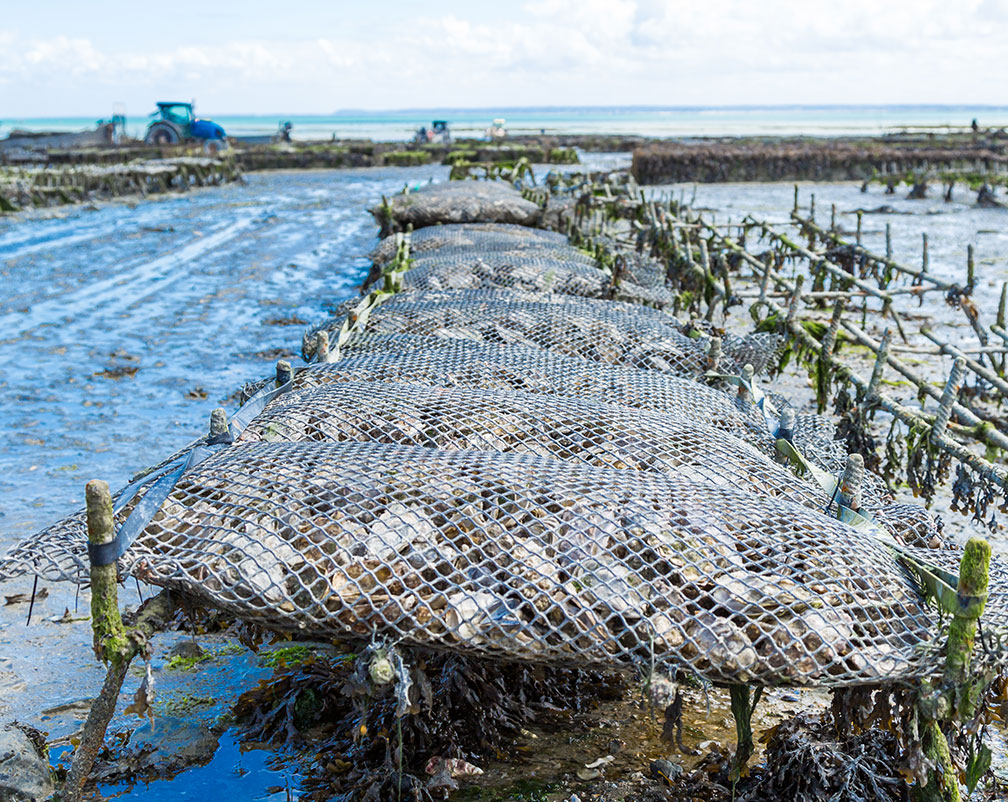
&#13;
<p>Ducasse, Alain. Mon Grand Livre de Cuisine: recette et techniques d'Alain Ducasse (pour iPad). s.l. : Alain Ducasse Edition.</p>&#13;

      </div>
]]></field_content></item><item key="41"><title>Babettes g&#xE6;stebud</title><field_image></field_image><field_index>ST005-05_DE</field_index><field_card_description></field_card_description><field_subtitle><![CDATA[<p>Gabriel Axel, Hollywood Classics, Danemark, 1987</p>
]]></field_subtitle><field_content><![CDATA[  <div class="paragraph paragraph--type--wysiwyg paragraph--view-mode--detailed-preview">
          
<div class="field-collection"><p>In <cite>Babettes gæstebud</cite> (Babettes Fest) flüchtet die bekannte Küchenchefin eines grossen Pariser Restaurants vor der Repression durch die Pariser Kommune im Jahr 1871. Sie findet Zuflucht bei zwei Schwestern in einem lutherischen Dorf im dänischen Jütland, die sich - als Pastorentöchter und in Erinnerung an ihren Vater - von Jugend an jegliches Vergnügen untersagen und sich wohltätigen Zwecken widmen. Wie die Schwestern leben auch die Dorfbewohner bescheiden und ohne besondere Wünsche. Nach einem Lotteriegewinn bereitet Babette den Dorfbewohnern ein raffiniertes Festessen im französischen Stil zu. Von Kaviarschnittchen bis zu edlen Weinen entdeckt die kleine Gemeinschaft vorsichtig die verschiedensten Geschmacksvergnügungen, und das Mahl versöhnt sogar Personen, die vorher miteinander zerstritten waren. Es lässt sogar alte Liebesgeschichten zu, die die beiden alten Schwestern endlich ausleben können, nachdem sie sich der Liebe immer versagt hatten.</p>&#13;
</div>
      </div>
]]></field_content></item><item key="42"><title>Babettes g&#xE6;stebud</title><field_image></field_image><field_index>ST005-05_EN</field_index><field_card_description></field_card_description><field_subtitle><![CDATA[<p>Gabriel Axel, Hollywood Classics, Danemark, 1987</p>
]]></field_subtitle><field_content><![CDATA[  <div class="paragraph paragraph--type--wysiwyg paragraph--view-mode--detailed-preview">
          
<div class="field-collection"><p>The protagonist in <cite>Babettes gæstebud</cite> (<em>Babette’s Feast</em>), a renowned chef in a top Parisian restaurant, flees the repression of the Paris Commune in 1871. She takes refuge in a Lutheran village in Jutland, Denmark, in the home of two sisters, daughters of a pastor. Under their father’s authority, since their youth the sisters have always deprived themselves of any pleasure, and devote themselves to charitable work. Likewise, the villagers live modestly, suppressing their desires. After winning the lottery, Babette decides to prepare a French-style feast for the villagers. From caviar on toast to fine wines, the small community slowly discovers the pleasures which the sense of taste can offer and the meal helps the villagers to resolve old disputes. It even represents a love story, which can finally be enjoyed by the two elderly sisters who had always shunned love.</p>&#13;
</div>
      </div>
]]></field_content></item><item key="43"><title>Babettes g&#xE6;stebud</title><field_image></field_image><field_index>ST005-05_FR</field_index><field_card_description></field_card_description><field_subtitle><![CDATA[<p>Gabriel Axel, Hollywood Classics, Danemark, 1987</p>
]]></field_subtitle><field_content><![CDATA[  <div class="paragraph paragraph--type--wysiwyg paragraph--view-mode--detailed-preview">
          
<div class="field-collection"><p>Dans le film<cite> Babettes gæstebud</cite><em> </em>(<em>Le Festin de Babette</em>), la cuisinière renommée d’un grand restaurant parisien, fuit la répression menée par la Commune de Paris en 1871. Elle se réfugie dans un village luthérien du Jutland au Danemark chez deux sœurs, filles de pasteur, qui, sous l’autorité de leur père, se refusent tout plaisir depuis leur jeunesse et se consacrent à des œuvres de charité. Comme elles, les villageois vivent en toute modestie et coupés de leurs désirs. Après avoir gagné à la loterie, Babette offre au voisinage un festin à la française élaboré par ses soins. Des toasts de caviar aux grands vins, la petite communauté découvre timidement le plaisir des sens par la bouche et le repas réconcilie les membres de précédentes disputes. Il symbolise même une histoire d’amour qui peut être enfin vécue par les deux vieilles sœurs qui se sont toujours empêchées d’aimer.</p>&#13;
</div>
      </div>
]]></field_content></item><item key="44"><title>Banane plantain</title><field_image><![CDATA[  <img loading="lazy" src="/sites/default/files/styles/course_tile/public/media/image/2017-01/Alimentarium_bananes_plantains_frites_0.jpg?itok=dWHXbiEZ" width="277" height="277" alt="AL025-02 banane plantain frites" typeof="foaf:Image" />


]]></field_image><field_index>AL025-02</field_index><field_card_description>La banane plantain, un fruit utilis&#xE9; comme f&#xE9;culent en raison de sa haute teneur en amidon</field_card_description><field_subtitle><![CDATA[<p>Originaire du Sud-est asiatique, la banane plantain est considérée comme un féculent et représente l’aliment de base de nombreuses populations des pays en développement. Fruit fragile d’une plante géante, le bananier plantain nécessite une attention particulière lors de sa croissance et de son transport.</p>
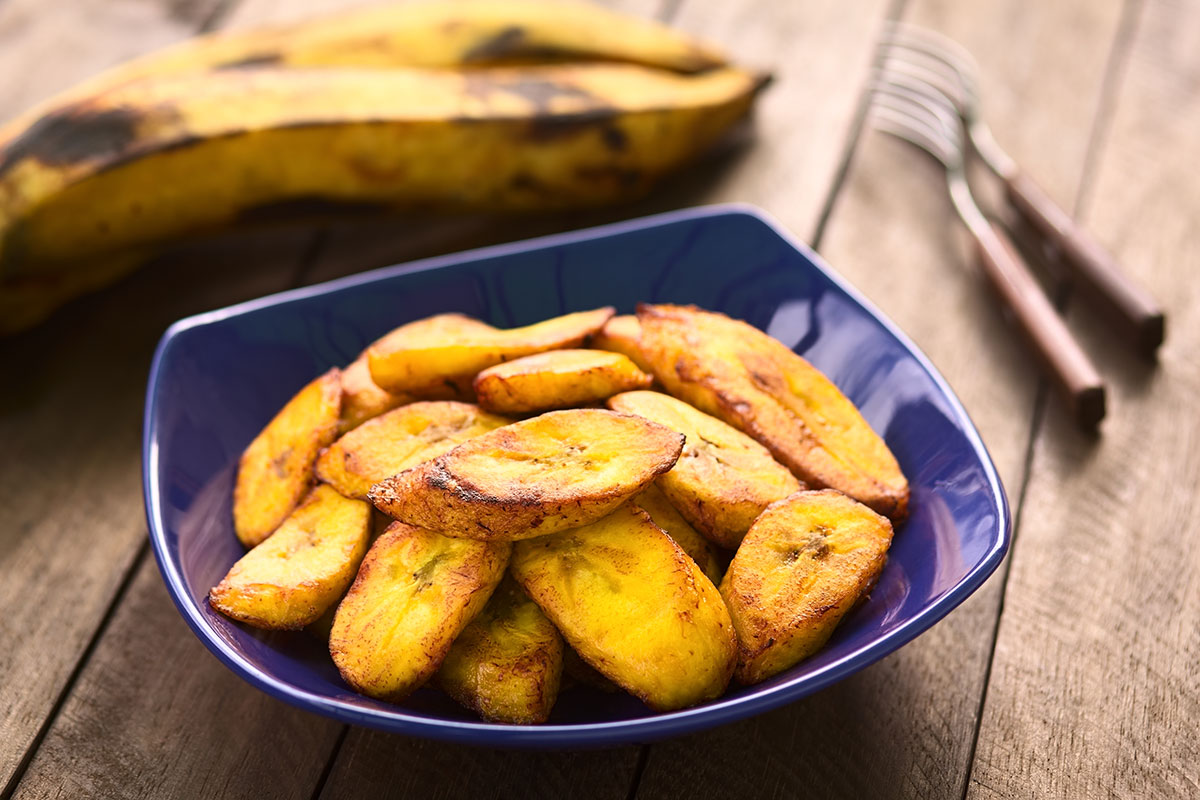
]]></field_subtitle><field_content><![CDATA[  <div class="paragraph paragraph--type--wysiwyg paragraph--view-mode--detailed-preview">
          
<div class="field-collection"><div data-embed-button="paragraph_library_item" data-entity-embed-display="view_mode:paragraphs_library_item.render" data-entity-type="paragraphs_library_item" data-entity-uuid="79408906-a6aa-4425-a73f-c767742501d8" data-langcode="fr" data-entity-embed-display-settings="[]" class="embedded-entity" xmlns:xlink="http://www.w3.org/1999/xlink">

            <div class="image-gallery-item">
        <a href="/sites/default/files/media/image/2017-01/alimentarium_banane_plantain_0.jpg" class="opener lightboxed" data-caption="
© Shutterstock / BW Folsom">
      <span class="svg-icon">
        <svg>
          <use xlink:href="svg/sprite.min.svg#icon-resize" />
        </svg>
      </span>
          
  <img loading="lazy" src="/sites/default/files/media/image/2017-01/alimentarium_banane_plantain_0.jpg" width="1008" height="403" alt="AL025-02 banane plantain" typeof="foaf:Image">


        </a>
      </div>
              <h6 class="gallery-caption">
          
© Shutterstock / BW Folsom
        </h6>
            </div>


</div><div class="field-collection"><h4>Origine de la banane plantain</h4><p>Originaire du Sud-est asiatique, la banane plantain, appelée ‘banane à cuire’ ou ‘banane à farine’, est le fruit d’une plante géante de la famille des Musaceae, le bananier plantain.</p>
</div><div class="field-collection"><h4>Culture et récolte de la banane plantain</h4><p>La <b>culture</b> du bananier plantain est concentrée en Afrique, dans les Caraïbes et en Amérique latine. La banane plantain représente la plus importante source de <b><u>glucides</u></b> pour les populations qui la cultivent.</p>

<p>La température optimale pour la croissance du bananier plantain est de&nbsp;28°C (une température inférieure freine son développement). Le terrain doit être préparé avant l’arrivée des pluies, et l’ajout de fertilisants tels que le compost ou le fumier est nécessaire pour augmenter le rendement et éviter l’épuisement des ressources du sol. Le bananier plantain a besoin de&nbsp;200&nbsp;mm d’eau par mois et est très sensible aux vents violents. Des améliorations génétiques ont permis d’obtenir des variétés plus résistantes aux maladies.</p>
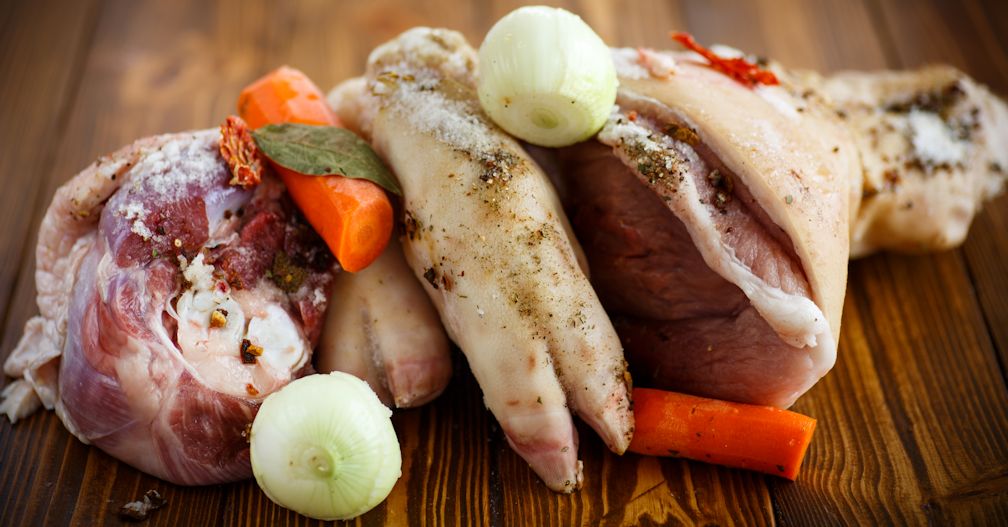
<p>Cette plante est composée d’un <b>rhizome</b>, sorte de racine horizontale sous la terre et dont sortent les feuilles. Ses <b>feuilles</b> sont grandes et leurs bases s’enroulent pour former un tronc. Le cycle de croissance des feuilles se situe entre&nbsp;120 à 130&nbsp;jours par feuille dans des conditions favorables. Ces feuilles atteignent&nbsp;150 à&nbsp;400&nbsp;cm de long et&nbsp;70 à&nbsp;100&nbsp;cm de large. La récolte des <b>régimes</b> de bananes (regroupements de fruits, comme des grappes) se fait manuellement environ&nbsp;3 à&nbsp;4&nbsp;mois après la floraison, et s’étale tout au long de l’année. Les régimes se conservent ensuite entre&nbsp;15 et&nbsp;30&nbsp;jours en fonction du moment de la récolte. Leur transport est délicat, car la banane est un fruit fragile qui supporte mal les chocs et les changements de température.</p>
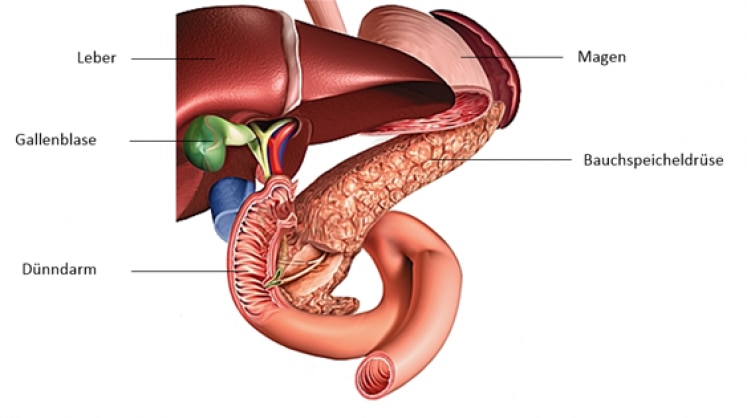
<p></p>

<div data-embed-button="paragraph_library_item" data-entity-embed-display="view_mode:paragraphs_library_item.render" data-entity-type="paragraphs_library_item" data-entity-uuid="54dd9748-825e-4337-96c7-4dd180b8adc5" data-langcode="fr" data-entity-embed-display-settings="[]" class="embedded-entity" xmlns:xlink="http://www.w3.org/1999/xlink">

            <div class="image-gallery-item">
        <a href="/sites/default/files/media/image/2017-01/Alimentarium_bananes_plantains_frites_0.jpg" class="opener lightboxed" data-caption="
© Shutterstock / Ildi Papp - Bananes plantains frites">
      <span class="svg-icon">
        <svg>
          <use xlink:href="svg/sprite.min.svg#icon-resize" />
        </svg>
      </span>
          
  <img loading="lazy" src="/sites/default/files/media/image/2017-01/Alimentarium_bananes_plantains_frites_0.jpg" width="1200" height="800" alt="AL025-02 banane plantain frites" typeof="foaf:Image">


        </a>
      </div>
              <h6 class="gallery-caption">
          
© Shutterstock / Ildi Papp - Bananes plantains frites
        </h6>
            </div>


</div><div class="field-collection"><h4>Produits dérivés</h4><p>Il existe trois espèces de bananes&nbsp;: les <strong>bananes douces</strong>, les <strong>bananes plantains</strong> et les <strong>bananes non comestibles </strong>(sauvages). Bien que la banane plantain s'apparente à la banane douce, mangée comme un fruit, elle n'est que très peu consommée crue. En effet, sa peau plus épaisse, sa chair plus ferme et moins sucrée expliquent qu’elle soit plutôt cuite, comme un légume, dans les soupes et les ragoûts par exemple</p>

<p>Les feuilles du bananier plantain sont assouplies au feu et utilisées dans l’industrie agroalimentaire pour envelopper et contenir les aliments cuisinés, par exemple. Elles ne modifient pas les propriétés des aliments et sont stérilisées grâce à leur passage au feu.</p>
</div><div class="field-collection"><h4>Nutrition</h4><p>Fournissant&nbsp;122&nbsp;kcal par&nbsp;100&nbsp;g, la banane plantain représente une source importante de glucides, mais également de potassium et de magnésium.</p>
</div>
      </div>
,   <div class="paragraph paragraph--type--wysiwyg paragraph--view-mode--detailed-preview">
          
<p>CAMUS, Gilles, 2012. La culture de la banane [en ligne]. PlanetVie. [Consulté le 23 mars 2016]. Disponible à l’adresse : <u>http://planet-vie.ens.fr/content/culture-banane</u></p>&#13;
&#13;
<p>INFOMUSA, 2001. Bananiers et Plantains [en ligne]<em>. La Revue Internationale. </em>Volume 10, n°1. [Consulté le 23 mars 2016]. Disponible à l’adresse : <u>https://www.bioversityinternational.org/fileadmin/_migrated/uploads/tx_news/Infomusa__La_revue_internationale_sur_bananiers_et_plantains_957.pdf</u></p>&#13;
&#13;
<p>QA international, 1996.<em> L'Encyclopédie visuelle des aliments</em>. p. 229. Québec : Éditions Québec Amérique inc. [Consulté le 21 mars 2016]. Disponible à l’adresse : <u>https://books.google.ch/books?isbn=2764410980</u></p>&#13;
&#13;
<p></p>&#13;

      </div>
]]></field_content></item><item key="45"><title>Basic preparations in cuisine</title><field_image><![CDATA[  <img loading="lazy" src="/sites/default/files/styles/course_tile/public/media/image/2016-10/shutterstock_Peredniankina_ingredients_pour_gelee_350321360_WEB_0.jpg?itok=RT_Bizjs" width="277" height="277" alt="AL017-09 - Préparation - Bases - Ingredients pour gelée" typeof="foaf:Image" />


]]></field_image><field_index>AL017-09</field_index><field_card_description>Marinades, jellies, panades, thickeners and stocks: the bases of cookery</field_card_description><field_subtitle><![CDATA[<p>Marinades, jellies, panades, thickeners and stocks are basic preparations for creating dishes. Those we know today have evolved from changes in cuisine over the centuries. Marinades are used to add flavour and sometimes tenderise meat while jellies add texture and a shiny appearance. Panade is prepared from flour, water, butter and eggs. Thickeners give consistency to liquids, while stocks are used as a base for various sauces.</p>
]]></field_subtitle><field_content><![CDATA[  <div class="paragraph paragraph--type--wysiwyg paragraph--view-mode--detailed-preview">
          
<div class="field-collection"><div data-embed-button="paragraph_library_item" data-entity-embed-display="view_mode:paragraphs_library_item.render" data-entity-type="paragraphs_library_item" data-entity-uuid="b8707c47-763f-40b2-b102-02fcc363c70d" data-langcode="en" data-entity-embed-display-settings="[]" class="embedded-entity" xmlns:xlink="http://www.w3.org/1999/xlink">

            <div class="image-gallery-item">
        <a href="/sites/default/files/media/image/2016-10/shutterstock_Peredniankina_ingredients_pour_gelee_350321360_WEB_0.jpg" class="opener lightboxed" data-caption="
© Shutterstock / Peredniankina - Ingredients for preparing a savoury jelly">
      <span class="svg-icon">
        <svg>
          <use xlink:href="svg/sprite.min.svg#icon-resize" />
        </svg>
      </span>
          
  <img loading="lazy" src="/sites/default/files/media/image/2016-10/shutterstock_Peredniankina_ingredients_pour_gelee_350321360_WEB_0.jpg" width="1008" height="527" alt="AL017-09 - Préparation - Bases - Ingredients pour gelée" typeof="foaf:Image">


        </a>
      </div>
              <h6 class="gallery-caption">
          
© Shutterstock / Peredniankina - Ingredients for preparing a savoury jelly
        </h6>
            </div>


</div><div class="field-collection"><h4>Preparation of basic bases, rigour before art</h4><p>Whether<b> flavouring</b> or <b>tenderising</b> meat, giving food a shiny appearance, making a <a href="/en/node/1276">water</a> and <a href="/en/node/1320">fat</a> mixture <b>homogeneous</b>, giving consistency to a liquid or preserving it and, above all, emphasising the characteristic aromas of meat, fish or shellfish, cookery is an <b>art</b> that first and foremost requires mastery of various <b>basic </b>preparations. These require ingredients of excellent <b>quality</b>, worked with immense <b>rigour</b>.</p>
</div><div class="field-collection"><h4>Creating the main bases of modern cuisine</h4><p><strong>Marinating</strong> food means <a href="/en/node/1329">seasoning</a> it by leaving it to soak in a liquid for varying periods of time. The liquid can be wine, vinegar, lemon juice or olive oil, for example, and flavoured with herbs or spices. <a href="/en/node/1338">Salt</a> is not used as it runs the risk of drying out the product. As well as giving flavour, wine <strong>marinade</strong> is used to tenderise meat. Lemon or sweet lime juice is mainly used for fish.</p>

<p><strong>Cooking jelly</strong> is a solid, translucent and shiny preparation. It is made by slow-<a href="/en/node/1332">cooking</a> food such as beef, veal or <a href="/en/node/1069">pig</a> trotters. The gelatine present in the food forms the jelly. The gelatine dissolves during cooking and solidifies as it cools. Jelly plays an important role in cold cookery. It is used as a binder in mousses, to add a shiny texture to dishes and to decorate or add flavour to pâtés and terrines.</p>

<p><strong>Panade</strong> was once a recipe made of <a href="/en/node/1067">bread</a> soaked in milk, occasionally adding butter or egg, and which used to be consumed like soup. Nowadays panade is a preparation made from flour, boiling water, butter and eggs. It is dried out on the hob or in the oven. The best-known <strong>panade</strong>-based dishes are <strong>quenelles</strong>, a kind of elongated ball of meat or fish, such as pike.</p>

<p><strong>Thickeners</strong> are mainly used to make a liquid firmer. They can be divided into three categories, depending if they are based on <strong>starch</strong>, <strong>protein</strong> or <strong>fat</strong>. Cornstarch, <a href="/en/node/1285">corn</a> flour and <u>potato</u> starch are well-known starch <strong>binders</strong>. Starch has the strongest binding effect between 80°C and 90°C. The principle is simple: The grains of starch absorb the water and begin to swell up. <strong>Egg</strong> yolk and <strong>blood</strong> are the main protein-based binders. They work best between 80°C and 83°C. At higher temperatures, the proteins coagulate and the thickener fails, hence these preparations must never be brought to the boil. <strong>Butter</strong> is used to bind hot preparations while <a href="/en/node/1293"><strong>oil</strong></a> is used in cold cookery. Although fats are not binding agents as such, they form an <a href="/en/node/1609"><strong>emulsion</strong></a> in the presence of an emulsifier. <strong>Lecithin</strong>, mainly found in egg yolk, is used to create an emulsion when beating fat and water together.</p>

<p>A <strong>stock</strong> is a concentrate of aromas and gelatine. It is obtained by slow cooking bones and trimmings from veal, poultry, game or shellfish carcasses in a large volume of water. The ingredients may be roasted or steamed beforehand and flavoured with spices, bouquet garni or herbs. Meat, fish or shellfish can give either white or brown stocks, depending on the technique used. A roux is a flour-based thickener. The Nouvelle Cuisine of the 20<sup>th</sup>&nbsp;century favoured butter and cream thickeners over roux and stocks, the latter deemed as being too rich.</p>
</div>
      </div>
,   <div class="paragraph paragraph--type--wysiwyg paragraph--view-mode--detailed-preview">
          
<p>FLAVIGNY, Laure, 2000<i>. Larousse gastronomique</i>. Paris : Larousse-Bordas</p>&#13;
&#13;
<p>VITAUX Jean et BENOÎT France, 2008. <i>Dictionnaire du Gastronome</i>. Paris : Presses Universitaires de France</p>&#13;
&#13;
<p>PAULI, Philip, 2008. <i>Technologie culinaire.</i> Winterthur : Pauli Fachbuchverlag AG</p>&#13;

      </div>
]]></field_content></item><item key="46"><title>Bauchspeichel-dr&#xFC;se</title><field_image><![CDATA[  <img loading="lazy" src="/sites/default/files/styles/course_tile/public/media/image/2016-05/pancreas_0.png?itok=Wxx15swW" width="277" height="277" alt="pancreas.png" typeof="foaf:Image" />


]]></field_image><field_index>CP0-M03</field_index><field_card_description>Die Bauchspeicheldr&#xFC;se produziert Hormone und Pankreassekret. Das Pankreassekret wird &#xFC;ber Ausf&#xFC;hrungsg&#xE4;nge in den Zw&#xF6;lffingerdarm abgegeben, wo es zur Verdauung von Fetten, Proteinen und Zucker beitr&#xE4;gt.</field_card_description><field_subtitle></field_subtitle><field_content><![CDATA[  <div class="paragraph paragraph--type--wysiwyg paragraph--view-mode--detailed-preview">
          
<div class="field-collection"><p>Die Bauchspeicheldrüse produziert Hormone und Pankreassekret. Das Pankreassekret wird über Ausführungsgänge in den Zwölffingerdarm abgegeben, wo es zur Verdauung von Fetten, Proteinen und Zucker beiträgt. Neben Wasser enthält das Pankreassekret Bikarbonat und zahlreiche Verdauungsenzyme. Das Bikarbonat neutralisiert die Säure des Nahrungsbreis, der aus dem Magen kommt, und verhindert so eine Reizung des Darms. Zu den Enzymen gehören: Lipase, die Triglyceride in Fettsäuren und Glyerol umwandelt; Phospholipase, die Phospholipide auspaltet;&nbsp; und Proteasen (Trypsin und Chymotrypsin), die die Arbeit des Pepsins fortsetzen und Proteine in Polypeptide und Aminosäuren aufspalten.</p>

<p></p>

<div data-embed-button="paragraph_library_item" data-entity-embed-display="view_mode:paragraphs_library_item.render" data-entity-type="paragraphs_library_item" data-entity-uuid="17977e35-71cb-49a0-aba1-51afeccfc05b" data-langcode="de" data-entity-embed-display-settings="[]" class="embedded-entity" xmlns:xlink="http://www.w3.org/1999/xlink">

            <div class="image-gallery-item">
        <a href="/sites/default/files/media/image/2016-05/pancreas-de_0.png" class="opener lightboxed" data-caption="
&nbsp;">
      <span class="svg-icon">
        <svg>
          <use xlink:href="svg/sprite.min.svg#icon-resize" />
        </svg>
      </span>
          
  <img loading="lazy" src="/sites/default/files/media/image/2016-05/pancreas-de_0.png" width="747" height="418" alt="pancreas-de.png" typeof="foaf:Image">


        </a>
      </div>
              <h6 class="gallery-caption">
          
&nbsp;
        </h6>
            </div>


<p>Amylase spaltet Stärke und Glycogen in Glucose und Maltose. Die Produktion von Hormonen erfolgt in inselartig verteilten Zellgruppen, den so genannten Langerhans-Inseln. Insgesamt gibt es rund eine Million dieser Inseln, sie machen jedoch nur ein Prozent der Gesamtmasse der Bauchspeicheldrüse aus. Die Langerhans-Inseln produzieren Insulin und Glucagon, zwei Hormone, die für den Körper äusserst wichtig sind, weil sie die Regulierung des Blutzuckerspiegels ermöglichen. Trinkt man z.B. ein stark zuckerhaltiges Getränk, so schüttet die Bauchspeicheldrüse eine grosse Menge Insulin aus, um den Blutzuckerspiegel zu senken. Führt man dem Körper umgekehrt über einen längeren Zeitraum keine Nahrung zu, so hilft Glucagon beim Aufrechterhalt eines ausreichend hohen Blutzuckerspiegels, um die verschiedenen Organe zu versorgen.</p>
</div>
      </div>
,   <div class="paragraph paragraph--type--wysiwyg paragraph--view-mode--detailed-preview">
          
<p>Elaine N. Marieb, <em>Human Anatomy &amp; Physiology</em>, frei nach der 6. englischsprachigen Ausgabe.</p>&#13;

      </div>
]]></field_content></item><item key="47"><title>Baumzucht-techniken</title><field_image><![CDATA[  <img loading="lazy" src="/sites/default/files/styles/course_tile/public/media/image/2016-09/GettyImages_Thomas_Imo_r%C3%A9colte_cacao_157518763_Web_0.jpg?itok=-sWJtt51" width="277" height="277" alt="GettyImages_Thomas_Imo_récolte_cacao_157518763_Web.jpg" typeof="foaf:Image" />


]]></field_image><field_index>AL017-07</field_index><field_card_description>Tausend Jahre Biotechnologie im Dienste der Obstbaumzucht</field_card_description><field_subtitle><![CDATA[<p>Die Obstbaumkultur beginnt schon in der Jungsteinzeit, als die Menschen sesshaft wurden und Landwirtschaft und Viehzucht entwickelten. Die Anlage von Obstgärten wirkt sich langfristig auf ein Stück Land aus. Stecklingsvermehrung, Veredelung, Beschneiden und Bewässern werden bis heute als Techniken des Obstanbaus eingesetzt. Sie gehen aber auf die ersten grossen Zivilisationen der Antike zurück.</p>
]]></field_subtitle><field_content><![CDATA[  <div class="paragraph paragraph--type--wysiwyg paragraph--view-mode--detailed-preview">
          
<div class="field-collection"><div data-embed-button="paragraph_library_item" data-entity-embed-display="view_mode:paragraphs_library_item.render" data-entity-type="paragraphs_library_item" data-entity-uuid="fab121b9-14e5-41f8-9393-ea670d28bee8" data-langcode="de" data-entity-embed-display-settings="[]" class="embedded-entity" xmlns:xlink="http://www.w3.org/1999/xlink">

            <div class="image-gallery-item">
        <a href="/sites/default/files/media/image/2016-09/GettyImages_Thomas_Imo_r%C3%A9colte_cacao_157518763_Web_0.jpg" class="opener lightboxed" data-caption="
© Getty Images / Thomas Imo">
      <span class="svg-icon">
        <svg>
          <use xlink:href="svg/sprite.min.svg#icon-resize" />
        </svg>
      </span>
          
  <img loading="lazy" src="/sites/default/files/media/image/2016-09/GettyImages_Thomas_Imo_r%C3%A9colte_cacao_157518763_Web_0.jpg" width="364" height="512" alt="GettyImages_Thomas_Imo_récolte_cacao_157518763_Web.jpg" typeof="foaf:Image">


        </a>
      </div>
              <h6 class="gallery-caption">
          
© Getty Images / Thomas Imo
        </h6>
            </div>


</div><div class="field-collection"><h4>Tausend Jahre biotechnologische Praxis</h4><p>Die Obstbaumzucht entstand zur <strong>Jungsteinzeit</strong> vor 12&nbsp;000 Jahren als Teil der Landwirtschaft und parallel zur Viehhaltung. Mit Recht lässt sich von einer Frühform der <strong>Biotechnologie</strong> sprechen: Die Menschen begannen, lebende Organismen einzuordnen und zu verändern, um sie bedarfsgerecht umzugestalten. Die ersten angebauten Obstbäume waren einheimische Arten. Der Austausch mit anderen Zivilisationen und die Perfektionierung von Fertigkeiten erbrachten nach und nach weitere Arten.</p>

<p></p>

<p>Die heute eingesetzten <strong>Obstbaumtechniken</strong> gehen auf die grossen Zivilisationen der <strong>Antike</strong> zurück: China, Mesopotamien und Ägypten. Sie nutzten die natürlichen Fortpflanzungsmethoden für Holzgewächse: die vegetative Vermehrung, d.h. Klonen durch Aufpropfen.</p>

<p></p>

<p>In <strong>Griechenland</strong> diskutierte um 450&nbsp;v.u.Z. die medizinische Schule des <strong>Hippokrates</strong> das <strong>Pfropfen</strong>, das aber schon ein Jahrtausend früher in <strong>China</strong> bekannt gewesen sein soll. Es hat zur Ausbreitung von in gemässigtem Klima gedeihenden Obstbäumen – Apfel, Birne und Pflaumen – beigetragen.</p>

<p>In Mesopotamien fand die <strong>künstliche Bestäubung</strong> Eingang in den <em>Codex Hammurabi</em>, ein <strong>babylonisches Gesetz</strong> um 1750&nbsp;v.u.Z. Zeitgleich wurden die Obstbaum<strong>beschneidung</strong> und komplexe <strong>Bewässerungssysteme</strong> perfektioniert.</p>

<p></p>

<p>Die <strong>Spaliertechnik</strong> (Kultivierung an Gerüsten) war schon den <strong>Ägyptern</strong> bekannt, wie Feigenbaumdarstellungen in Gräbern um 1400&nbsp;v.u.Z. beweisen. Im mittelalterlichen <strong>Europa</strong> übernahmen <strong>Mönche</strong> diese Praxis, die bis heute eingesetzt wird.</p>
</div><div class="field-collection"><h4>Baumpflanzen – eine Sache der Geduld</h4><p>Die Baumzucht benötigt genauere <strong>Planung</strong> und komplexere Techniken als Getreideanbau. Denn die Anlage eines Obstgartens hat langfristige Auswirkungen auf das kultivierte Land. Manche Sorten benötigen zudem Jahre, bis sie Früchte tragen.</p>

<p></p>

<p>Zunächst wird der Kultivar – eine künstlich erzeugte und angebaute Kulturpflanzen-Sorte – dem Klima entsprechend <strong>ausgewählt</strong>. Um ihn anzubauen, könnte nun einfach Samen ausgesät werden, aber der Baum wüchse zu langsam und die Qualität der Früchte wäre ungewiss. Deshalb wird Reproduktion durch Klonen bevorzugt. Dazu gibt es zwei Techniken. Hobbygärtner entscheiden sich für die einfachere, aber auch langsamere Vermehrung durch <strong>Stecklinge</strong>, während Baumschulen das kompliziertere, aber rentablere <strong>Pfropfen</strong> wählen.</p>

<p></p>

<p>Um einen <strong>Steckling</strong> zu ziehen, wird der zu vermehrenden Pflanze eine Triebspitze entnommen. Diese wird in einen Topf mit Erde gesteckt, damit sie Wurzeln treibt und sich zu einem neuen Baum entwickelt - einem Klon des ersten. Beim <strong>Pfropfen</strong> wird der Steckling (Pfröpfling) in eine Gastpflanze (Unterlage) eingebracht, damit beide miteinander verwachsen und sich gemeinsam weiterentwickeln. Die durch Pfropfen erhaltenen Früchte sind oft grösser und süsser als die aus Stecklingen gezogener Bäume. Dafür sind aber gute technische Fertigkeiten sowie die Kenntnis der Kompatibilität von Pfröpfling und Unterlage Voraussetzung.</p>

<p></p>

<p>Form und Fruchtbildung der Bäume werden durch <strong>Beschneiden</strong> von Zweigen und Knospen beeinflusst. Durch das Schneiden zum <strong>Spalier</strong> entsteht zum Beispiel eine flache <strong>Krone</strong>. Der Baum braucht weniger Platz und erhält gleichzeitig eine optimale <strong>Sonnenbestrahlung</strong>. So kann er direkt an einer Wand wachsen, die die tags gespeicherte Wärme nachts abgibt. Dadurch bildet der Baum süssere Früchte. Diese Technik hilft zudem kälteempfindlichen Arten in raueren Klimazonen zu überleben.</p>

<p></p>

<p>Der <strong>Einsatz</strong> von Insektiziden und Fungiziden sowie regelmässige <strong>Bewässerung</strong> ergänzen diese Zuchtmethoden, indem sie Wachstum fördern und Krankheitsrisiken senken. Ziel aller Massnahmen ist eine optimale Ernte.</p>
</div><div class="field-collection"><h4>Manuelle und maschinelle Werkzeuge</h4><p>Totes Holz und unregelmässige Zweige werden mit einem <a href="/de/node/1971"><strong>Astschneider</strong></a>, einer langen Schere zum Ausschneiden, oder einer Säge entfernt. Die motorgetriebene Gartenschere dient dazu, den Baum in eine optimale Form zu schneiden. Um Stecklinge zu ziehen, wählt man eine manuelle Gartenschere.</p>

<p></p>

<p>Für die Ernte gibt es geeignete Werkzeuge: lange <strong>„Stangen“</strong>, um die Früchte zum Fallen zu bringen, Erntenetze, Leitern sowie mechanische Hilfsmittel wie maschinelle Obstsauger.</p>
</div>
      </div>
,   <div class="paragraph paragraph--type--wysiwyg paragraph--view-mode--detailed-preview">
          
<p></p>&#13;
&#13;
<p>BREDAUTEAU, Jean, FAURÉS, Yves, 1992. <i> Atlas d’arboriculture fruitière vol. 1 (3e éd.) : généralités sur la culture des arbres fruitiers.</i> Paris : Éditions TEC ET DOC/Lavoisier. ISBN 9782852067851</p>&#13;
&#13;
<p>JULLIEN, Elisabeth, 2014. Cultiver et soigner les arbres. Eyrolles : Éditions Sang de la Terre. ISBN 9782212138719</p>&#13;
&#13;
<p>LEROY, Éric, LOIR, Lore, 2015. <i>Jardin du monde : se nourrir pour survivre. </i>Ebook : Press Leroy Agency. ISBN 9782322014620</p>&#13;
&#13;
<p>TONELLI, Nicole, GALLOUIN, François, 2013. <i>Des Fruits et des graines comestibles du monde entier</i>. Paris : Lavoisier. ISBN 9782743014810</p>&#13;

      </div>
]]></field_content></item><item key="48"><title>Bedarf an Antioxidantien</title><field_image></field_image><field_index>CP0-M32</field_index><field_card_description>Weshalb brauchen wir Antioxidantien?</field_card_description><field_subtitle></field_subtitle><field_content><![CDATA[  <div class="paragraph paragraph--type--wysiwyg paragraph--view-mode--detailed-preview">
          
<div class="field-collection"><h2>Weshalb brauchen wir Antioxidantien?</h2>&#13;
&#13;
<p>Oxidation ist ein natürlicher Prozess, der in allen lebenden Organismen stattfindet. Beim Atmen, beim Stoffwechsel und bei der Zellatmung, aber auch während einer Krankheit, bei einer Verletzung oder bei intensiver körperlicher Betätigung (gilt nur für Menschen) werden freie Radikale produziert.<br />&#13;
Freie Radikale entstehen zudem durch externe Faktoren wie Verschmutzung, Zigarettenrauch, Sonnenlicht (UV-Strahlung), Pestizide und andere Chemikalien.<br />&#13;
Bei moderaten Konzentrationen spielen freie Radikale eine wichtige Rolle bei verschiedenen biologischen Prozesses, etwa bei der Entspannung der glatten Muskulatur oder der zellulären Signaltransduktion. Sie können sogar vom Immunsystem eigens dafür produziert werden, Bakterien oder beschädigte Zellen abzutöten.<br />&#13;
Freie Radikale sind äusserst instabile Moleküle, denen mindestens ein Elektron fehlt. Um das fehlende Elektron und damit ihre Stabilität wiederzuerlangen, reagieren sie aggressiv mit dem nächstbesten Molekül, um ihm das fehlende Elektron zu entreissen. Das attackierte Molekül wird daraufhin selbst zum freien Radikal, wodurch eine Kettenreaktion entsteht. </p>&#13;
&#13;
<h2>Was ist die Aufgabe von Antioxidantien?</h2>&#13;
&#13;
<p>Pflanzen, Tiere und Menschen haben ihre eigenen Verteidigungssysteme gegen Oxidation entwickelt, die als Antioxidantien bezeichnete, schlagkräftige Moleküle synthetisieren. Tiere und Menschen können jedoch nicht alle benötigten Antioxidantien selbst synthetisieren und müssen sie daher über pflanzliche Nahrung aufnehmen.<br />&#13;
Antioxidantien unterbinden die oben erwähnte Kettenreaktion, indem sie radikalische Zwischenprodukte inaktivieren und andere Oxidationsreaktionen unterbinden. Idealerweise besteht ein Gleichgewicht zwischen der Produktion freier Radikale und dem Abwehrmechanismus.<br />&#13;
Bei einer übermässigen Produktion freier Radikale oder einem Mangel an Antioxidantien entsteht oxidativer Stress, der Lipide, Proteine und DNA schädigt und sogar Zelltod verursachen kann.<br />&#13;
Die Ansammlung freier Radikale ist an der Entstehung verschiedener Krankheiten wie Herz-Kreislauf-Erkrankungen, Krebs und Diabetes beteiligt und fördert den Alterungsprozess.</p>&#13;
&#13;
<h2>Wo kommen Antioxidanten vor?</h2>&#13;
&#13;
<p>Die Vitamine C und E sind die bekanntesten Antioxidantien und in Früchten und Gemüsen (Vitamin C) sowie pflanzlichen in Ölen (Vitamin E) enthalten.  Sie wirken gemeinsam mit dem ebenfalls antioxidativ wirksamen Vitamin A und sind in der Lage, einander zu regenerieren.<br />&#13;
Viele Carotinoide sind ebenfalls Antioxidantien, etwa das in Karotten oder dunkelgrünen Salaten vorkommende Beta-Carotin oder das in Tomaten und Wassermelonen vorhandene Lycopin.<br />&#13;
Auch Polyphenole sind eine grosse Klasse von Antioxidantien. Dazu zählen Isoflavanole aus Sojapflanzen oder Anthocyane, die Heidelbeeren ihre blaue Farbe geben.</p>&#13;
&#13;
<h2>Wussten Sie, dass Pflanzen Carotinoide oder Polyphenole als Sonnenschutz einsetzen, um sich gegen die oxidative Wirkung des Sonnenlichts und Verbrennen zu schützen?</h2>&#13;
&#13;
<p>Es gibt empfohlene Tagesdosen für Vitamine, nicht aber für andere Antioxidantien. Generell bietet eine getreide-, frucht- und gemüselastige Ernährung die empfohlene Menge an antioxidativen Vitaminen und zahlreiche andere antioxidativ wirksame Stoffe. Antioxidantien sollten daher am besten über die Nahrungsmittel aufgenommen werden, in denen sie enthalten sind. Sollte aber eine Vitaminsupplementierung notwendig sein, ist eine Überdosierung zu vermeiden, denn mehr ist in diesem Fall nicht besser. Zu viele Antioxidantien können nämlich eine prooxidative Wirkung haben und damit genau das Gegenteil von dem bewirken, was man erreichen will.</p>&#13;
</div>
      </div>
,   <div class="paragraph paragraph--type--wysiwyg paragraph--view-mode--detailed-preview">
          
<p>ILSI EUROPE CONCISE MONOGRAPH SERIES. OXIDANTS, ANTIOXIDANTS, AND DISEASE PREVENTION 1995</p>&#13;
&#13;
<p>Free radicals in the physiological control of cell function.  W. Dröge   Physiological Reviews 2002, 82:47-95</p>&#13;

      </div>
]]></field_content></item><item key="49"><title>Bedarf an Ballaststoffen</title><field_image></field_image><field_index>CP0-M35</field_index><field_card_description>Was sind Ballaststoffe?</field_card_description><field_subtitle></field_subtitle><field_content><![CDATA[  <div class="paragraph paragraph--type--wysiwyg paragraph--view-mode--detailed-preview">
          
<div class="field-collection"><p>Was sind Ballaststoffe?<br />&#13;
Ballaststoffe sind lange Kohlenhydrat-Ketten (aus zehn oder mehr Einfachzuckern), die im Dünndarm weder verdaut noch absorbiert werden können. Sie werden von Mikroorganismen im Dickdarm ganz oder teilweise fermentiert. <br />&#13;
Ballaststoffe sind entweder natürlich in Nahrungsmitteln enthalten oder werden ihr in verarbeiteter oder sogar synthetisierter Form zur Gesundheitsförderung zugefügt.</p>&#13;
&#13;
<p>Weshalb brauchen wir Ballaststoffe?<br />&#13;
Einige Ballaststoffe sind wasserlöslich und werden dabei im Allgemeinen viskos, wie Fruchtpektin, mit dem sich Konfitüre gelieren lässt. Andere wiederum sind wasserunlöslich und nur gering oder gar nicht viskos, wie Zellulose aus Weizenkleie. Der Viskositätsgrad ist ausschlaggebend für ihre biologischen Eigenschaften.<br />&#13;
Ballaststoffe können auf verschiedene Arten zu einer guten Gesundheit beitragen:</p>&#13;
&#13;
<ul>&#13;
	<li>Sie nehmen im Magen viel Volumen ein, insbesondere wasserlösliche Ballaststoffe quellen stark auf. Dadurch verringern sie die Aufnahme anderer, kalorienreicher Nahrungsmittel.</li>&#13;
	<li>Sie verlangsamen die Entleerung des oberen Verdauungstrakts und verlängern so das Gefühl von Fülle, sodass wir weniger essen.</li>&#13;
	<li>Sie enthalten pro Gramm nur 2 Kilokalorien und sorgen damit im Vergleich zu anderen Makronährstoffen wie Fett, Zucker und Protein für eine geringere Kalorienzufuhr.</li>&#13;
	<li>Sie verlangsamen die Verdauung sowie die Aufnahme von Kohlenhydraten und Fett; damit unterstützen sie die Regulierung des Glukose- und Cholesterinspiegels im Blut. Es ist klar belegt, dass wasserlösliche Ballaststoffe aufgrund ihres Einflusses auf den Cholesterinspiegel bei der Prävention von Herz-Kreislauf-Erkrankungen eine wichtige Rolle spielen. Dies gilt insbesondere in Verbindung mit einer Ernährung, die arm an gesättigten Fettsäuren ist.</li>&#13;
	<li>Sie steigern das Stuhlgewicht; dieses wird durch die grosse Menge an Bakterien, die Ballaststoffe im Darm fermentieren, weiter erhöht. Bei dieser Fermentation entstehen zudem kurzkettige Fettsäuren (SCFA), die sich positiv auf die Gesundheit auswirken.</li>&#13;
	<li>Wasserlösliche Ballaststoffe beugen Verstopfung und bakteriellen Blinddarmentzündungen vor, indem sie den Darminhalt feucht halten. Wasserunlösliche Ballaststoffe beschleunigen hingegen die Darmpassage und verringern so das Risiko einer Divertikulitis; zudem wird vermutet, dass sie zur Senkung des Darmkrebsrisikos beitragen.</li>&#13;
</ul>&#13;
&#13;
<p>Was sind die wichtigsten Ballaststoffquellen in unserer Ernährung?<br />&#13;
Gemüse, Hülsenfrüchte, Früchte, Vollkorn und Nüsse sind die wesentlichen Ballaststoffquellen in unserer Ernährung.</p>&#13;
&#13;
<p>Wie viele Ballaststoffe brauchen wir?<br />&#13;
Die täglich empfohlene Ballaststoffmenge beträgt 25 g, was nicht leicht zu erreichen ist.<br />&#13;
Eine Portion Früchte und Gemüse enthält üblicherweise 2–4 g Ballaststoffe. Hülsenfrüchte enthalten 6–8 g pro Portion und eine Scheibe Vollkornbrot 2–3 g.<br />&#13;
Es ist deshalb sehr wichtig, die empfohlenen 5 Portionen Früchte und Gemüse pro Tag sowie Hülsenfrüchte und Getreide zu sich zu nehmen.</p>&#13;
&#13;
<p>Wussten Sie, dass Popcorn eine gute Ballaststoffquelle ist, da oft Teile der Getreidekornschale noch vorhanden sind? Vorsicht aber beim Würzen und Garnieren Ihres Popcorns!</p>&#13;
</div>
      </div>
,   <div class="paragraph paragraph--type--wysiwyg paragraph--view-mode--detailed-preview">
          
<p>ILSI EUROPE CONCISE MONOGRAPH SERIES, DIETARY FIBRE  (2006)</p>&#13;
&#13;
<p>Dietary fibre intake and risk of cardiovascular disease: systematic review and meta-analysis.D E Threapleton et al,  British Medical Journal 2013, 347:68-79</p>&#13;

      </div>
]]></field_content></item></response>